


On the Sunday afternoon after typhoon Nepartak hit Taiwan, I paid my second visit to the Songshan Tobacco Plant. Standing in front of the plant’s warehouses, I fell into a reverie of imagining what had once transpired here.
Taking out my cellphone, I set about capturing not only the buildings themselves, but also something of the vicissitudes I imagined they had gone through. It was then that I noticed a man who appeared to be as fascinated with the exterior as I was, more so than with what was to be found inside.
I said to him, “There are many exhibitions in the warehouses. Do they not hold any interest for you?”
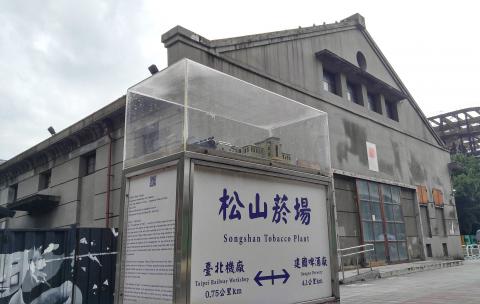
Photo: Ethan Zhan, Taipei Times
照片:台北時報詹豐造
“I did not come here to look at art. I am more interested in the history of the place.”
“The Songshan Tobacco Plant was built by people, art was created by people. The only difference is that one was made in the past, the other was created in the present. What difference is there?”
“There’s a huge difference. The tobacco plant came into being in history, and history is of the past. So, for whatever reason, there was once a demand for the production of tobacco, and the Japanese chose this site to build a tobacco plant, and many Japanese and Taiwanese started to come here to work and to live. Hence, everything you see in the plant, just as everything that has an existence in history, be it a thing of beauty, or of little aesthetic consequence, or indeed unsightly, has its own intrinsic meaning. You can then account for why the Songshan Tobacco Plant was constructed by the railroad, why it was built next to the Taipei Railway Workshop, and why there is a railway platform inside. It was all for the transport of raw materials into the plant, or for the distribution of products elsewhere: both of these needs were met by the railway. It also accounts for the existence of dormitories, male and female bathrooms, operating theaters, canteens, and even a nursery and a daycare center.”
“Surely, though, there is meaning in objects of art, too.”
“Perhaps, but then again, perhaps not. However, you might spend all day wandering through five or six exhibitions, and if it all goes way over your head, you are being little more than a dilettante with pretensions to culture. And after you return home, will you actually remember anything you have seen?”
“But these historical buildings in the Songshan Tobacco Plant were also built to convey some sort of architectural aesthetics, weren’t they? Even if not everyone quite understands these aesthetics.”
“True. But the architectural aesthetics are linked to its practical use. Let me give you an example. You use cellphones and computers, don’t you?”
“Yes, I do.”
“If a cellphone has a lot of features, and yet is as ugly as sin, would you still want to use it?”
“No, I suppose not.”
“Exactly. So the perfect combination of function and external aesthetics brings meaning. Otherwise, it’s nothing more than beauty over substance.”
(Translated by Ethan Zhan, Taipei Times)
尼伯特颱風過後的一個週日的午後,我再次造訪松山菸廠。佇立在菸廠的倉庫前,我忍不住仰屋興嘆。於是我拿出手機,試圖捕捉古蹟的典雅與歷史的更迭。在此同時,我發現了一名同樣對菸廠的外面比對菸廠的裡面有興趣的人。
「倉庫裡面有很多展覽啊,沒有一樣可以吸引你啊?」我問。
「我不是來看什麼文創的,我是來看歷史的。」他說。
「松山菸廠是人蓋的,文創也是人創造的,只差在一個是以前造的,一個是現在造的,有那麼大的差別?」
「差別可大了。菸廠的存在是歷史,歷史是過去發生的事,比如因為某些因素需要製菸,所以日本人選了這個地方,蓋了一座菸廠,然後開始有很多日本人、臺灣人來這裡工作、生活。因此菸廠裡面、歷史裡面的每樣東西,不管它是美的,是不美的,或甚至是醜的,都有它存在的意義。這就是為什麼你可以跟人家解釋,為什麼松山菸廠就蓋在鐵路沿線,與台北機廠比鄰而居,然後菸廠裡面還有個鐵路月臺。因為不管你是運材料進來,或把成品運出去,都可以透過鐵路辦到。這也是為什麼你可以跟人解釋為何這裡面還有宿舍、男女浴池、手術室、福利社,甚至育嬰室及托兒所。」
「我相信文創的東西也都是有它的意義的。」
「或許有,或許沒有。但如果你看不懂,一整天看了五六個展覽下來,也只是附庸風雅、走馬看花。回家後,也不會記得自己到底看過了些什麼。」
「松山菸廠的這些歷史建築不也呈現了某種建築美學?即使不是每個人都了解其中的內涵。」
「是的。但菸廠的建築美學是跟現實需要結合的。比如說,你用手機、用電腦吧?」
「嗯,用啊。」
「如果一台手機性能很強,但外觀奇醜無比,你會有使用的慾望嗎?」
「不會。」
「對。所以,能充分結合一個東西的性能與外觀的美學,這樣的創意對你才是有意義的。不然,只是虛有其表而已。」(台北時報詹豐造)
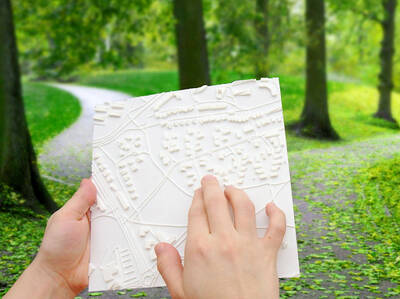
Have you ever wondered how people navigate the world when they can’t see a map? For individuals with visual impairments, conventional maps are nearly impossible to use. This is where tactile maps come in — essential tools that allow people to “see” the world through touch. A tactile map is specially designed with raised lines, textures, and symbols to represent geographical features such as roads, rivers, and buildings. Users explore it with their fingertips. However, these maps are not exclusively for people with visual disabilities. They serve as valuable multisensory learning tools that enhance spatial understanding for everyone, making
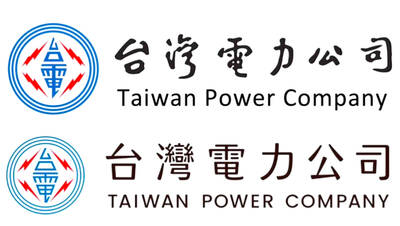
The debate surrounding Taipower’s recent corporate identity reboot has gone well beyond the design community. The controversy began after Taipower replaced the familiar “Taiwan Power Company” wording — widely regarded as the calligraphy of Yu You-ren (1879-1964), former Control Yuan president and master calligrapher — with a modern logotype by designer Aaron Nieh’s team, Aaron Nieh Workshop. Taipower said the change was not a wholesale replacement of old signage, but an “optimization of its identity system,” aimed at meeting the needs of digital media, electronic bills, apps, social media graphics and various small-format applications. Existing physical markings, such as building

Since 2005, the third Monday in January has come to be known as “Blue Monday.” In other words, that day is believed to be the most depressing day of the year. This concept seems logical at first. After all, Monday marks the start of the school or workweek after two days of rest and fun. Also, blue is a color that is often associated with sadness. Furthermore, in many parts of the world, January is a time when the weather is cold, rainy, and gloomy. But is there any scientific proof that this January day is truly sadder than any of

Continued from yesterday(延續自昨日) https://www.taipeitimes.com/News/lang For the most part, the idea of “Blue Monday” has been rejected as a myth. Some mental health experts also say there is a danger in labeling a certain day as the most depressing time of the entire year. Some argue that if people expect to feel sadder on the third Monday in January, this belief alone may increase their anxiety. One group that is worried about the negative effect of believing in Blue Monday is Samaritans. A mental health charity based in the UK, Samaritans is working to turn Blue Monday into “Brew Monday.” In this


 RSS
RSS