


After the Republic of China government took over Taiwan following the end of World War II, it established a number of legal regulations that forced Aborigines to adopt Han Chinese names, on the basis of which household registration officials changed Aborigines’ names as they saw fit. It was not until Taiwan became a democratic society that Aborigines were allowed to change back to their original clan names. An Internet user posted a comment on the PTT online bulletin boards exposing how in the early days the government picked random names for Aborigines. Besides “passer-by,” “ant,” “birdie” and “gas,” even “you-know-who” were assigned as names, prompting netizens to exclaim, “That is really over the top!”
An Internet user posted the revelation on the PTT bulletin board, asking everyone to have a look at how the government used to assign names to Orchid Islanders. The poster quoted examples such as Tsai Hsiao-niao (Birdie Tsai), Hsieh Lu-jen (Passer-by Hsieh), Lin Ma-yi (Ant Lin) and Chen Pi-lien (a girl’s name given to a boy), all from Iraralay Village. Examples from Imorod Village include Chiang Wa-szu (Gas Chiang — who was appointed as township mayor in the 1970s), Chiang Na-ko (You-Know-Who Chiang) and Chou Hsi-lang, whose name sounds like “dead person” in Hoklo. Further examples include Tseng Chia-yu (Add Oil Tseng), a former township council chairperson from Iralino Village, and Hsieh Chia-shui (Add Water Hsieh) of Iratay Village. The poster contended that there was no good reason to replace perfectly good Tao-language names with Han Chinese ones.
At present the government officially recognizes 16 Aboriginal ethnic groups, each of which has its own way of naming people and each of whose names have their own meanings. For example, the Amis boy’s name Mayaw means “the star that stands guard by the moon,” while the Tao girl’s name Malgan means light and joy.
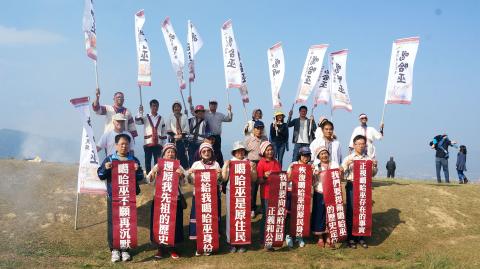
Photo: Tung Chen-kuo, Liberty Times
照片:自由時報記者佟振國
People responded with comments such as “‘My name is Chiang You-Know-Who.’ ‘Who?’ ‘You-know-who.’ ‘No, really, who?‘ ‘You-know-who.’ I thought You-Know-Who was Lord Voldemort,” while another wrote, “In my eyes, you are just an ant.” A lot of netizens were fuming after reading the story, slamming the authorities with comments such as “They were plainly messing people around!” and “What a shame, these are blatant insults!”
(Liberty Times, translated by Julian Clegg)
二戰結束國民政府接收台灣後,連續制訂法條強迫原住民必須更改為漢名,並由戶籍人員肆意為原住民更名。直到台灣進入民主化社會後,原住民才得以更改為其原氏族本名。有網友在PTT板上爆料指出,早期政府任意為原住民取名,除了「路人」、「螞蟻」、「小鳥」、「瓦斯」,就連「那個」也成了名字,讓網友直呼:「真是過份!」
網友在PTT板上爆料,要大家看看早期政府是如何給蘭嶼人取名的,並舉朗島部落的蔡小鳥、謝路人、林螞蟻、陳碧蓮(男性);紅頭部落的江瓦斯(七十年代官派鄉長)、江那個、周西郎;野銀部落的曾加油(前任鄉代主席);漁人部落的謝加水等等為例,認為好好的達悟名字,卻被政府強迫改漢名。
目前政府認定的台灣原住民族有十六族,每一族的命名方式都不相同,而不同族群的命名也都有其不同的涵義。例如:阿美族的男性名字Mayaw(馬耀),意思是守護月亮旁的星星;達悟族的女性名字Malgan(瑪兒坎)則有光輝、心神愉快的含意。
有人說:「『我叫江那個。』『哪個?』『那個。』『到底是哪個?』」,「『那個』我還以為是佛地魔咧!」,「我把你當螞蟻看。」不少網友看了更是相當憤怒,大罵「擺明是欺負人!」,「很可惡,根本侮辱人!」。
(自由時報)


A: Apart from the musical The Phantom of the Opera, off-Broadway classic “I Love You, You’re Perfect, Now Change” and musical-themed concert “Broadway Hits Live” are also touring Taiwan. B: Musical-themed concert? That sounds interesting. A: Set for April 18 and 19, the show will feature a group of Broadway vocalists and dancers — with British singer Keala Settle as a special guest. B: So the audience can enjoy all the timeless hits from various shows at one concert. . . I like that. A: And there’s more: Andrew Lloyd Webber’s classic musical Jesus Christ Superstar will finally visit Taiwan for the first time
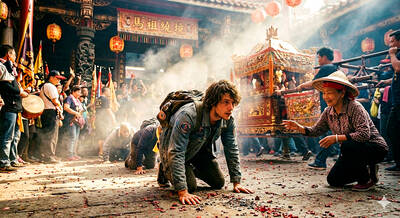
★ Bilingual Story is a fictionalized account. 雙語故事部分內容純屬虛構。 Lucas was already on the ground before he fully understood what was happening. “Hurry! Kneel down!” someone shouted. The asphalt was warm against his knees. Around him, dozens of people lay flat in the narrow street outside Jenn Lann Temple in Dajia. Some pressed their hands together in prayer. Others closed their eyes. Lucas had only come to look at the temple. An hour earlier he had stepped into the noisy courtyard out of curiosity. Inside the main hall, people held incense sticks, bowed three times,

Despite being a basic tool, pens come in a wide variety of forms. Classic styles include fountain pens, which deliver liquid ink smoothly through metal tips. Another common type is the ballpoint pen, which is easy to use. There are even special felt pens that are especially popular among artists. __1__ They have a small hole at the top. So why is it there in the first place? Could it actually be a design flaw? __2__ Since 1991, companies such as BIC have been producing ballpoint pens with holes in their caps for two main reasons: quality control

Visitors walking down the streets of London and other major English cities might notice a curious sight. Many of the old __1__ have some of their windows boarded up. What’s even stranger is that there doesn’t appear to be any consistent pattern as to which windows get covered. This architectural __2__ dates back over 300 years during a time when “coin clipping” was a common crime in England. Back then, silver coins had simple designs with __3__, unmarked edges. Without any pattern extending to the coins’ rims, it was difficult to tell if the edges had been __4__. This


 RSS
RSS