


Jeremiah Heaton was playing with his daughter in their Abingdon, Virginia home last winter when she asked whether she could be a real princess.
Heaton, a father of three who works in the mining industry, didn’t want to make any false promises to Emily, then 6, who was “big on being a princess,” but he still said yes.
Within months, Heaton was journeying through the desolate southern stretches of Egypt and into an unclaimed 207,200-hectare patch of arid desert.
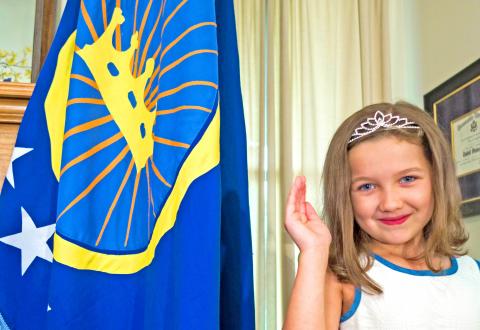
Photo: AFP
照片:法新社
There, on June 16 — Emily’s seventh birthday — he planted a blue flag with four stars and a crown on a rocky hill. The area, a sandy expanse sitting along the Sudanese border, morphed from what locals call Bir Tawil into what Heaton and his family call the “Kingdom of North Sudan.”
There, Heaton is the self-described king and Emily is his princess.
“I wanted to show my kids I will literally go to the ends of the Earth to make their wishes and dreams come true,” Heaton said.
(Courtesy of Liberty Times)
去年冬天,耶利米.希頓在位於維吉尼亞州艾賓頓的自宅與女兒玩耍時,女兒問他,她能否成為真正的公主。
有三個小孩、任職礦業的希頓,不想對當時六歲、「真的很想當公主」的艾蜜莉,許下虛假的承諾,但他還是答應女兒了。
用好幾個月的時間,希頓穿過埃及南部的廣袤荒地,來到一塊面積二十萬七千兩百公頃的無主不毛沙漠。
六月十六日,也就是艾蜜莉七歲生日當天,他在那塊土地的一座石丘上,插上一面有四個星星與一個皇冠圖案的藍色旗幟。這塊沿著蘇丹邊界的廣闊沙地,就此從當地人口中的比爾泰維勒,搖身一變成為希頓及其家人所稱的「北蘇丹王國」。
希頓在此自立為王,艾蜜莉就是他的公主。
希頓說:「我要讓我的孩子們知道,我真的會拚了老命實現他們的希望與夢想。」
(自由時報提供/翻譯:張沛元)
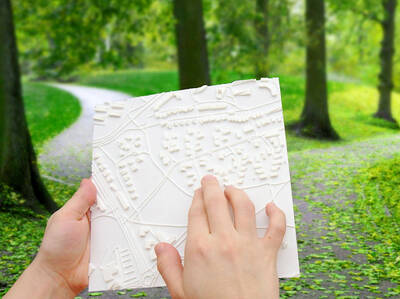
Have you ever wondered how people navigate the world when they can’t see a map? For individuals with visual impairments, conventional maps are nearly impossible to use. This is where tactile maps come in — essential tools that allow people to “see” the world through touch. A tactile map is specially designed with raised lines, textures, and symbols to represent geographical features such as roads, rivers, and buildings. Users explore it with their fingertips. However, these maps are not exclusively for people with visual disabilities. They serve as valuable multisensory learning tools that enhance spatial understanding for everyone, making
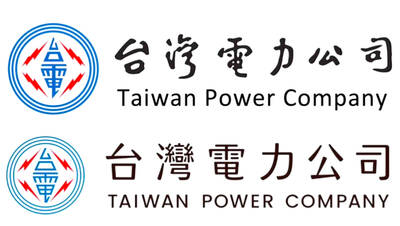
The debate surrounding Taipower’s recent corporate identity reboot has gone well beyond the design community. The controversy began after Taipower replaced the familiar “Taiwan Power Company” wording — widely regarded as the calligraphy of Yu You-ren (1879-1964), former Control Yuan president and master calligrapher — with a modern logotype by designer Aaron Nieh’s team, Aaron Nieh Workshop. Taipower said the change was not a wholesale replacement of old signage, but an “optimization of its identity system,” aimed at meeting the needs of digital media, electronic bills, apps, social media graphics and various small-format applications. Existing physical markings, such as building

Since 2005, the third Monday in January has come to be known as “Blue Monday.” In other words, that day is believed to be the most depressing day of the year. This concept seems logical at first. After all, Monday marks the start of the school or workweek after two days of rest and fun. Also, blue is a color that is often associated with sadness. Furthermore, in many parts of the world, January is a time when the weather is cold, rainy, and gloomy. But is there any scientific proof that this January day is truly sadder than any of

Continued from yesterday(延續自昨日) https://www.taipeitimes.com/News/lang For the most part, the idea of “Blue Monday” has been rejected as a myth. Some mental health experts also say there is a danger in labeling a certain day as the most depressing time of the entire year. Some argue that if people expect to feel sadder on the third Monday in January, this belief alone may increase their anxiety. One group that is worried about the negative effect of believing in Blue Monday is Samaritans. A mental health charity based in the UK, Samaritans is working to turn Blue Monday into “Brew Monday.” In this


 RSS
RSS