


Has a figure from the past been spotted at a popular historical site? A few days ago, Lai Po-fan, a psychology major at National Taiwan University, caught everybody’s eye when he showed up in dark green Han Chinese clothing at the ancient Longshan Temple in Changhua County’s Lugang Township. Lai says that Han Chinese robes are the most beautiful example of Chinese heritage and that he began wearing them three years ago in the hope of reflecting the Han Chinese folk culture.
Why are you wearing an ancient costume? Are you Korean? Would you stop scaring people? Where is your horse, sir? These are the most frequent questions and reactions Lai receives from people when he is decked out in Han Chinese garb. He usually smiles and tells people that he is not wearing an ancient costume, but the Han Chinese outfit — the historical garment of the Han Chinese people. He says that the most special features of Han Chinese attire are its right lapel and wide sleeves.
Lai says that one of the reasons why he wants to wear Han Chinese clothing is that his relatives and friends complained it was a hassle to wear traditional bridal chaplets and shawls at weddings. It was then that he started to research into the traditional garb of the Han Chinese people. After going to university, he had a Han Chinese robe custom-made and has since worn it as a daily garment. He wears it when he rides a scooter, goes to school, goes shopping, takes out garbage and even when he sleeps.
Lai recalled the first time he stepped out of his home in a complete set of Han Chinese garments. “I was walking back and forth at the door before I finally decided to leave the house key in the room. I shut the door and eventually walked out,” he said. His family members at first found his behavior hard to believe and then advised him to think it over carefully. Now they’re used to it.
Lai persisted in following the tradition by wearing a complete set of Han Chinese clothing, including an inner garment and pants, although his hat and belt are the products of modern times. He said that his neighbor was once scared by seeing him wearing a Han Chinese robe. Lai even sleeps in a white inner garment. Once he was woken up to take out the garbage, and he rushed downstairs before he could put on a coat. His neighbor was speechless at the sight of him in a white robe.
“I view the traditional culture from the perspective of clothing,” said Lai. He says history textbooks seldom mention the dressing of the ancients, so he wears Han Chinese clothing to reflect Han Chinese culture, hoping more people will appreciate the beauty of these ancient garments. (LIBERTY TIMES, TRANSLATED BY THEODORE YANG)
古代人現身古蹟?日前身穿一身青綠色漢服的台大心理系學生賴柏帆,出現在古色古香的彰化縣鹿港鎮龍山寺時,吸引全場的目光,他說,他認為漢服是最美的文化遺產,從三年前開始穿著漢服,希望能夠透過漢服來體現漢人的常民文化!
為什麼要穿古裝呢?你是韓國人嗎?不要嚇人好嗎?大爺您的馬呢?這些都是賴柏帆穿漢服時最常遇到的問題與反應。他笑著說,通常他都會先告訴別人,他穿的不是「古裝」,而是「漢服」,也就是漢人所穿的衣服,最大的特徵是右衽與寬袖。
賴柏帆說,他會想要穿漢服,起因之一是他的親友結婚想要穿戴傳統的鳳冠霞帔又嫌麻煩,他才開始去思考研究什麼是漢人的傳統服裝,考上大學之後,他特別去訂製漢服,從此把漢服當作日常服裝,經常穿著漢服騎機車、上學、逛街,甚至睡覺與倒垃圾。
賴柏帆透露,其實他第一次穿著全套漢服要踏出家門時,「曾在門口徘徊多時,走走停停,最後決定把家中鑰匙留在房間,門一甩,才終於走了出去!」他說,當時家人的反應也是從難以置信、勸他深思熟慮,到如今以平常心對待。
賴柏帆堅持的漢服主義,不只是外衣,外衣底下的裡衣、長褲也是照傳統來,不過,帽子和皮帶就是現代物品了。他說,他曾經穿漢服嚇到鄰居,是因為他連睡覺都常穿漢服白色睡袍,有回他在睡夢中被叫起來倒垃圾,還來不及套上外衣就衝下樓,鄰居見到他一身的白袍,嚇得說不出話來。
「我是藉著服裝的角度來切入傳統文化!」賴柏帆說,他發現歷史教科書最少提到的就是當時的人穿什麼樣的服裝,他透過穿著漢服來體現漢人的常民文化,也希望有更多人認識漢服之美。(自由時報記者劉曉欣)
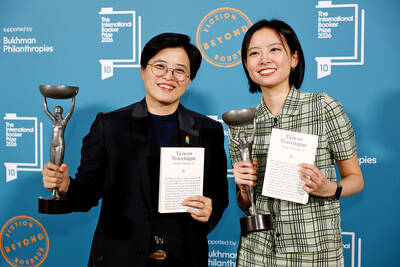
Taiwan Travelogue, the novel by Taiwanese author Yang Shuang-zi and translated into English by Lin King, won the prestigious International Booker Prize in London on May 19. It marks the first time a Taiwanese literary work has received the International Booker Prize, setting a historic milestone both for Taiwanese literature and for the award itself. Prior to this achievement, Taiwan had only once appeared on the Booker radar, when Taiwanese author Wu Ming-yi was longlisted for the Booker Prize in 2018 with The Stolen Bicycle. The International Booker Prize honors works of fiction translated into English and published in the UK or Ireland.

A: Time magazine recently released its list of “The 100 Most Influential People of 2026.” It’s categorized into six groups: Artists, Pioneers, Titans, Icons, Leaders and Innovators. B: TSMC chairman C.C. Wei made the list this year. Which category is he in? A: Wei is actually among the Pioneers, with figures including Disney CEO Josh D’Amaro and MrBeast — the first YouTuber ever to surpass 400 million subscribers. B: Led by Wei, Taiwan’s “silicon shield” TSMC is the sixth-largest company in the world. A: As Nvidia founder Jensen Huang wrote in his introduction, “C.C. Wei is truly one of the

The animal kingdom is full of surprises that challenge our understanding of biology. From remarkable feeding mechanisms to extreme defense strategies, some creatures possess traits so unusual that they seem like pure fiction. Here are four fascinating examples that show nature’s endless creativity. The humble snail may appear simple, but its mouth tells a different story. Snails possess a ribbon-like tongue called a radula, densely covered with anywhere from 1,000 to 12,000 tiny teeth. This structure works like a cheese grater, allowing them to scrape and grind food with surprising efficiency. Far from being passive creatures, snails are actually

As climate change and urbanization push city temperatures higher, walking outdoors is becoming increasingly uncomfortable in many parts of the world, especially when prolonged time spent in sunlight is involved. As a result, outdoor lovers are now seeking cooler, shaded walking routes. However, most mainstream map apps still do not __1__ shaded footpaths. Enter routing.osm.ch — a Swiss web-based route planner that introduces a novel solution to this problem. Its “Vampire mode,” named after the legendary creatures’ fear of being __2__ natural light, was developed by a Swiss research team led by Professor Stefan Keller. The platform combines open data from


 RSS
RSS