


Can you tell what these two girls are doing? They are making snow angels! If you've never played in the snow before, you might not know how to make a snow angel. First, you need to find a place where the snow is new and smooth, like the field in this picture. Then you lay down on your back in the snow and put your arms out. Next, you move your arms up and down and move your legs in and out in the snow.
When you stand up, you have to be very careful. Turn around and you will see the shape of an angel in the snow in front of you! Even though it can be hard to find snow in Taipei, you can still make angels. Just go to the beach and make them in the sand. Of course, they won't be snow angels. They'll be sand angels! (Kayleen Hartman, staff writer)
你看得出來這兩個女孩在做什麼嗎?她們在做雪天使!假如你不曾玩過雪,你可能不知道怎麼做雪天使。首先,你要找一塊剛下雪且雪質綿滑的地方,像是這張照片的空地。然後,你躺在雪上,把手臂伸展開來。接著,讓手臂上下移動,雙腿不斷打開又合上。
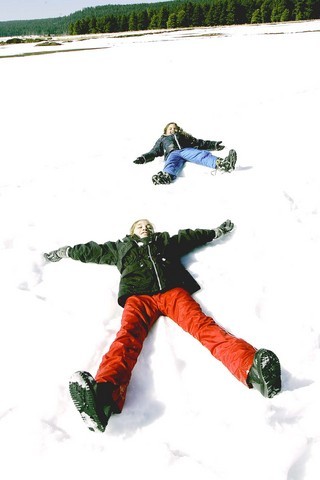
PHOTO : AP
當你站起來時,你必須非常小心。轉過身,你會看見雪地裡有天使的形狀,出現在你眼前!雖然台北很難看到雪,你還是可以做天使。只要到海邊,在沙灘上做天使。當然,那不是雪天使,而是沙天使!
(翻譯:賴美君)
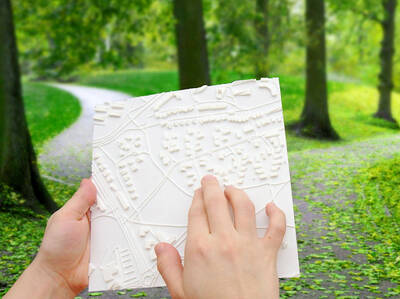
Have you ever wondered how people navigate the world when they can’t see a map? For individuals with visual impairments, conventional maps are nearly impossible to use. This is where tactile maps come in — essential tools that allow people to “see” the world through touch. A tactile map is specially designed with raised lines, textures, and symbols to represent geographical features such as roads, rivers, and buildings. Users explore it with their fingertips. However, these maps are not exclusively for people with visual disabilities. They serve as valuable multisensory learning tools that enhance spatial understanding for everyone, making

The debate surrounding Taipower’s recent corporate identity reboot has gone well beyond the design community. The controversy began after Taipower replaced the familiar “Taiwan Power Company” wording — widely regarded as the calligraphy of Yu You-ren (1879-1964), former Control Yuan president and master calligrapher — with a modern logotype by designer Aaron Nieh’s team, Aaron Nieh Workshop. Taipower said the change was not a wholesale replacement of old signage, but an “optimization of its identity system,” aimed at meeting the needs of digital media, electronic bills, apps, social media graphics and various small-format applications. Existing physical markings, such as building

Since 2005, the third Monday in January has come to be known as “Blue Monday.” In other words, that day is believed to be the most depressing day of the year. This concept seems logical at first. After all, Monday marks the start of the school or workweek after two days of rest and fun. Also, blue is a color that is often associated with sadness. Furthermore, in many parts of the world, January is a time when the weather is cold, rainy, and gloomy. But is there any scientific proof that this January day is truly sadder than any of

Continued from yesterday(延續自昨日) https://www.taipeitimes.com/News/lang For the most part, the idea of “Blue Monday” has been rejected as a myth. Some mental health experts also say there is a danger in labeling a certain day as the most depressing time of the entire year. Some argue that if people expect to feel sadder on the third Monday in January, this belief alone may increase their anxiety. One group that is worried about the negative effect of believing in Blue Monday is Samaritans. A mental health charity based in the UK, Samaritans is working to turn Blue Monday into “Brew Monday.” In this


 RSS
RSS