


Countries on the frontlines of climate change have warned they cannot wait another year for long-sought aid to recover from disasters as floods and hurricanes wreak havoc across the globe.
The appeal came during a meeting of the “loss and damage” fund that will conclude Friday amid concerns it is unlikely to be able to approve climate aid until 2025.
“We cannot wait until the end of 2025 for the first funds to get out the door,” said Adao Soares Barbosa, a board member from East Timor and a long-standing negotiator for the world’s poorest nations.
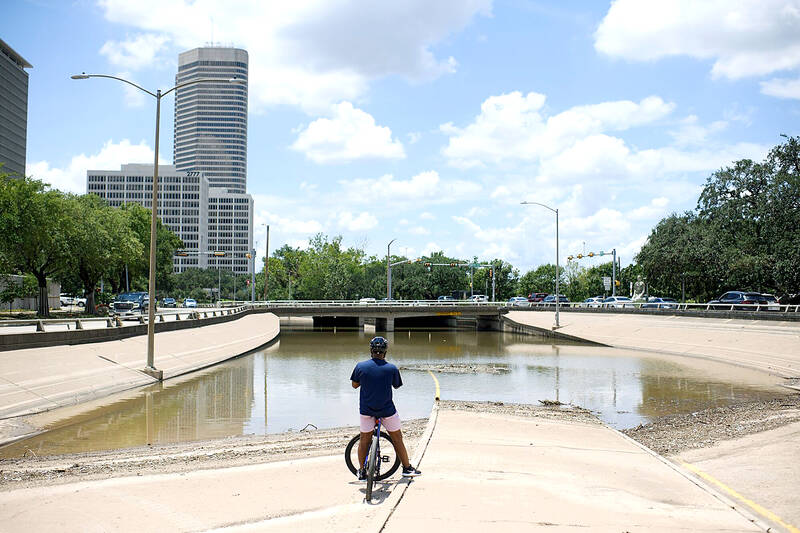
Photo: Bloomberg
“Loss and damage isn’t waiting for us.”
Nearly 200 nations agreed at the UN COP28 summit last November to launch a fund responsible for distributing aid to developing countries to rebuild in the wake of climate disasters.
That historic moment has given way to complex negotiations to finalize the fund’s design, which some countries worry will not move at a pace or scale that matches the tempo of extreme-weather disasters afflicting their people.
“The urgency of needs of vulnerable countries and communities cannot be left until we have every hair in place for this fund,” said Barbosa.
Damage bills for climate disasters can run into the billions and there is barely enough cash set aside for loss and damage at present to cover just one such event, experts say.
‘IMMENSE PRESSURE
This year has witnessed a string of catastrophes on multiple continents, from floods and landslides to heatwaves and wildfires.
Delegates met in South Korea for the second meeting of the loss and damage fund this week as Hurricane Beryl left a trail of destruction across the Caribbean and North America.
The “massive” destruction witnessed in recent weeks “puts immense pressure on us to deliver on our work,” Richard Sherman, the South African co-chair of the board steering the negotiations, told the meeting.
The fund said it wanted money approved “as soon as possible, but realistically by mid-2025,” according to an official document.
In an appeal for faster action, Elizabeth Thompson, a board member from Barbados, said Hurricane Beryl alone had caused “apocalyptic” damage worth “multiple billion dollars.”
“In five islands of the Grenadines... 90 percent of the housing is gone... Houses look like packs of cards and strips of wood, roofs are gone, trees are gone, there is no food, there is no water, there is no power,” she said.
“We cannot keep talking while people live and die in a crisis that they do not cause.”
Thompson said the fund needed to reflect “the urgency and the scale required to respond to... the risk, the damage and the devastation faced by people across the world who need this fund.”
NO MONEY, NO FUND
Wealthy nations have so far pledged around US$661 million to the loss and damage fund. South Korea contributed an additional US$7 million at the start of this week’s meeting.
“That would hardly cover the likely losses from one major climate-related disaster,” said Camilla More, of the International Institute for Environment and Development.
Some estimates suggest developing countries need over US$400 billion annually to rebuild after climate-related disasters. One study put the global bill at between US$290 billion and US$580 billion a year by 2030, and rising after that.
In one example in 2022, unprecedented flooding in Pakistan caused more than US$30 billion in damages and economic losses, according to a UN-backed assessment.
Developing nations had been pushing for a specific fund to distribute aid to recover from climate impacts for 30 years, and the agreement struck in November was hailed a major diplomatic breakthrough.
“(But) we can’t have a fund without money,” said Brandon Wu from ActionAid.
Technical discussions are taking place this year over the details of the loss and damage fund, including with the World Bank which will house the fund on an interim basis.
The Philippines was chosen this week to host the fund’s board. Contentious discussions remain to decide how the money is allocated and in what form it should be made available to countries. On Tuesday, more than 350 nongovernmental organizations sent a letter to the fund’s board demanding that a substantial share of the money be made directly available as small grants to local communities and indigenous groups.

Taiwan’s English education system is being pulled apart by three opposing forces. Bilingual Nation 2030 pulls students toward English and global communication. Artificial Intelligence (AI) readiness pulls them toward digital judgment, verification and AI-mediated work. But Taiwan’s old exam culture pulls them back toward memorization, grammar drills, timed reading and correct answers. If the education system keeps using old exams to define success, it risks producing graduates who are neither genuinely bilingual nor genuinely AI-ready, but trained for tasks machines can already perform. The first force is Bilingual Nation 2030. Launched in 2018, the policy aimed to “help Taiwan’s workforce connect

It seems every few days one bumps into one of those “real man” comments in which Taiwan is urged to “face reality” or similar, and “make a deal,” with the speaker implying that soon it will be too late. “Deal” advocates always present themselves as having a superior grip on reality, and the manly ability to make the “hard choice.” Their testosterone-laden language often echoes that of Taiwan sellout advocates. Note that such commentary always specifies a process (“make a deal, work with, make progress”), never the end state of what occupation by a violent authoritarian colonialist state will entail. In

There are shadowy cabals plotting to sell out Taiwan to be annexed by China, by invasion if necessary. Fortunately, they are buffoons. In 2019, former Bamboo Union gangster and founder of the China Unification Promotion Party (CUPP), Chang An-le (張安樂, colorfully known as “White Wolf”), led a protest at the Legislative Yuan against comments made by then-premier Su Tseng-chang (蘇貞昌) that in the event of an attack by China, he would never surrender, but would protect the nation by fighting to the end, even if he only had a broom. Chang had party members bring a wooden casket that they
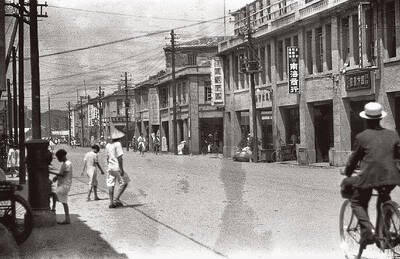
June 1 to June 7 "If all Taiwanese were as afraid of dying as you, then what would happen?” Physician Shih Chiang-nan (施江南) reportedly said this to his wife Chen Chiao-tung (陳焦桐) after she urged him to stop intervening on behalf of Taiwanese soldiers stranded overseas after serving in the Japanese Army during World War II. Shih had clashed with high-ranking officials over the issue, engaged in several heated arguments with Taiwan governor-general Chen Yi (陳儀) and allegedly shouted at general Ko Yuan-fen (柯遠芬), chief of staff of the Taiwan Garrison Command, over


 RSS
RSS