


Shares in Taiwan recorded their third-heaviest point decline in history yesterday after a plunge on Wall Street on Friday amid renewed fears over the US Federal Reserve turning hawkish.
The technology sector bore the brunt of losses as investors cashed out following a breathtaking surge over the past few months powered by a race into all things linked to artificial intelligence (AI).
News that Iran and Israel had traded fire sparked worries about an escalation of the Middle East crisis, adding to the gloomy mood on trading floors and sending oil prices surging more than 5 percent.
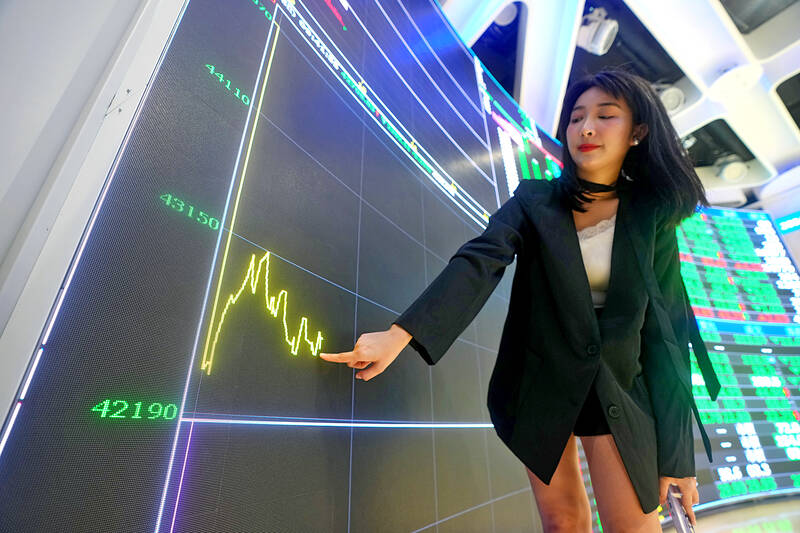
Photo: CNA
The TAIEX ended down 1,568.16 points, or 3.48 percent, at 43,502.78, while the New Taiwan dollar fell sharply against the US dollar, losing NT$0.105 to close at NT$31.580.
Yesterday’s fall in the TAIEX was the third-steepest on record, after a fall of 2,065.87 on April 7 last year, and 1,807.21 on Aug. 5, 2024, Taiwan Stock Exchange data showed.
“The losses largely reflected the US tumble on Friday after the much stronger May job data,” Hua Nan Securities Co (華南永昌證券) analyst Kevin Su (蘇俊宏) said, referring to the latest US nonfarm payroll data in which 172,000 jobs were created, double a market estimate.
That data “will put the Fed in a tough spot on rate cuts and could even lead to a rate hike later this year,” Su said.
Contract chipmaker Taiwan Semiconductor Manufacturing Co (TSMC, 台積電), which accounts for more than 40 percent of total market value, lost 2.96 percent. Smartphone IC designer MediaTek Inc (聯發科) fell 5.35 percent and iPhone assembler and AI server maker Hon Hai Precision Industry Co (鴻海精密), also known as Foxconn Technology Group (富士康), dropped 5.27 percent.
As listed companies would have to report last month’s sales by today, “the market is expecting heavyweights like TSMC to report strong revenue to support the TAIEX,” Su said.
Elsewhere in Asia, Seoul’s KOSPI stock index tanked 8.3 percent as chipmaker Samsung Electronics Co shed more than 10 percent and rival SK Hynix Inc lost 7.7 percent.
Japan’s benchmark Nikkei 225 dropped 3.9 percent with market darlings across the semiconductor supply chain falling furthest. There were also hefty losses in Hong Kong, Shanghai, Singapore, Manila, Jakarta, Mumbai, Wellington and Bangkok.
The market was closed in Sydney for the King’s Birthday, a holiday.
Meanwhile, fears about a re-escalation of the Iran war pushed crude prices sharply higher yesterday after Israel said it had struck targets in western and central Iran.
Brent crude jumped as much as 5.1 percent, and West Texas Intermediate crude climbed 4.8 percent.
“Fading hopes for progress in Middle East peace negotiations kept energy markets on edge, and a handful of disappointing guidance updates from major technology companies interrupted what had become an increasingly one-way artificial intelligence trade,” SPI Asset Management managing partner Stephen Innes said.
Additional reporting by AFP
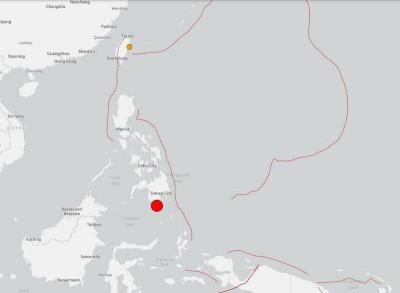
A magnitude 7.8 earthquake struck off the southern coast of Mindanao in the Philippines at 7:38am today, prompting the US Tsunami Warning System to issue an alert for neighboring countries, including Taiwan. The system issued a purple alert indicating a "tsunami threat." The potential threat zone includes Taiwan, the Philippines, Papua New Guinea, Yap and Palau. Philippine authorities were assessing the damage from the quake, with the office of civil defense seeking to verifying initial reports that 15 people had been killed and 129 injured in the region, mostly from falling debris. Arlene Hollero, disaster chief of Maasim town in the Philippines' Sarangani Province,
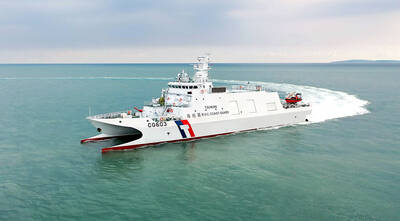
‘GRAY ZONE’ PRESSURE: Beijing’s activities are intended to create the deceitful impression that China has jurisdiction over the area around Taiwan, the CGA said Taiwan’s rights over its territorial waters and exclusive economic zone must not be violated by any country, the Mainland Affairs Council said yesterday, adding that it will not accept any unprovoked actions. The council issued the remarks in response to the China Coast Guard conducting maritime enforcement drills near eastern Taiwan and claiming to fully exercise China’s maritime administrative law enforcement authority. The Coast Guard Administration (CGA) has been closely monitoring the situation and is taking concrete steps to defend the nation’s sovereignty and secure its waters, the council said. China has no sovereign rights over the waters off eastern
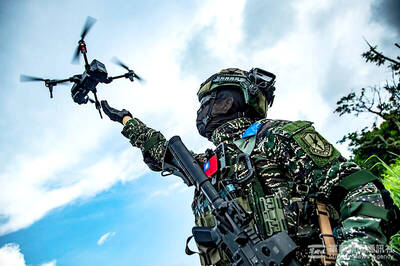
RESILIENCE: Taiwan plays a key role in semiconductors, energy, information infrastructure and advanced manufacturing, AIT Director Raymond Greene said Taiwan’s continued investment in deterrence and resilience remains vital, especially in uncrewed systems and other emerging technologies, American Institute in Taiwan (AIT) Director Raymond Greene said yesterday. Greene made the remarks at the annual National Strategic Summit on Supply Chain Resilience held by the Research Institute for Democracy, Society and Emerging Technology (DSET), a government-backed think tank. As Taiwan last year became the US’ fourth-largest trading partner and supply chain security is becoming more important, cooperation in emerging technologies continues to deepen between the two countries, he said. The US is committed to accelerating innovation, building key infrastructure, strengthening cooperation

The National Chungshan Institute of Science and Technology yesterday showcased its locally developed variants of the Vision 60 robotic patrol dog, which it plans to deploy on the nation’s outlying territories in the South China Sea. The variants were produced under the Joint Lab project — created by the institute and domestic companies — and assembled with domestically produced motors, lenses and artificial intelligence (AI) systems alongside licensed tech from the US, Missile and Rocket Systems Research Division deputy director Jen Kuo-kang (任國光) told the media event at a military base in Taipei’s Dazhi (大直) area. Taiwan has built up its strengths


 RSS
RSS