


Advanced Micro Devices Inc (AMD), a US maker of artificial intelligence (AI) processors and a rival to the world’s most valuable company, Nvidia Corp, yesterday announced an investment of more than US$10 billion into Taiwan’s chip industry.
The company said investments would be made “across the Taiwan ecosystem to expand strategic partnerships and scale advanced packaging capabilities for AI infrastructure.”
As the home of chip production giants Taiwan Semiconductor Manufacturing Co (TSMC, 台積電) and Hon Hai Precision Industry Co (鴻海精密), also known as Foxconn Technology Group (富士康), Taiwan is a powerhouse in the manufacturing of semiconductors used to train and power AI systems.
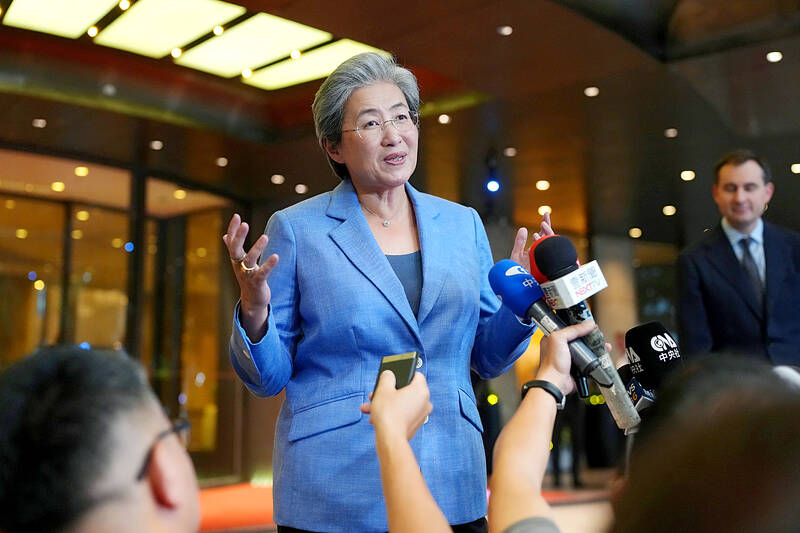
Photo: CNA
AMD — whose chief executive officer, Lisa Su (蘇姿丰), is due to speak today in Taipei — said in a statement that it was working with firms in Taiwan and elsewhere on advanced computing components that are essential in AI data centers.
The company “is advancing leading-edge silicon, packaging and manufacturing technologies that enable higher performance, greater efficiency and faster deployment of AI systems,” it said.
Among the deals announced yesterday was a hardware development partnership with Taiwanese chip packaging and testing provider ASE Technology Holding Co (日月光投控) and its subsidiary Siliconware Precision Industries Co (矽品精密).
AMD is also working with other partners including Powertech Technology Inc (力成科技), Sanmina Corp and Inventec Corp (英業達) to bolster its capabilities in the region, it said.
AMD is among other chipmakers increasing their presence in Taiwan and seeking to boost capacity as AI demand rises. Although Nvidia remains the dominant provider of AI processors, data center customers are increasingly seeking alternatives — a trend that has helped AMD.
“As AI adoption accelerates, our global customers are rapidly scaling AI infrastructure to meet growing compute demand,” Su said in a statement.
Su is visiting Taiwan and is set to join a fireside chat hosted by a local media firm today.
AMD yesterday also announced that its next-generation EPYC processor, called “Venice,” is ramping up production in Taiwan using TSMC’s advanced 2-nanometer process technology, with plans to do the same at TSMC’s Arizona fabrication facility.
Venice is the first high-performance computing (HPC) product in the industry to enter production using TSMC’s 2-nanometer process technology, AMD said in a separate statement.
The production of Venice comes as AMD continues to build momentum in the server market, reflecting growing customer demand for EPYC processors to power modern cloud, enterprise, HPC and AI deployments, it said.
“As AI and agentic workloads scale rapidly, customers need platforms that can move from innovation to production faster. Our deep partnership with TSMC is helping AMD bring leadership compute technologies to market with the speed and scale required to meet this moment,” Su said.
Additional reporting by staff writer and Bloomberg
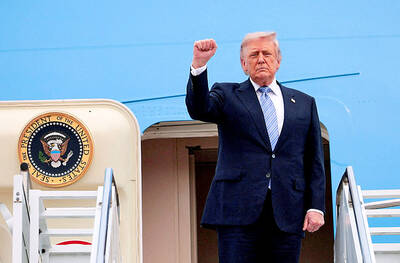
US-CHINA SUMMIT: MOFA welcomed US reassurance of no change in its Taiwan policy; Trump said he did not comment when Xi talked of opposing independence US President Donald Trump yesterday said he has not made a decision on whether to move forward with a major arms package for Taiwan after hearing concerns about it from Chinese President Xi Jinping (習近平). Trump’s comments on Taiwan came as he flew back to Washington after wrapping up critical talks in which both leaders said important progress was made in stabilizing US-China relations even as deep differences persist between the world’s two biggest powers on Iran and Taiwan. “I will make a determination,” Trump said, adding: “I’ll be making decisions. But, you know, I think the last thing we need right
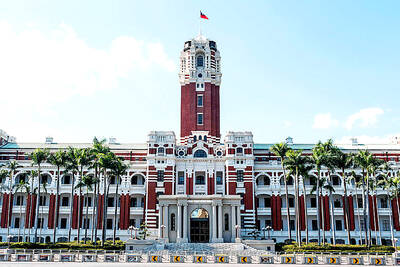
SECURITY: Taipei presses the US for arms supplies, saying the arms sales are not only a reflection of the US security commitment to Taiwan but also serve as a mutual deterrent against regional threats Taiwan is committed to preserving the cross-strait “status quo” and contributing to regional peace and stability, the Presidential Office said yesterday. “It is an undeniable fact that the Republic of China is a sovereign and independent democratic nation,” Presidential Office spokeswoman Karen Kuo (郭雅慧) reiterated, adding that Beijing has no right to claim sovereignty over Taiwan. The statements came after US President Donald Trump warned against Taiwanese independence. Trump wrapped up a state visit to Beijing on Friday, during which Chinese President Xi Jinping (習近平) had pressed him not to support Taiwan. Taiwan depends heavily on US security backing to deter China from carrying
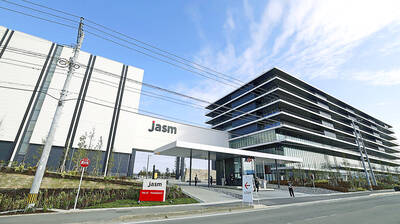
The subsidiary of Taiwan Semiconductor Manufacturing Co (TSMC, 台積電) in Kumamoto, Japan, turned a profit in the first quarter of this year, marking the first time the first fab of the unit has become profitable since mass production started at the end of 2024. According to the contract chipmaker’s financial statement released on Friday, Japan Advanced Semiconductor Manufacturing Inc (JASM), a joint venture running the fab in Kumamoto, posted NT$951 million (US$30.19 million) in profit in the January-to-March period, compared with a loss of NT$1.39 billion in the previous quarter, and a loss of NT$3.25 billion in the first quarter of
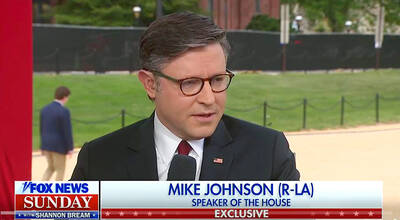
RESOLUTE BACKING: Two Republican senators are planning to introduce legislation that would impose immediate sanctions on China if it attempts to invade Taiwan US House of Representatives Speaker Mike Johnson on Sunday reaffirmed US congressional support for Taiwan, saying the US and “all freedom-loving people” have a stake in preventing China from seizing Taiwan by force. Johnson made the remarks in an interview with Fox News Sunday on US President Donald Trump’s summit with Chinese President Xi Jinping (習近平) last week. In an interview that aired on Friday on Fox News, just as Trump wrapped up a high-stakes visit to China, he said he has yet to green-light a new US$14 billion arms package to Taiwan and that it “depends on China.” “It’s a very good


 RSS
RSS