


The WHO yesterday convened a meeting of its emergency committee amid an urgent search for vaccines and medicines to combat a widening Ebola outbreak in the Democratic Republic of the Congo and Uganda.
The WHO was to consult the committee for “temporary recommendations” on dealing with the rare Bundibugyo strain, which has no approved treatment and might have spread undetected for weeks.
More than 500 suspected cases and 131 deaths linked to Ebola have been reported across four health zones in the northeastern province of Ituri, DR Congo Minister of Public Health, Hygiene and Social Welfare Roger Kamba said on Monday night.
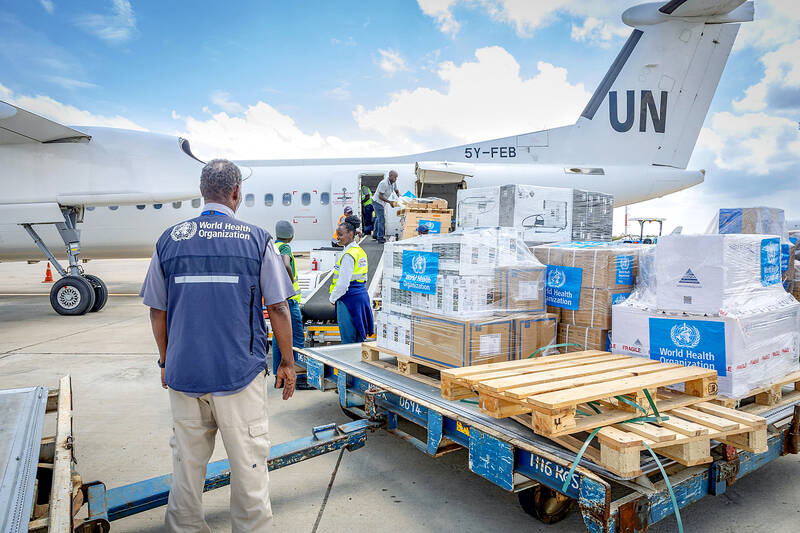
Photo: WHO / Reuters
Uganda has confirmed two cases and one death in Kampala, while authorities in Goma, the eastern Congolese city controlled by a rebel group, said 189 contacts linked to a confirmed case were being monitored.
The outbreak might have circulated for weeks before authorities realized they were dealing with Ebola.
The first case was seen on April 24, but health officials were not alerted because locals initially believed it was a “mystical disease,” Kamba said.
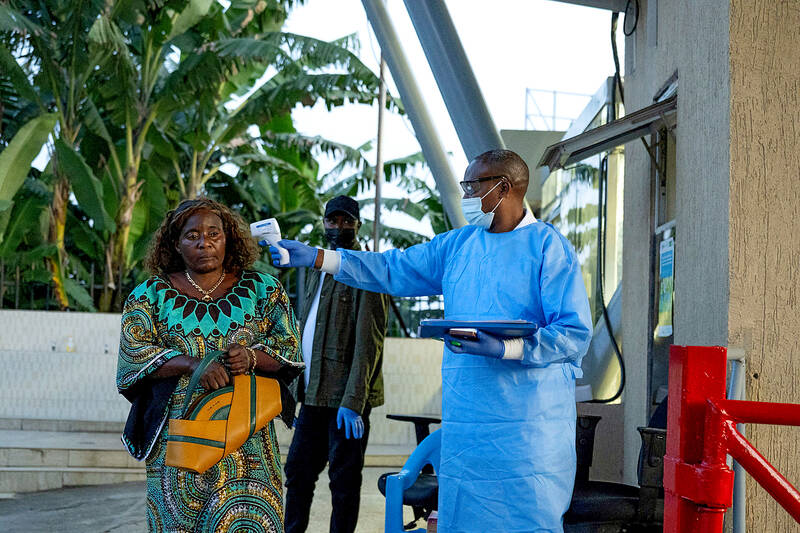
Photo: Reuters
Many sick people sought traditional or alternative treatments instead of going to hospitals, allowing the virus to spread.
A US missionary doctor has tested positive and is being sent to Germany for supportive care.
The first formal alert only came on May 5, after multiple deaths had already occurred, Kamba said.
Initial tests in the northeastern Congolese city of Bunia were negative, because samples were screened only for the more common and deadlier Ebola Zaire strain.
Samples sent to Kinshasa on Thursday last week later confirmed the presence of Ebola, and by early Friday, the country’s biomedical institute identified it as the Bundibugyo strain.
Part of the challenge facing the authorities is that Bundibugyo is the least-studied strain and harder to detect early than the better-known Zaire variant.
While Ebola Zaire often causes dramatic hemorrhaging, Bundibugyo can initially resemble malaria or the flu, delaying recognition and isolation of cases.
Three potential vaccines and several treatments are being evaluated and prioritized, Africa Centers for Disease Control and Prevention Director-General Jean Kaseya said on social media.
“We’re pushing hard to accelerate GMP manufacturing,” Kaseya said, referring to the pharmaceutical-grade production standards required before vaccines can enter clinical testing.
Most Ebola countermeasures were developed for the Zaire strain after the 2013-2016 West African epidemic killed more than 11,000 people.
The WHO on Sunday declared the latest outbreak a public health emergency of international concern — its highest level of alarm — before convening its emergency committee, an unprecedented step that WHO Director-General Tedros Adhanom Ghebreyesus said reflected concern about the epidemic’s scale and speed.
“I did not do this lightly,” Tedros told the World Health Assembly, the annual meeting of member states, in Geneva, Switzerland.
It was the first time a WHO director has declared a health emergency before the committee meets to recommend it, he said.
The DR Congo media ministry said it would begin issuing regular public updates on the outbreak — likely daily — alongside officials from the health ministry and the National Institute for Biomedical Research.
Uganda postponed its annual Martyrs’ Day celebrations on June 3, an event that can attract as many as 2 million people, because of the outbreak risk. Germany is preparing to treat the US patient, its health ministry said.
The WHO has deployed personnel, equipment and emergency funding to support the Ebola response, including an additional US$3.4 million from its contingency fund, Tedros said.
Africa’s CDC has sent emergency-response specialists, activated a continental coordination system with the WHO and mobilized US$2 million to support containment efforts.
The outbreak is testing health agencies as they face growing financial pressure. Tedros estimates that about 90 percent of the WHO’s core budget for the current two-year funding cycle has been secured, but cautioned the remaining gap “will not be easy to mobilize.”
Because much donor funding remains earmarked for specific programs, WHO continues to face “pockets of poverty in many areas of our work,” Tedros said.
Health officials say rapid testing, contact tracing and isolation remain the most important tools for slowing transmission, while researchers work to find vaccines and treatments for Bundibugyo.
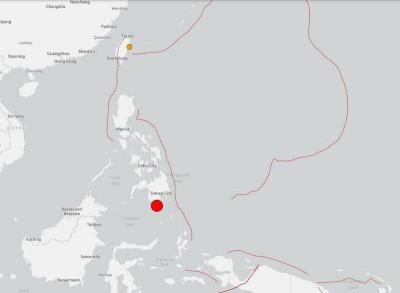
A magnitude 7.8 earthquake struck off the southern coast of Mindanao in the Philippines at 7:38am today, prompting the US Tsunami Warning System to issue an alert for neighboring countries, including Taiwan. The system issued a purple alert indicating a "tsunami threat." The potential threat zone includes Taiwan, the Philippines, Papua New Guinea, Yap and Palau. Philippine authorities were assessing the damage from the quake, with the office of civil defense seeking to verifying initial reports that 15 people had been killed and 129 injured in the region, mostly from falling debris. Arlene Hollero, disaster chief of Maasim town in the Philippines' Sarangani Province,

‘GRAY ZONE’ PRESSURE: Beijing’s activities are intended to create the deceitful impression that China has jurisdiction over the area around Taiwan, the CGA said Taiwan’s rights over its territorial waters and exclusive economic zone must not be violated by any country, the Mainland Affairs Council said yesterday, adding that it will not accept any unprovoked actions. The council issued the remarks in response to the China Coast Guard conducting maritime enforcement drills near eastern Taiwan and claiming to fully exercise China’s maritime administrative law enforcement authority. The Coast Guard Administration (CGA) has been closely monitoring the situation and is taking concrete steps to defend the nation’s sovereignty and secure its waters, the council said. China has no sovereign rights over the waters off eastern
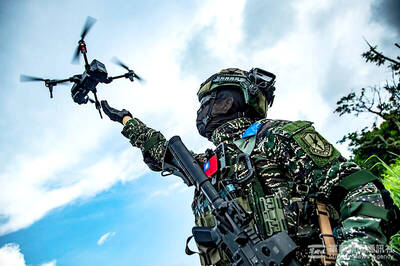
RESILIENCE: Taiwan plays a key role in semiconductors, energy, information infrastructure and advanced manufacturing, AIT Director Raymond Greene said Taiwan’s continued investment in deterrence and resilience remains vital, especially in uncrewed systems and other emerging technologies, American Institute in Taiwan (AIT) Director Raymond Greene said yesterday. Greene made the remarks at the annual National Strategic Summit on Supply Chain Resilience held by the Research Institute for Democracy, Society and Emerging Technology (DSET), a government-backed think tank. As Taiwan last year became the US’ fourth-largest trading partner and supply chain security is becoming more important, cooperation in emerging technologies continues to deepen between the two countries, he said. The US is committed to accelerating innovation, building key infrastructure, strengthening cooperation

RIGHT DIRECTION: Taiwan’s efforts to prevent forced labor include a proposal to ‘fully prohibit’ employers from withholding workers’ documents, an official said Taiwan is to establish a mechanism to restrict imports of goods linked to forced labor, the Executive Yuan said yesterday, after the US proposed imposing additional tariffs on Taiwanese goods over labor concerns. “The Ministry of Labor and the Ministry of Economic Affairs are to establish an interministerial review procedure,” Executive Yuan spokesperson Michelle Lee (李慧芝) said at a news briefing in Taipei. “The government is to use the Foreign Trade Act [貿易法] as the legal basis to restrict imports of goods produced with forced labor” and bring its supply chain governance more in line with international standards on human rights, resilience


 RSS
RSS