


A group of Chinese naval vessels, including a destroyer, yesterday passed through a waterway between two islands administered by the Japanese prefecture of Okinawa, as it returned home after testing far-seas capabilities, China said.
Vessel formation 133 dispatched by the Chinese People’s Liberation Army’s (PLA) Eastern Theater Command completed its training in the western Pacific, and has returned through the Yonaguni-Iriomote Waterway, said the command, which is responsible for east China, the East China Sea and the Taiwan Strait.
While non-Japanese vessels are allowed to pass through the narrow band of waters in the middle of the Yonaguni-Iriomote Waterway, Japan reserves the right to take action if vessels stray into the country’s territorial sea, defined as seas 12 nautical miles (22km) from its shoreline.
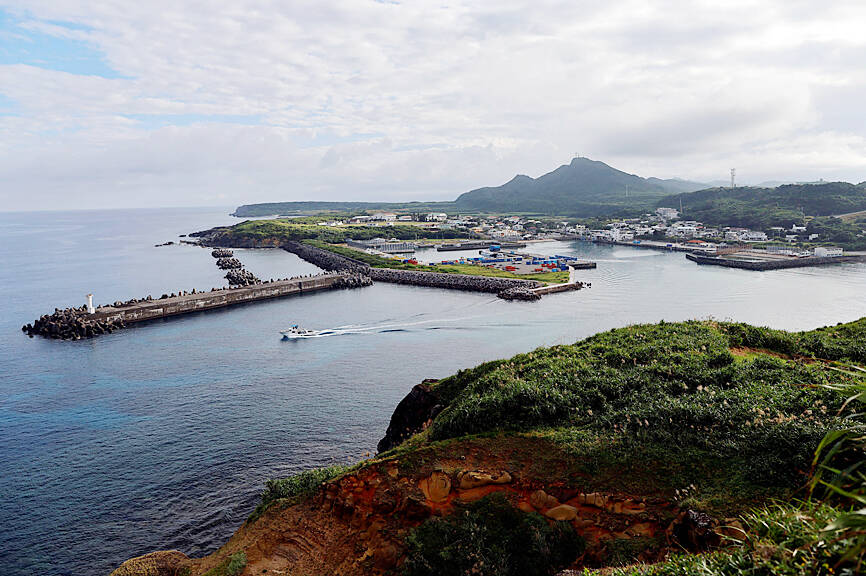
Photo: Reuters
The width of the waterway is about 65km.
To reach the Pacific Ocean, the PLA formation on Sunday sailed between the Japanese islands of Amami Oshima and Yokoate, a passage northeast of the Yonaguni-Iriomote Waterway and farther away from Taiwan.
The transit followed the passage of a Japanese destroyer through the Taiwan Strait on Friday that Beijing said was a “deliberate provocation.”
Beijing has responded aggressively on occasion to foreign navies sailing through the Taiwan Strait, which China says is not international waters.
The Japanese transit provoked an angry response from the Chinese Ministry of Foreign Affairs, which said Japan’s deployment of a military vessel in the Strait was “a display of force” and “a deliberate provocation” that threatens China’s sovereignty and security.
The Chinese Ministry of National Defense said that the passage of the Japanese destroyer had sent a “wrong” signal to pro-independence forces in Taiwan.
Sino-Japanese ties have significantly weakened since November last year when Japanese Prime Minister Sanae Takaichi said that a hypothetical Chinese attack on Taiwan could be considered an “existential threat” to Japan, triggering a military response.
Yonaguni, just 110km off Taiwan’s eastern coast, is increasingly on the radar of China and Japan.
In September 2024, PLA Navy aircraft carrier the Liaoning (遼寧) passed through the Yonaguni-Iriomote Waterway, marking the first transit of a Chinese aircraft carrier in Japan’s contiguous waters, triggering loud protests from Tokyo.
In November last year, the Japanese Ministry of Defense said it had been advancing a plan to deploy a medium-range surface-to-air missile unit at a military base on the island.
The announcement triggered even more hostility from China, which has said the move was “extremely dangerous.”
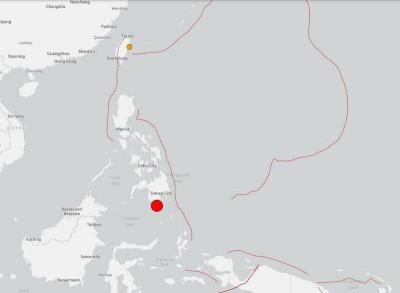
A magnitude 7.8 earthquake struck off the southern coast of Mindanao in the Philippines at 7:38am today, prompting the US Tsunami Warning System to issue an alert for neighboring countries, including Taiwan. The system issued a purple alert indicating a "tsunami threat." The potential threat zone includes Taiwan, the Philippines, Papua New Guinea, Yap and Palau. Philippine authorities were assessing the damage from the quake, with the office of civil defense seeking to verifying initial reports that 15 people had been killed and 129 injured in the region, mostly from falling debris. Arlene Hollero, disaster chief of Maasim town in the Philippines' Sarangani Province,
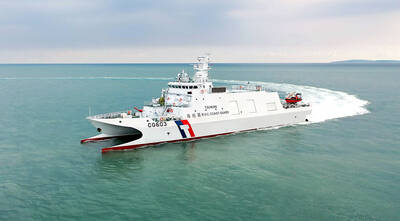
‘GRAY ZONE’ PRESSURE: Beijing’s activities are intended to create the deceitful impression that China has jurisdiction over the area around Taiwan, the CGA said Taiwan’s rights over its territorial waters and exclusive economic zone must not be violated by any country, the Mainland Affairs Council said yesterday, adding that it will not accept any unprovoked actions. The council issued the remarks in response to the China Coast Guard conducting maritime enforcement drills near eastern Taiwan and claiming to fully exercise China’s maritime administrative law enforcement authority. The Coast Guard Administration (CGA) has been closely monitoring the situation and is taking concrete steps to defend the nation’s sovereignty and secure its waters, the council said. China has no sovereign rights over the waters off eastern
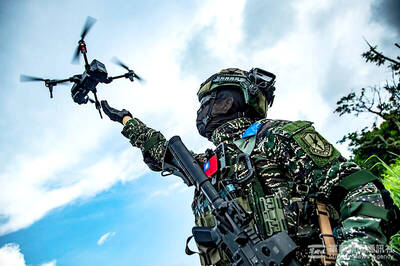
RESILIENCE: Taiwan plays a key role in semiconductors, energy, information infrastructure and advanced manufacturing, AIT Director Raymond Greene said Taiwan’s continued investment in deterrence and resilience remains vital, especially in uncrewed systems and other emerging technologies, American Institute in Taiwan (AIT) Director Raymond Greene said yesterday. Greene made the remarks at the annual National Strategic Summit on Supply Chain Resilience held by the Research Institute for Democracy, Society and Emerging Technology (DSET), a government-backed think tank. As Taiwan last year became the US’ fourth-largest trading partner and supply chain security is becoming more important, cooperation in emerging technologies continues to deepen between the two countries, he said. The US is committed to accelerating innovation, building key infrastructure, strengthening cooperation

The National Chungshan Institute of Science and Technology yesterday showcased its locally developed variants of the Vision 60 robotic patrol dog, which it plans to deploy on the nation’s outlying territories in the South China Sea. The variants were produced under the Joint Lab project — created by the institute and domestic companies — and assembled with domestically produced motors, lenses and artificial intelligence (AI) systems alongside licensed tech from the US, Missile and Rocket Systems Research Division deputy director Jen Kuo-kang (任國光) told the media event at a military base in Taipei’s Dazhi (大直) area. Taiwan has built up its strengths


 RSS
RSS