


The Taiwan People's Party (TPP) today expelled at-large Legislator Li Zhenxiu (李貞秀) following a series of controversies, effectively stripping her of her legislative seat.
The party’s Central Review Committee reached the decision during a meeting this afternoon, with the expulsion effective immediately.
As a result, Li loses her qualification to serve as an at-large lawmaker.
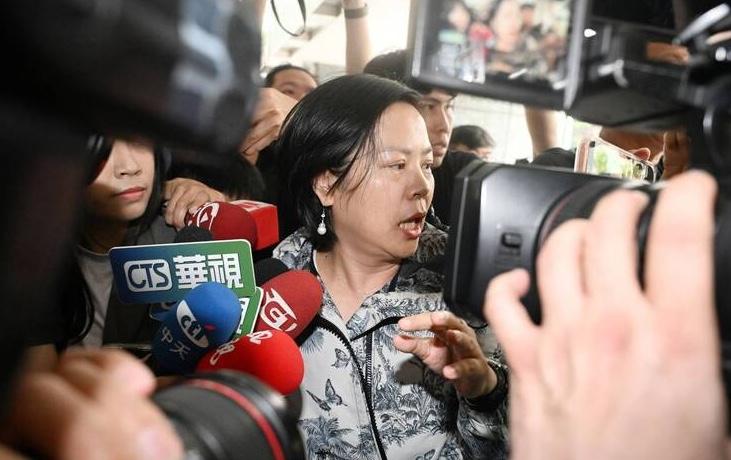
Photo: Liao Chen-hui, Taipei Times
Li — who was born in China, but has lived in Taiwan for three decades after marrying a Taiwanese man — has been embroiled in ongoing disputes regarding her nationality and eligibility to serve as a legislator.
She was recently referred to the party’s Central Review Committee for disciplinary action after she claimed during a livestream that Hsinchu Mayor Ann Kao (高虹安) took NT$7 million (US$220,046) from TPP founder Ko Wen-je (柯文哲).
In an interview this morning, TPP Chairman Huang Kuo-chang (黃國昌) said that at-large legislators must respond to the expectations and demands of supporters and fulfill their promises to voters, rather than fighting for their own personal interests.
Asked if Li had met these standards, Huang replied: "No."
Li arrived at TPP headquarters at about 2:30pm to present her case to the committee.
Following the meeting, the party issued a statement confirming its decision to revoke her membership.
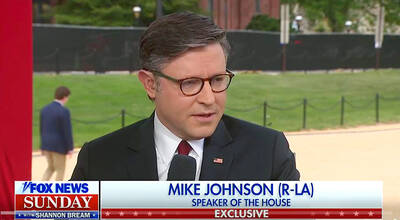
RESOLUTE BACKING: Two Republican senators are planning to introduce legislation that would impose immediate sanctions on China if it attempts to invade Taiwan US House of Representatives Speaker Mike Johnson on Sunday reaffirmed US congressional support for Taiwan, saying the US and “all freedom-loving people” have a stake in preventing China from seizing Taiwan by force. Johnson made the remarks in an interview with Fox News Sunday on US President Donald Trump’s summit with Chinese President Xi Jinping (習近平) last week. In an interview that aired on Friday on Fox News, just as Trump wrapped up a high-stakes visit to China, he said he has yet to green-light a new US$14 billion arms package to Taiwan and that it “depends on China.” “It’s a very good

DRONE CENTRAL: Taiwan aims to become Asia’s democratic hub for drones, with most exports focused on high-quality military-grade models, an official said Taiwan’s drone industry is expected to expand significantly by 2030, producing 100,000 units per month and exporting half of them, the Ministry of Economic Affairs said yesterday. Current drone production capacity is about 15,000 units per month, but the industry can quickly scale up as demand increases, Industrial Development Administration Director-General Chiou Chyou-huey (邱求慧) told a news conference in Taipei. Taiwan’s drone output grew 2.5-fold last year to NT$12.9 billion (US$408.3 million) under a government program to develop the uncrewed vehicle sector, he said. The Executive Yuan in October last year approved plans to invest NT$44.2 billion into domestic production of uncrewed aerial

WARNING: China should stop engaging in actions that undermine regional peace and stability, as it would only build resentment among people across the Strait, the CGA said China has deployed more than 100 navy, coast guard and other vessels in waters from the Yellow Sea to the South China Sea and the western Pacific since US President Donald Trump and Chinese President Xi Jinping (習近平) met in Beijing, National Security Council Secretary-General Joseph Wu (吳釗燮) said yesterday. “In this part of the world, #China is the one & only PROBLEM wrecking the #StatusQuo & threatening regional peace & stability,” Wu wrote on X. In a separate post, he said Beijing was coercing Taiwan’s maritime domain, calling it illegal and provocative, after the Coast Guard Administration (CGA) expelled a
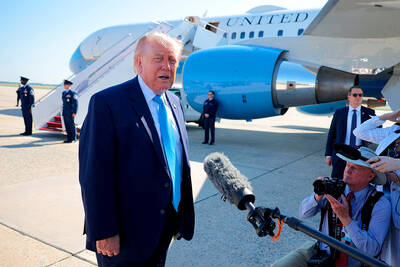
US President Donald Trump yesterday said he would speak to President William Lai (賴清德) as his administration considers whether to move ahead with a US$14 billion weapons sale to Taiwan — a potential arms deal that has drawn criticism from China. “Well, I’ll speak to him. I speak to everybody,” Trump told reporters yesterday when asked if he had any plans to call his counterpart, although he did not offer a time frame for when such a conversation could take place. Trump previously said he would speak to the person “that’s running Taiwan,” without specifying who he meant. “We have that situation very


 RSS
RSS