


Chinese President Xi Jinping (習近平) and Chinese Nationalist Party (KMT) Chairwoman Cheng Li-wun (鄭麗文) met in Beijing yesterday, where they vowed to bring people on both sides of the Taiwan Strait closer to facilitate the “great rejuvenation of the Chinese nation.”
The meeting was held in the East Hall of the Great Hall of the People, a venue typically reserved for meetings between Xi and foreign heads of state.
In public remarks prior to a closed-door meeting, Xi, in his role as head of the Chinese Communist Party (CCP), said that Taiwan is historically part of China, and remains an “inalienable” and “inseparable” part of Chinese territory.
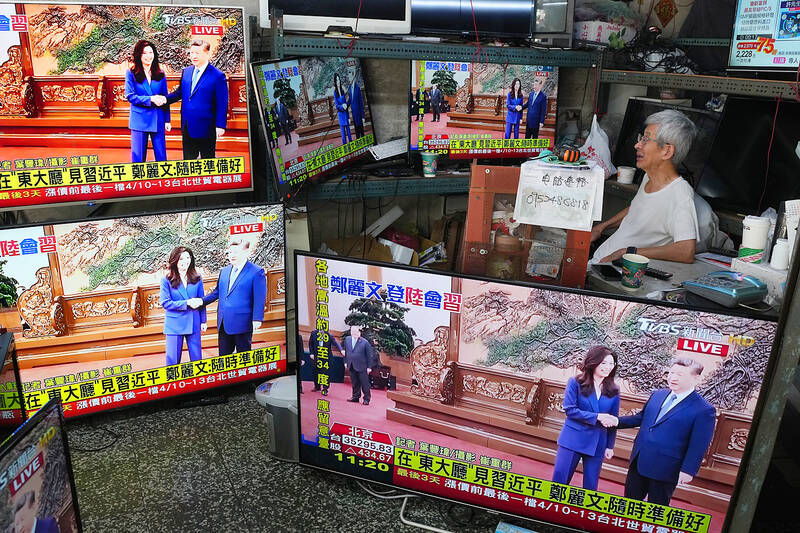
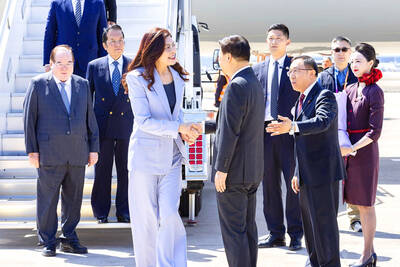
Photo: CNA
As the world faces great changes, “the broader trend of the great rejuvenation of the Chinese nation will not change, and the great tide of people on both sides of the Strait growing closer and coming together will not change,” Xi said.
The phrase “rejuvenation of the Chinese nation,” which Cheng later echoed, refers to the CCP’s goal to turn China into a great power by 2049, the 100th anniversary of the People’s Republic of China (PRC), but it also connotes making Taiwan officially part of the PRC.
China’s “national reunification,” which includes annexing Taiwan, is an “essential step toward national rejuvenation,” according to a white paper published by China’s Taiwan Affairs Office in 2022.
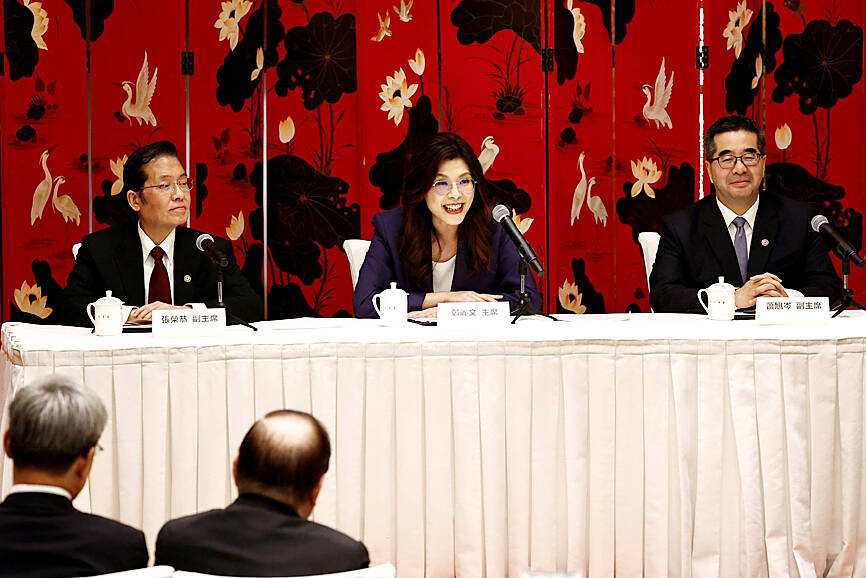
Photo: Reuters
Vowing to strengthen exchanges with Taiwan and push for peace across the Taiwan Strait, Xi said that China was willing to engage in dialogue with all Taiwanese political parties and civil society, but that engagement came with a major precondition.
He said it would be based on the “shared political foundation characterized by a firm adherence to the ‘1992 consensus’ and opposition to Taiwan independence.”
The so-called “1992 consensus,” a term former Mainland Affairs Council (MAC) chairman Su Chi (蘇起) in 2006 admitted making up in 2000, refers to a tacit understanding between the KMT and the CCP that both sides of the strait acknowledge there is “one China,” with each side having its own interpretation of what “China” means.
Echoing Xi’s remarks, Cheng said that in the more than 100 years of interactions between the KMT and the CCP, “all we ever wanted is to guide the Chinese nation out of decline and toward rejuvenation.”
“The great Chinese rejuvenation involves people on both sides of the strait. It is about the reawakening and resurgence of Chinese civilization,” Cheng said.
Cheng called on Taiwan and China to put political differences aside, and jointly work toward the creation of a “symbiosis of coprosperity” underpinned by a systemic solution for preventing war.
The two sides of the Taiwan Strait should build sustainable avenues for dialogue and mechanisms for cooperation underpinned by a “shared political foundation characterized by a firm adherence to the ‘1992 consensus’ and opposition to Taiwan independence,” Cheng said.
“Hopefully, through the persistent efforts of our two parties, the Taiwan Strait will no longer be a geopolitical flashpoint and will never be a chessboard for interference by external forces,” she said.
In Taipei, Presidential Office spokeswoman Karen Kuo (郭雅慧) said that Xi used his interaction with the KMT leader to pull Taiwan off the world stage and trap it within a “‘one China’ framework,” locking it into the CCP’s political agenda of “national rejuvenation.”
The MAC condemned Cheng for acting as a “united front accomplice,” saying that her proposed “peace framework” is merely a thinly veiled “unification framework.”
MAC Minister Chiu Chui-cheng (邱垂正) said that Cheng’s adherence to the so-called “1992 consensus” and echoing of Beijing’s political narratives ignores mainstream public opinion in Taiwan and endorses the CCP’s attempts to eradicate the Republic of China.
For Beijing, the only acceptable “peace framework” is “one country, two systems,” which Taiwan and its people categorically reject, Chiu said.
The government would monitor the KMT’s actions closely to ensure they do not undermine national security or break the law, MAC Deputy Minister Liang Wen-chieh (梁文傑) said.
The council would pay particular attention to whether the KMT’s subsequent behavior, such as its handling of the national defense budget stalled in the Legislative Yuan, aligns with Beijing’s agenda at the expense of Taiwan’s self-defense capabilities, he added.
Tunghai University Cross-Strait Research Center deputy executive director Hung Pu-chao (洪浦釗) said that meeting was carefully orchestrated to frame Taiwan as an internal Chinese affair, thereby denying the legitimacy of international intervention and characterizing any foreign involvement as unwarranted meddling.
This strategy not only targets the international community, but also manipulates Taiwan’s domestic discourse by downplaying the urgency of the Chinese military threat, Hung said.
The resulting “illusion of peace” makes defense budgets and arms purchases easier to question, which could erode Taiwan’s security ties with the US and regional allies, he said.
Additional reporting by Chung Li-hua

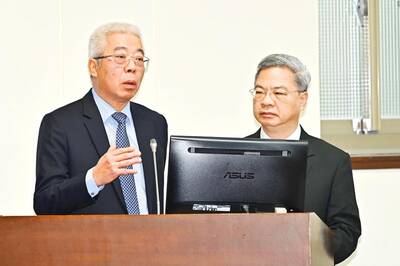
Taiwan has arranged for about 8 million barrels of crude oil, or about one-third of its monthly needs, to be shipped from the Red Sea this month to bypass the Strait of Hormuz and ease domestic supply pressures, CPC Corp, Taiwan (CPC, 台灣中油) said yesterday. The state-run oil company has worked with Middle Eastern suppliers to secure routes other than the Strait of Hormuz, through which about 20 percent of the world’s oil and liquefied natural gas typically passes, CPC chairman Fang Jeng-zen (方振仁) said at a meeting of the legislature’s Economics Committee in Taipei. Suppliers in Saudi Arabia have indicated they
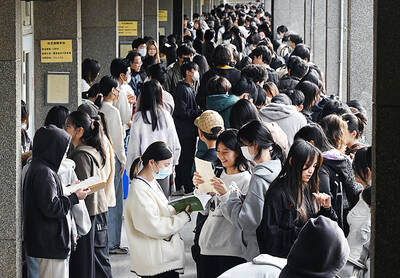
A global survey showed that 60 percent of Taiwanese had attained higher education, second only to Canada, the Ministry of the Interior said. Taiwan easily surpassed the global average of 43 percent and ranked ahead of major economies, including Japan, South Korea and the US, data from the Organisation for Economic Co-operation and Development (OECD) for 2024 showed. Taiwan has a high literacy rate, data released by the ministry showed. As of the end of last year, Taiwan had 20.617 million people aged 15 or older, accounting for 88.5 percent of the total population, with a literacy rate of 99.4 percent, the data
CCP ‘PAWN’? Beijing could use the KMT chairwoman’s visit to signal to the world that many people in Taiwan support the ‘one China’ principle, an academic said Chinese Nationalist Party (KMT) Chairwoman Cheng Li-wun (鄭麗文) yesterday arrived in China for a “peace” mission and potential meeting with Chinese President Xi Jinping (習近平), while a Taiwanese minister detailed the number of Chinese warships currently deployed around the nation. Cheng is visiting at a time of increased Chinese military pressure on Taiwan, as the opposition-dominated Legislative Yuan stalls a government plan for US$40 billion in extra defense spending. Speaking to reporters before going to the airport, Cheng said she was going on a “historic journey for peace,” but added that some people felt uneasy about her trip. “If you truly love Taiwan,

NEW LOW: The council in 2024 based predictions on a pessimistic estimate for the nation’s total fertility rate of 0.84, but last year that rate was 0.69, 17 percent lower An expected National Development Council (NDC) report expects the nation’s population to drop below 12 million by 2065, with the old-age dependency ratio to top 100 percent sooner than 2070, sources said yesterday. The council is slated to release its latest population projections in August, using an ultra-low fertility model, the sources said. The previous report projected that Taiwan’s population would fall to 14.37 million by 2070, but based on a new estimate of the total fertility rate (TFR) — the average number of children born to a woman over her lifetime — the population is expected to reach 12 million by


 RSS
RSS