


Both sides of the Taiwan Strait share a political foundation based on the “1992 consensus” and opposition to Taiwanese independence, Chinese Nationalist Party (KMT) Chairwoman Cheng Li-wun (鄭麗文) today said during her meeting with Chinese President Xi Jinping (習近平).
Both sides of the Strait should plan and build institutionalized and sustainable mechanisms for dialogue and cooperation based on that foundation to make peaceful development across the Strait irreversible, she said.
Peace is a shared moral value across the Strait, and both sides should move beyond political confrontation to seek institutionalized solutions to prevent war, she said.
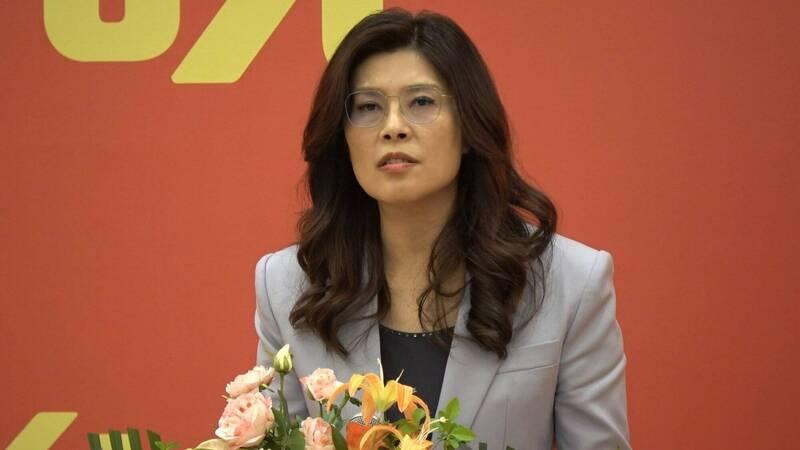
Photo: Taipei Times file photo
Mutually beneficial cross-strait relations are what the public on both sides long for, and that interactions and exchanges should be reciprocal, she said.
"I, Li-wun, sincerely hope that one day in the future, I will have the opportunity to be the host and welcome General Secretary Xi and all of you here present in Taiwan," she added, using Xi's title as head of the Chinese Communist Party (CCP).
Cheng told Xi she hoped that, through the efforts of both parties, the Taiwan Strait would no longer be a focal point of potential conflict and would certainly not become a "chessboard for outside forces to intervene in."
She said she hoped that the Taiwan Strait would become a waterway linking kinship, civilization and hope, with the two sides demonstrating to the world their wisdom in resolving differences and their compassion in contributing to peace and development.
The CCP and the KMT should work together to build a modern Chinese civilization as a model for global integration and prosperity, Cheng said.
Since former KMT chairman Lien Chan’s (連戰) landmark “peace trip” to China in 2005, which broke the ice, the two parties have taken a forward-looking historical perspective to promote reconciliation and peaceful development across the Strait, she said.
The future direction of cross-strait relations is a shared question, she said, adding that although interactions between the KMT and CCP over more than a century have had ups and downs, both sides have consistently sought the rejuvenation of the Chinese nation.
The “great rejuvenation of the Chinese nation” represents the shared revival of people on both sides, a renewed flourishing of Chinese civilization and a contribution to global peace and human progress, Cheng said.
She praised China’s development under Xi’s leadership, saying that it had completely alleviated poverty, built a moderately prosperous society and continued to advance.
While people on the two sides of the Strait live under different systems, they should respect one another and move toward each other, she said.
The so-called “1992 consensus,” a term former Mainland Affairs Council chairman Su Chi (蘇起) in 2006 admitted making up in 2000, refers to a tacit understanding between the KMT and the Chinese government that both sides of the Strait acknowledge there is “one China,” with each side having its own interpretation of what “China” means.
Additional reporting by Reuters

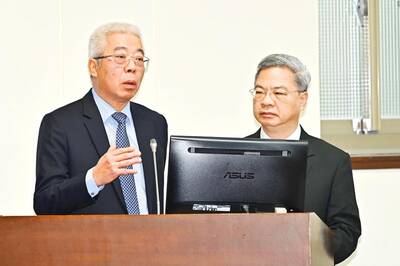
Taiwan has arranged for about 8 million barrels of crude oil, or about one-third of its monthly needs, to be shipped from the Red Sea this month to bypass the Strait of Hormuz and ease domestic supply pressures, CPC Corp, Taiwan (CPC, 台灣中油) said yesterday. The state-run oil company has worked with Middle Eastern suppliers to secure routes other than the Strait of Hormuz, through which about 20 percent of the world’s oil and liquefied natural gas typically passes, CPC chairman Fang Jeng-zen (方振仁) said at a meeting of the legislature’s Economics Committee in Taipei. Suppliers in Saudi Arabia have indicated they
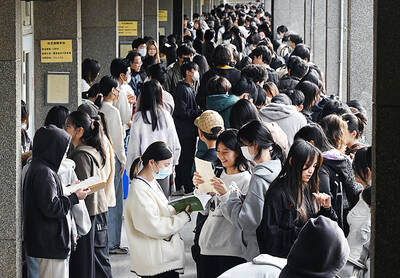
A global survey showed that 60 percent of Taiwanese had attained higher education, second only to Canada, the Ministry of the Interior said. Taiwan easily surpassed the global average of 43 percent and ranked ahead of major economies, including Japan, South Korea and the US, data from the Organisation for Economic Co-operation and Development (OECD) for 2024 showed. Taiwan has a high literacy rate, data released by the ministry showed. As of the end of last year, Taiwan had 20.617 million people aged 15 or older, accounting for 88.5 percent of the total population, with a literacy rate of 99.4 percent, the data
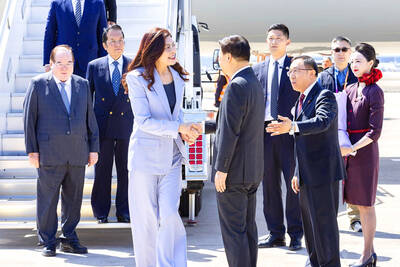
CCP ‘PAWN’? Beijing could use the KMT chairwoman’s visit to signal to the world that many people in Taiwan support the ‘one China’ principle, an academic said Chinese Nationalist Party (KMT) Chairwoman Cheng Li-wun (鄭麗文) yesterday arrived in China for a “peace” mission and potential meeting with Chinese President Xi Jinping (習近平), while a Taiwanese minister detailed the number of Chinese warships currently deployed around the nation. Cheng is visiting at a time of increased Chinese military pressure on Taiwan, as the opposition-dominated Legislative Yuan stalls a government plan for US$40 billion in extra defense spending. Speaking to reporters before going to the airport, Cheng said she was going on a “historic journey for peace,” but added that some people felt uneasy about her trip. “If you truly love Taiwan,

NEW LOW: The council in 2024 based predictions on a pessimistic estimate for the nation’s total fertility rate of 0.84, but last year that rate was 0.69, 17 percent lower An expected National Development Council (NDC) report expects the nation’s population to drop below 12 million by 2065, with the old-age dependency ratio to top 100 percent sooner than 2070, sources said yesterday. The council is slated to release its latest population projections in August, using an ultra-low fertility model, the sources said. The previous report projected that Taiwan’s population would fall to 14.37 million by 2070, but based on a new estimate of the total fertility rate (TFR) — the average number of children born to a woman over her lifetime — the population is expected to reach 12 million by


 RSS
RSS