


Israel and the US yesterday carried out a wave of attacks on Iran, killing at least 25 people and hitting the South Pars natural gas field, and Tehran responded with missile fire on Israel and its Gulf Arab neighbors. US President Donald Trump’s deadline for Tehran to reopen the Strait of Hormuz loomed as mediators circulated a new ceasefire proposal.
Explosions rang out in Tehran and low-flying jets could be heard for hours as the capital was pounded. Thick black smoke rose near the city’s Azadi Square after one airstrike hit the grounds of the Sharif University of Technology.
Among those killed in one of the attacks on Tehran was the head of intelligence for Iran’s paramilitary Revolutionary Guard, Major General Majid Khademi, Iranian state media and Israel’s minister of defense said.
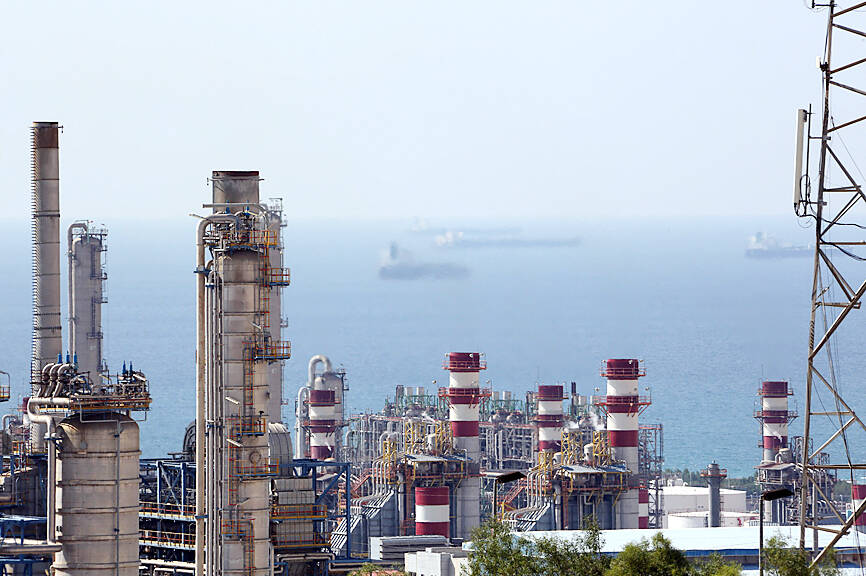
Photo: AFP
Another attack hit South Pars, the world’s largest gas field shared by Iran and Qatar, Iran’s semiofficial Fars news agency and other Iranian media reported, blaming both Israel and the US.
Neither immediately claimed responsibility for the attack on the offshore field, which Israel hit earlier in the war. After the earlier attack Trump said Israel would not hit South Pars again, but at the same time warned if Iran continued striking Qatar’s energy infrastructure the US would “massively blow up the entirety” of the field.
Iranian missiles hit the northern Israeli city of Haifa, where four people were found dead in the rubble of a residential building.
Kuwait, the United Arab Emirates and Saudi Arabia all activated their air defenses to intercept incoming Iranian missiles and drones, as Tehran kept up the pressure on its Gulf neighbors. Iran’s regular attacks on regional energy infrastructure and its stranglehold on the Strait of Hormuz, through which one-fifth of the world’s oil is shipped in peacetime, has sent global energy prices soaring.
Under pressure at home as consumers are growing increasingly concerned, Trump gave Tehran a deadline set to expire last night Washington time, saying if no deal was reached to reopen the strait, the US would hit Iran’s power plants and other infrastructure targets and send the country “back to the stone ages.”
“Tuesday will be Power Plant Day, and Bridge Day, all wrapped up in one, in Iran,” he wrote in a social media post, adding that if Iran did not open the strait “you’ll be living in Hell.”
In an effort to stop the fighting, Egyptian, Pakistani and Turkish mediators have sent Iran and the US a proposal calling for a 45-day ceasefire, and the reopening of the Strait of Hormuz to give time to try and find a way to end the war, two Mideast officials said.
Iran and the US have not responded to the proposal, sent late on Sunday night to Iranian Minister of Foreign Affairs Abbas Araghchi and US envoy to the Middle East Steve Witkoff, the officials said, speaking on condition of anonymity to discuss the private negotiations.
European Council President Antonio Costa called for diplomacy to be given a chance, writing on X that “any targeting of civilian infrastructure, namely energy facilities, is illegal and unacceptable.”
“Escalation will not achieve a ceasefire and peace,” he said. “Only negotiations will, namely the ongoing efforts led by regional partners.”
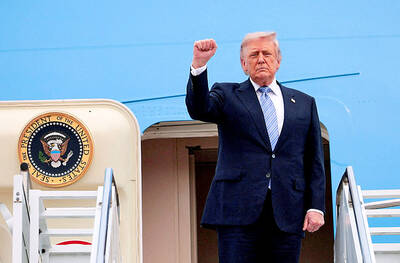
US-CHINA SUMMIT: MOFA welcomed US reassurance of no change in its Taiwan policy; Trump said he did not comment when Xi talked of opposing independence US President Donald Trump yesterday said he has not made a decision on whether to move forward with a major arms package for Taiwan after hearing concerns about it from Chinese President Xi Jinping (習近平). Trump’s comments on Taiwan came as he flew back to Washington after wrapping up critical talks in which both leaders said important progress was made in stabilizing US-China relations even as deep differences persist between the world’s two biggest powers on Iran and Taiwan. “I will make a determination,” Trump said, adding: “I’ll be making decisions. But, you know, I think the last thing we need right
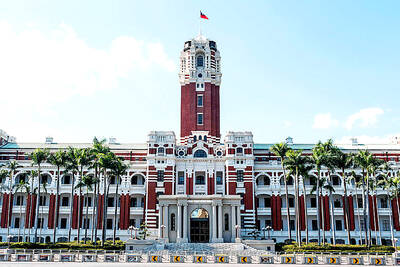
SECURITY: Taipei presses the US for arms supplies, saying the arms sales are not only a reflection of the US security commitment to Taiwan but also serve as a mutual deterrent against regional threats Taiwan is committed to preserving the cross-strait “status quo” and contributing to regional peace and stability, the Presidential Office said yesterday. “It is an undeniable fact that the Republic of China is a sovereign and independent democratic nation,” Presidential Office spokeswoman Karen Kuo (郭雅慧) reiterated, adding that Beijing has no right to claim sovereignty over Taiwan. The statements came after US President Donald Trump warned against Taiwanese independence. Trump wrapped up a state visit to Beijing on Friday, during which Chinese President Xi Jinping (習近平) had pressed him not to support Taiwan. Taiwan depends heavily on US security backing to deter China from carrying
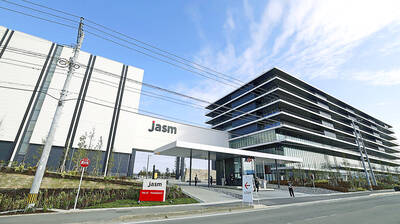
The subsidiary of Taiwan Semiconductor Manufacturing Co (TSMC, 台積電) in Kumamoto, Japan, turned a profit in the first quarter of this year, marking the first time the first fab of the unit has become profitable since mass production started at the end of 2024. According to the contract chipmaker’s financial statement released on Friday, Japan Advanced Semiconductor Manufacturing Inc (JASM), a joint venture running the fab in Kumamoto, posted NT$951 million (US$30.19 million) in profit in the January-to-March period, compared with a loss of NT$1.39 billion in the previous quarter, and a loss of NT$3.25 billion in the first quarter of
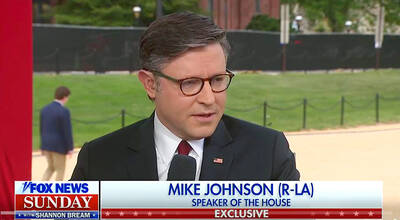
RESOLUTE BACKING: Two Republican senators are planning to introduce legislation that would impose immediate sanctions on China if it attempts to invade Taiwan US House of Representatives Speaker Mike Johnson on Sunday reaffirmed US congressional support for Taiwan, saying the US and “all freedom-loving people” have a stake in preventing China from seizing Taiwan by force. Johnson made the remarks in an interview with Fox News Sunday on US President Donald Trump’s summit with Chinese President Xi Jinping (習近平) last week. In an interview that aired on Friday on Fox News, just as Trump wrapped up a high-stakes visit to China, he said he has yet to green-light a new US$14 billion arms package to Taiwan and that it “depends on China.” “It’s a very good


 RSS
RSS