


A restart plan for the Guosheng Nuclear Power Plant in New Taipei City’s Wanli District (萬里) and the Ma-anshan Nuclear Power Plant in Pingtung County’s Hengchun Township (恆春) would be submitted to the Nuclear Safety Commission by the end of the month, President William Lai (賴清德) said yesterday, reversing the government’s policy to abolish nuclear energy.
On May 17 last year, Taiwan shut down its last nuclear reactor and became the first non-nuclear nation in East Asia, fulfilling the Democratic Progressive Party (DPP) government’s pledge of a “nuclear-free homeland.”
Even without nuclear power, Taiwan can maintain a stable electricity supply until 2032, with daily reserve margins consistently above 10 percent, Lai said.
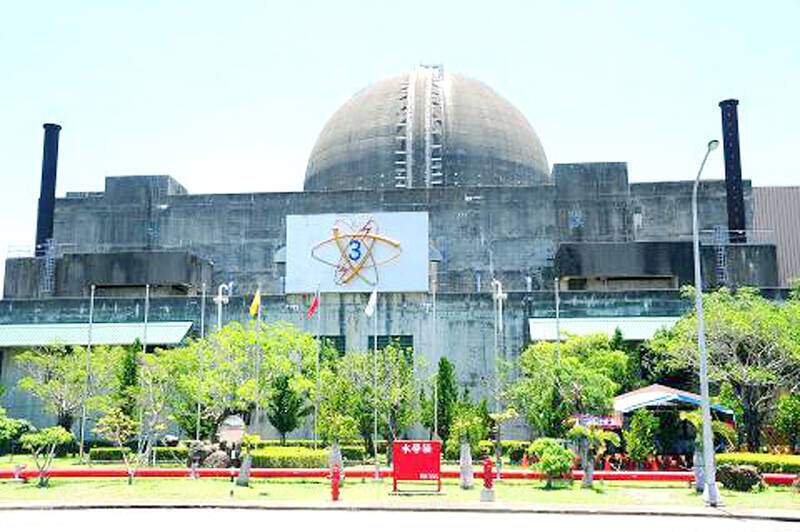
Photo: Tsai Tsung-hsien, Taipei Times
However, to comply with recent changes to the law, robust economic development, the international community’s need for low-carbon electricity and the power demands of the artificial intelligence era, the government is considering restarting nuclear power, he said during a gathering of business leaders hosted by the Entrepreneurs Club in Taichung.
Lai was referring to the Legislative Yuan’s amendments to the Nuclear Reactor Facilities Regulation Act (核子反應器設施管制法) last year.
The amendments provide a legislative basis for the continuation of nuclear power plant operations even after entering the decommissioning stage.

Photo: CNA
The Guosheng Nuclear Power Plant and the Ma-anshan Nuclear Power Plant were selected for the restart plan after Taiwan Power Co’s (Taipower, 台電) preliminary evaluations found the plants fit for reactivation, Lai said.
GE Aerospace and Westinghouse Electric would assist Taipower in conducting the safety audits to clear the way for the plants’ restart proposals, he added.
Lai reiterated that nuclear safety, nuclear waste disposal and public consensus are the three key factors the Nuclear Safety Commission would consider.
Sources said Taipower plans to submit the restart plan for the Ma-anshan Nuclear Power Plant to the Nuclear Safety Commission on Friday.
Taipower is carrying out preparatory work and implementing the plan, but the plant can only resume operations once the results are reviewed and licensed, they said.
How long the plant would operate after the restart would depend on the safety inspections, they said, adding that Taipower would first order a batch of new fuel rods, sufficient for at least 1.5 years of operation.
The company must procure these new fuel rods by the end of the year if it aims to restart the plant in 2028, they said.
Guosheng Nuclear Power Plant personnel should begin removing fuel rods from the reactor core by the end of the year, sources said.
The overall schedule is roughly one year behind the Ma-anshan Nuclear Power Plant, with a restart possible as early as 2029, they said.
In other news, Lai said Taiwan must be fully prepared, as it is unclear how long the conflict in the Middle East could last.
The nation’s legally required oil reserves cover about 90 days, and current reserves exceed 100 days, “so there is no problem,” Lai said.
As for natural gas, the legal storage requirement is 11 days, and Taiwan has enough for 12 to 14 days, he added.
Oil and gas supplies for next month are sufficient, and purchases from the US would arrive in June, he said.
Additional reporting by CNA
See STORIES on page 2

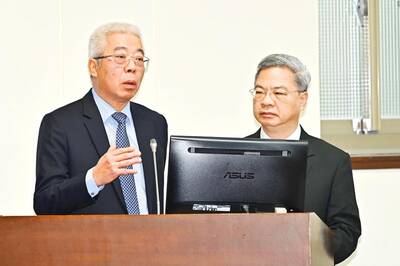
Taiwan has arranged for about 8 million barrels of crude oil, or about one-third of its monthly needs, to be shipped from the Red Sea this month to bypass the Strait of Hormuz and ease domestic supply pressures, CPC Corp, Taiwan (CPC, 台灣中油) said yesterday. The state-run oil company has worked with Middle Eastern suppliers to secure routes other than the Strait of Hormuz, through which about 20 percent of the world’s oil and liquefied natural gas typically passes, CPC chairman Fang Jeng-zen (方振仁) said at a meeting of the legislature’s Economics Committee in Taipei. Suppliers in Saudi Arabia have indicated they
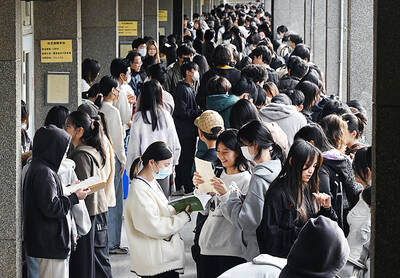
A global survey showed that 60 percent of Taiwanese had attained higher education, second only to Canada, the Ministry of the Interior said. Taiwan easily surpassed the global average of 43 percent and ranked ahead of major economies, including Japan, South Korea and the US, data from the Organisation for Economic Co-operation and Development (OECD) for 2024 showed. Taiwan has a high literacy rate, data released by the ministry showed. As of the end of last year, Taiwan had 20.617 million people aged 15 or older, accounting for 88.5 percent of the total population, with a literacy rate of 99.4 percent, the data

CCP ‘PAWN’? Beijing could use the KMT chairwoman’s visit to signal to the world that many people in Taiwan support the ‘one China’ principle, an academic said Chinese Nationalist Party (KMT) Chairwoman Cheng Li-wun (鄭麗文) yesterday arrived in China for a “peace” mission and potential meeting with Chinese President Xi Jinping (習近平), while a Taiwanese minister detailed the number of Chinese warships currently deployed around the nation. Cheng is visiting at a time of increased Chinese military pressure on Taiwan, as the opposition-dominated Legislative Yuan stalls a government plan for US$40 billion in extra defense spending. Speaking to reporters before going to the airport, Cheng said she was going on a “historic journey for peace,” but added that some people felt uneasy about her trip. “If you truly love Taiwan,

NEW LOW: The council in 2024 based predictions on a pessimistic estimate for the nation’s total fertility rate of 0.84, but last year that rate was 0.69, 17 percent lower An expected National Development Council (NDC) report expects the nation’s population to drop below 12 million by 2065, with the old-age dependency ratio to top 100 percent sooner than 2070, sources said yesterday. The council is slated to release its latest population projections in August, using an ultra-low fertility model, the sources said. The previous report projected that Taiwan’s population would fall to 14.37 million by 2070, but based on a new estimate of the total fertility rate (TFR) — the average number of children born to a woman over her lifetime — the population is expected to reach 12 million by


 RSS
RSS