


The Ministry of the Interior has announced subsidy standards for measures aimed at bolstering national security and resilience, with a NT$6.25 billion (US$195.8 million) budget earmarked.
Following the passage of the special resilience act at the legislature last year, the ministry outlined details of the regulations for the implementation of the act.
For disaster response and life-support equipment, the ministry has allocated NT$1.58 billion to assist local governments in establishing 368 disaster coordination centers nationwide, and equipping 7,748 villages with emergency disaster-response and life-sustaining equipment.
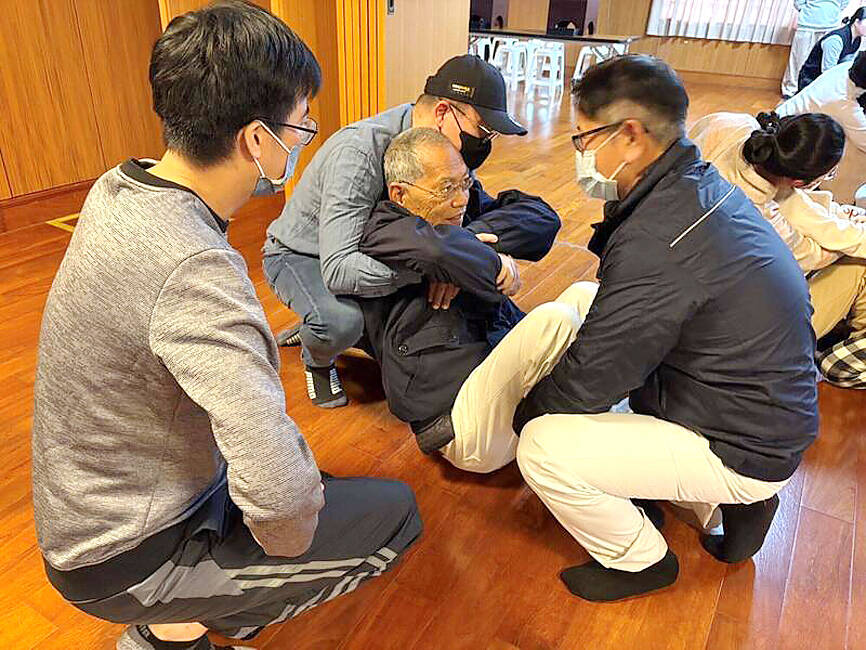
Photo courtesy of the Taichung Civil Affairs Bureau
Local governments can receive up to NT$1.1 million for each disaster prevention collaboration center, while villages can receive up to NT$150,000 per site.
The ministry has also allocated NT$732 million to improve existing air-raid shelter spaces and equipment in public buildings, along with NT$482.6 million for the procurement of supplies and improvements, as part of a broader effort to enhance whole-of-society defense resilience.
For air-raid shelter facilities, NT$1.25 billion is earmarked to subsidize local governments in upgrading fire-resistant shelters and equipment in public buildings.
Of the funding, up to NT$732 million would be used for construction and engineering work to improve existing shelter spaces in public buildings, including design and supervision costs.
A total of NT$482.6 million is allocated to subsidize the procurement of supplies and equipment, as well as spatial upgrades, calculated at up to NT$1,000 per person based on the shelter’s capacity, subject to review of needs.
Meanwhile, NT$3.41 billion is earmarked for counterterrorism capabilities and protection of critical infrastructure.
The funding would be used to expand and upgrade equipment for the National Police Agency Special Operations Group and to procure gear for police tasked with protecting key infrastructure.
A total of NT$1.99 billion is allocated for subsidizing the installation of anti-drone systems, aimed at bolstering counterterrorism capabilities and improving the security of critical infrastructure.
The government last year proposed the Special Statute on Strengthening the Resilience of the Economy, Society, and National Security in Response to International Developments in response to the US tariffs.
The act took effect on March 12 last year and is to remain in force until Dec. 31 next year.
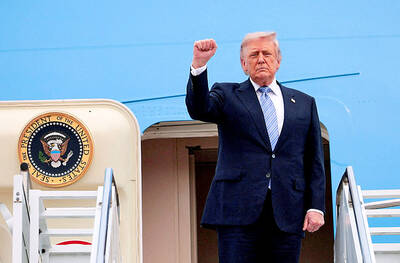
US-CHINA SUMMIT: MOFA welcomed US reassurance of no change in its Taiwan policy; Trump said he did not comment when Xi talked of opposing independence US President Donald Trump yesterday said he has not made a decision on whether to move forward with a major arms package for Taiwan after hearing concerns about it from Chinese President Xi Jinping (習近平). Trump’s comments on Taiwan came as he flew back to Washington after wrapping up critical talks in which both leaders said important progress was made in stabilizing US-China relations even as deep differences persist between the world’s two biggest powers on Iran and Taiwan. “I will make a determination,” Trump said, adding: “I’ll be making decisions. But, you know, I think the last thing we need right
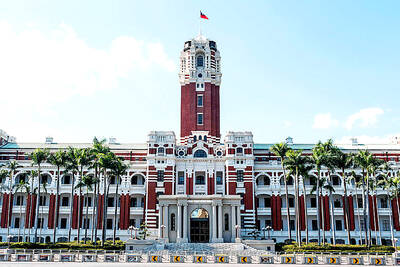
SECURITY: Taipei presses the US for arms supplies, saying the arms sales are not only a reflection of the US security commitment to Taiwan but also serve as a mutual deterrent against regional threats Taiwan is committed to preserving the cross-strait “status quo” and contributing to regional peace and stability, the Presidential Office said yesterday. “It is an undeniable fact that the Republic of China is a sovereign and independent democratic nation,” Presidential Office spokeswoman Karen Kuo (郭雅慧) reiterated, adding that Beijing has no right to claim sovereignty over Taiwan. The statements came after US President Donald Trump warned against Taiwanese independence. Trump wrapped up a state visit to Beijing on Friday, during which Chinese President Xi Jinping (習近平) had pressed him not to support Taiwan. Taiwan depends heavily on US security backing to deter China from carrying
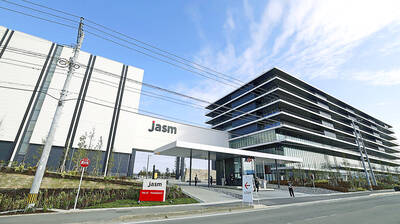
The subsidiary of Taiwan Semiconductor Manufacturing Co (TSMC, 台積電) in Kumamoto, Japan, turned a profit in the first quarter of this year, marking the first time the first fab of the unit has become profitable since mass production started at the end of 2024. According to the contract chipmaker’s financial statement released on Friday, Japan Advanced Semiconductor Manufacturing Inc (JASM), a joint venture running the fab in Kumamoto, posted NT$951 million (US$30.19 million) in profit in the January-to-March period, compared with a loss of NT$1.39 billion in the previous quarter, and a loss of NT$3.25 billion in the first quarter of
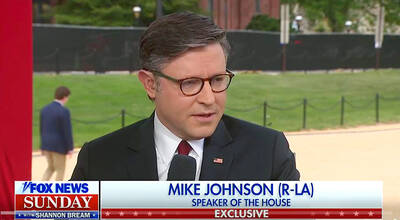
RESOLUTE BACKING: Two Republican senators are planning to introduce legislation that would impose immediate sanctions on China if it attempts to invade Taiwan US House of Representatives Speaker Mike Johnson on Sunday reaffirmed US congressional support for Taiwan, saying the US and “all freedom-loving people” have a stake in preventing China from seizing Taiwan by force. Johnson made the remarks in an interview with Fox News Sunday on US President Donald Trump’s summit with Chinese President Xi Jinping (習近平) last week. In an interview that aired on Friday on Fox News, just as Trump wrapped up a high-stakes visit to China, he said he has yet to green-light a new US$14 billion arms package to Taiwan and that it “depends on China.” “It’s a very good


 RSS
RSS