


The military exercises China staged around Taiwan last week were provocative and revealed Beijing’s “unacceptable attitude” that threatens “peaceful coexistence across the Taiwan Strait,” Member of the European Parliament (MEP) Michael Gahler said yesterday.
Alluding to global geopolitical challenges, Gahler said while meeting President William Lai (賴清德) at the Presidential Office in Taipei that “many certainties that we have had over decades seem to be fading away,” without going into detail.
Against this backdrop, Gahler, who chairs the European Taiwan Friendship Group, underlined the importance of the European Parliament and democracies worldwide speaking out about maintaining peace in the Taiwan Strait, a condition Gahler said China has attempted to alter.
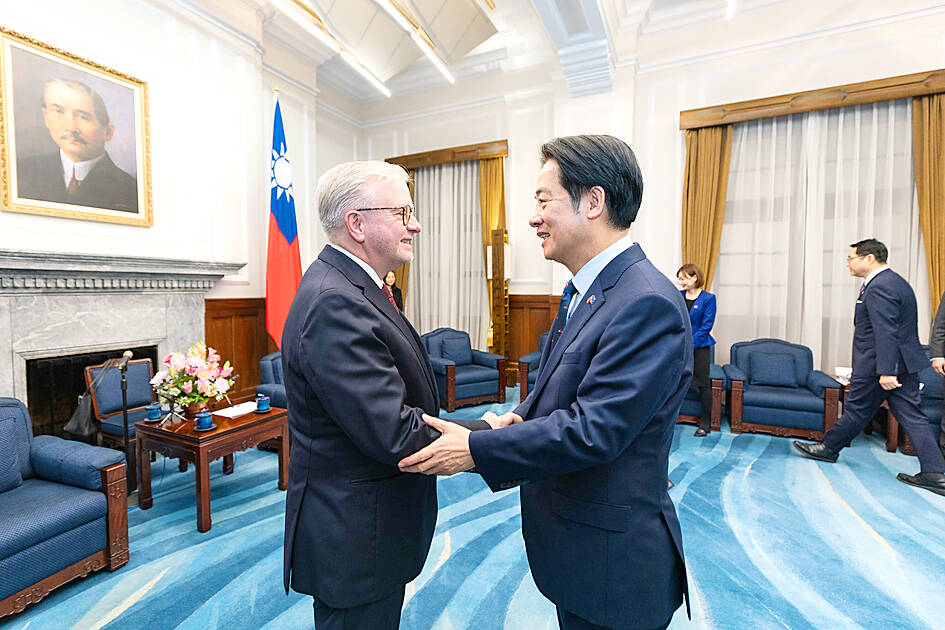
Photo courtesy of the Presidential Office
“The Taiwan Strait is an international strait, and it’s good that different countries demonstrate that by sending ships through the Strait and making it clear that we do not accept a unilateral change of the status quo,” said Gahler, who is leading a 10-member group on a six-day visit to Taiwan until Friday.
Gahler said the international community has strongly condemned Beijing’s “belligerent and aggressive posture,” as witnessed in last week’s large-scale military drills in the waters and airspace around Taiwan.
“This is such a provocation and an unacceptable attitude that endangers the peaceful coexistence across the Strait,” he said.
One common challenge facing Taiwan and Europe is the “unlawful and unfriendly” sabotage of undersea communications cables, he said, adding that his delegation exchanged opinions on this issue with Taiwanese officials on Monday.
Lai said that due to China’s incessant military intimidation and harassment of Taiwan, and its coercion through economic and diplomatic avenues, many Taiwanese have embraced the adage of “peace through strength.”
Only by democracies working together can democratic values and the rules-based international order be upheld, he said.
Lai also highlighted progress in Taiwan-Europe interactions, including the Formosa Club holding its annual conference in Taiwan for the first time last year and Vice President Hsiao Bi-khim (蕭美琴) addressing the European Parliament at the invitation of the Inter-Parliamentary Alliance on China in November last year.
The parliament’s staunch support for Taiwan over the years has “sent the clear message to the international community that the virtuous never stand alone,” he said.
During the trip, the delegation is to meet with representatives of Taiwan’s semiconductor industry, and hold talks with specialists on a range of issues, including countering misinformation and cyberattacks, hybrid security threats, Taiwan-EU economic and trade cooperation, and situations in the Indo-Pacific region and the Taiwan Strait, the Ministry of Foreign Affairs said last week.
The delegation is also scheduled to visit outlying Kinmen County, it said.
In addition to Gahler, the delegation includes MEPs Sven Simon, Wouter Beke, Christophe Gomart, Marion Walsmann, Iuliu Winkler, Michal Szczerba and Jan Farsky.
Additional reporting by Kayleigh Madjar
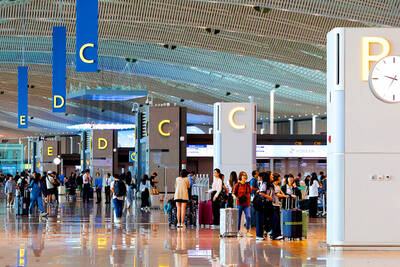
South Korea has adjusted its electronic arrival card system to no longer list Taiwan as a part of China, a move that the Ministry of Foreign Affairs said would help facilitate exchanges between the two sides. South Korea previously listed “Taiwan” as “Taiwan (China)” in the drop-down menus of its online arrival card system, where people had to fill out where they came from and their next destination. The ministry had requested South Korea make a revision and said it would change South Korea’s name on Taiwan’s online immigration system from “Republic of Korea” to “Korea (South),” should the issue not be

The Legislative Yuan’s Finance Committee yesterday approved proposed amendments to the Amusement Tax Act (娛樂稅法) that would abolish taxes on films, cultural activities and competitive sporting events, retaining the fee only for dance halls and golf courses. The proposed changes would set the maximum tax rate for dance halls and golf courses at 50 and 20 percent respectively, with local governments authorized to suspend the levies. Article 2 of the act says that “amusement tax shall be levied on tickets sold or fees charged by amusement places, facilities or activities” in six categories: “Cinema; professional singing, story-telling, dancing, circus, magic show, acrobatics

Tainan, Taipei and New Taipei City recorded the highest fines nationwide for illegal accommodations in the first quarter of this year, with fines issued in the three cities each exceeding NT$7 million (US$220,639), Tourism Administration data showed. Among them, Taipei had the highest number of illegal short-term rental units, with 410. There were 3,280 legally registered hotels nationwide in the first quarter, down by 14 properties, or 0.43 percent, from a year earlier, likely indicating operators exiting the market, the agency said. However, the number of unregistered properties rose to 1,174, including 314 illegal hotels and 860 illegal short-term rental
INFLATION UP? The IMF said CPI would increase to 1.5 percent this year, while the DGBAS projected it would rise to 1.68 percent, with GDP per capita of US$44,181 The IMF projected Taiwan’s real GDP would grow 5.2 percent this year, up from its 2.1 percent outlook in January, despite fears of global economic disruptions sparked by the US-Iran conflict. Taiwan’s consumer price index (CPI) is projected to increase to 1.5 percent, while unemployment would be 3.4 percent, roughly in line with estimates for Asia as a whole, the international body wrote in its Global Economic Outlook Report published in the US on Monday. The figures are comparatively better than the IMF outlook for the rest of the world, which pegged real GDP growth at 3.1 percent, down from 3.3 percent


 RSS
RSS