


Minister of Foreign Affairs Lin Chia-lung (林佳龍) has been invited to the 12th Warsaw Security Forum in Poland to deliver a keynote speech on the “Reinvention of Global Democratic Supply Chains,” the Ministry of Foreign Affairs said yesterday.
The ministry quoted Lin as saying that through the visit, he hopes to have meaningful exchanges with European partners, and show Europe the importance of Taiwan.
Lin also hopes to push for closer Taiwan-Europe cooperation, the ministry added.
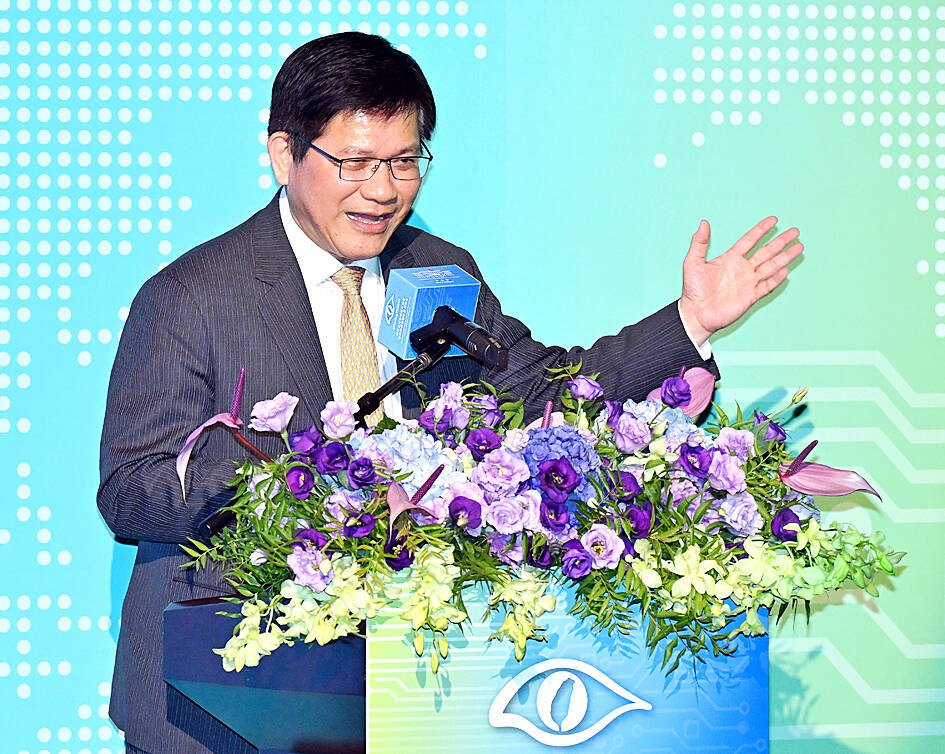
Photo: Liao Chen-huei, Taipei Times
Lin, who departed for Poland on Saturday, plans meet with friends and exchange ideas in Europe, share Taiwan’s values of democracy, peace and prosperity, deepen Taiwan international connections, and promote the nation’s “integrated diplomacy” foreign policy, the foreign ministry said.
In addition to having meaningful exchanges with European partners, Lin also wrote on Facebook that he also hopes to leverage the strengths of think tank diplomacy to broaden Taiwan’s international space.
Since its establishment in 2014, the Warsaw Security Forum has become the most influential dialogue platform on security and foreign policy in central and eastern Europe, he said.
The forum has become increasingly important in recent years, as the Russian authoritarian regime has been expanding, severely threatening Europe’s security, and central and eastern Europe is at the front line of the threat, he added.
Lin said he brings the public’s expectations with him on the trip, hoping to let Europe see Taiwan’s importance, including how Taiwan is protecting democracy and freedom, and contributing to maintaining peace and stability in the Indo-Pacific region, and global prosperity.
Lin said he also looks forward to closer cooperation between Taiwan and Europe, and through Taiwanese industries’ technological capability, manufacturing capacity and flexibility, assist Europe help its reindustrialization goals amid US-China competition, and maintain the rules-based international order.
Poland has been very supportive for Taiwan in recent years, Democratic Progressive Party Legislator Michelle Lin (林楚茵), chairwoman of the Taiwan-Poland inter-parliamentary amity association, said yesterday.
Poland is willing to allow Lin to make his itinerary public before his departure, she said.
While Lin’s previous visits focused on trade and culture, his attendance at the Warsaw Security Forum is more symbolic, said Wang Hung-jen (王宏仁), executive director of the Institute for National Policy Research.
Lin’s trip is expected to counterbalance Chinese Minister of Foreign Affairs Wang Yi’s (王毅) visit to Poland earlier this month, and highlight the similar challenges faced by Taiwan and Poland when dealing with China’s and Russia’s “gray zone” tactics, he said.
This would mean the geopolitical location of the Taiwan Strait and Russia’s invasion has made European countries empathize with security issues in the Strait, said Su Tzu-yun (蘇紫雲), a researcher at the state-run Institute for National Defense and Security Research (INDSR).
Lin’s plan to participate in the forum as foreign minister should be treated in a normal way, he said.
The invitation for Lieutenant General Hsieh Jih-sheng (謝日升), deputy chief of the ministry’s Office of the Deputy Chief of General Staff for Intelligence, to take part in the forum, represented a shift in practice, he said.
In the past, Taiwan was usually represented by military think tanks, such as the INDSR, he said.
The participation of an active high-ranking general indicated a dual-track approach that combines military and diplomatic efforts, he said, calling it a major breakthrough in Taiwan’s diplomatic space.

‘NO SECURITY RISK’: The Railway Bureau reassured the public that the technicians’ activities were limited to technical guidance and did not involve sensitive systems The Railway Bureau yesterday said it had invited eight Chinese technicians to assist with an airport MRT construction project. The bureau issued the confirmation after an Internet user said Chinese nationals had entered the construction zone of Taiwan Taoyuan International Airport’s Terminal 3 project. They asked why “individuals from an enemy state” were allowed access to such a major national infrastructure project, which raised serious concerns over Taiwan’s industrial safety, sensitive systems and information security. The bureau’s Northern Region Engineering Branch Office said subcontractor Taiwan Handle Industrial Co (台灣手把工業) of the Taoyuan airport MRT’s “Contract No. CU05 Project A14 Station Civil, MEP &

A US uncrewed surface vessel (USV) encountered multiple Chinese warships during an autonomous transit of the Taiwan Strait, US defense company Seasats said in a statement on Wednesday. Seasats announced that a Lightfish USV had completed the first autonomous transit of the Taiwan Strait. Over five days, the USV traversed the entire length of the Strait while constantly monitoring surface vessel traffic, the company said. The Lightfish encountered multiple Chinese warships, one of which was a Chinese People’s Liberation Army Navy (PLAN) Type 056 corvette, it said. The Chinese vessels were operating “well within Taiwan’s exclusive economic zone without transmitting their identity via the
‘BOOMING’: ’ The number of partners we have here is incredible. You can see from their stock prices. They’re doing so well, they’re so happy,’ Jensen Huang said Nvidia Corp’s spending in Taiwan has ballooned to about US$150 billion a year, 10 times the US$10 billion to US$15 billion the company spent five years ago, Nvidia chief executive officer Jensen Huang (黃仁勳) said yesterday, suggesting Taiwan’s strategic importance in the global artificial intelligence (AI) supply chain. “Taiwan is the epicenter of the AI revolution. This is where the chips come, packaging comes. This is where the systems are made. This is where AI supercomputers were created,” Huang said at a meeting for the company’s employees in Beitou-Shilin Technology Park (北投士林科技園區) in Taipei, the planned site of Nvidia’s Taipei headquarters. “Taiwan
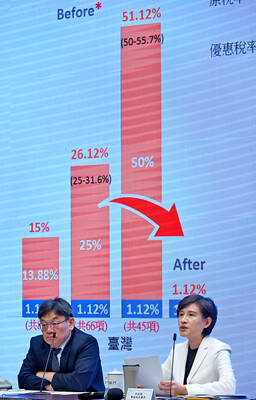
GREATER REACH? Auto parts and wood products would face tariffs of up to 15%, matching those targeting the EU, Japan and South Korea, Vice Premier said The US has announced that preferential tariff treatment for Taiwan’s non-semiconductor Section 232 goods would take effect retroactively from May 1, the Executive Yuan said yesterday. The US government yesterday posted a notice on the Federal Register’s public inspection Web site previewing tariff concessions for Taiwan under a memorandum of understanding (MOU) on Taiwan-US investment after two months of negotiations. The MOU signed on Jan. 15 stipulated three major preferential tariff arrangements: a 15 percent “reciprocal” tariff rate for Taiwan without stacking most-favored nation (MFN) rates; preferential Section 232 treatment for semiconductors and related products; and preferential Section 232 treatment for non-semiconductor


 RSS
RSS