


China should restrain itself and refrain from being a troublemaker that sabotages peace and stability in the Indo-Pacific region, President William Lai (賴清德) said yesterday.
Lai made the remarks after China Coast Guard vessels sailed into disputed waters off the Senkaku Islands — known as the Diaoyutai Islands (釣魚台) in Taiwan — following a remark Japanese Prime Minister Sanae Takaichi made regarding Taiwan.
Takaichi during a parliamentary session on Nov. 7 said that a “Taiwan contingency” involving a Chinese naval blockade could qualify as a “survival-threatening situation” for Japan, and trigger Tokyo’s deployment of its military for defense.
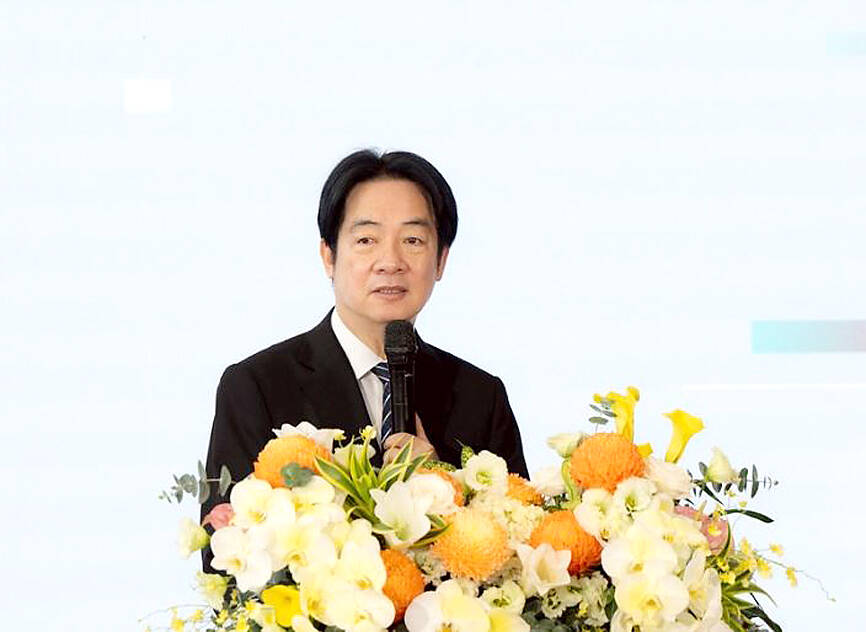
Photo: screen grab from the Presidential Office’s Flickr page
Asked about the escalating tensions between Japan and China, Lai said that Beijing’s “hybrid coercion” against Japan has seriously disrupted peace and stability in the Indo-Pacific region.
The international community should continue to pay attention to the matter, he said.
Lai also urged China to restrain itself and act like a major power by keeping the rules-based international order to maintain regional peace, stability and prosperity, instead of being a “troublemaker.”
Asked about the Chinese Nationalist Party’s (KMT) criticism of Takaichi as being “reckless,” Lai told reporters that US Ambassador to Japan George Glass has publicly expressed his support, saying Takaichi’s remarks benefit not only US-Japan ties, but also regional peace and stability.
Politicians in Taiwan, particularly those in the opposition, should respect Japan’s internal affairs and be aware of regional developments, he said, adding that it is inappropriate to negatively interpret Japan’s political efforts.
Asked about China’s threats against Democratic Progressive Party Legislator Puma Shen (沈伯洋), Lai condemned Beijing’s transnational repression and attempts to interfere with Taiwan’s constitutional system.
Such violence is intolerable to the global community and democratic countries would certainly voice support for Shen, he said.
“That is why I urged Legislative Speaker Han Kuo-yu (韓國瑜) to speak out to defend the legislature’s dignity and freedom of speech,” the president said.
“That is not to take advantage of Shen or use the issue to engage in political infighting. It is simply because Shen is a member of the legislature and one must adopt the right attitude” on the matter,” he said.
In response to Lai’s call, Han on Wednesday last week compared Taiwan’s national security to a table supported by “four legs,” which he said are “defending the Republic of China (ROC, Taiwan), defending democracy and freedom, maintaining US-Taiwan ties and maintaining cross-strait ties.”
“Except for the US-Taiwan relationship, Lai had already broken the three other legs,” Han said at the time.
Lai yesterday said that he hoped Han realizes that Chinese transnational repression of any person living in Taiwan is a violation of ROC sovereignty.
China has continued to ramp up military coercion, infiltration campaigns and “united front” work against Taiwan over the past few years, he said.
Most countries think that it is China — rather than Taiwan — that is undermining cross-strait peace and stability, Lai said, adding that Beijing has seized every opportunity to play Taiwan off against the US by spreading a “US skepticism” narrative.
“It is China, instead of Taiwan, that has chopped off the four legs of Han’s table,” he added.
Han should not make excuses for aggressors, he said.
“Competition is inevitable, as we belong to different political parties, but we still belong to the same country and should unite to fight represssion by hostile, external political forces,” he said. “If we make excuses for Chinese cross-border repression today, that would give Beijing an excuse if it decides to launch an invasion against Taiwan.”
Additional reporting by Chiang Chih-hsiung

A signaling system malfunction disrupted high-speed rail (HSR) services beginning at 8am today, with trains temporarily reduced to three northbound and three southbound trains per hour as authorities conduct inspections. The malfunction occurred on a section of track in Miaoli County during pre-operation checks early this morning, forcing northbound and southbound trains to use a single track, the HSR operator said. The regular schedule has been replaced with three hourly trains offering only nonreserved seating in each direction, stopping at every station, it said, adding that business class cars would still have reserved seating. Departures from terminal stations are scheduled at the top

DRONE CENTRAL: Taiwan aims to become Asia’s democratic hub for drones, with most exports focused on high-quality military-grade models, an official said Taiwan’s drone industry is expected to expand significantly by 2030, producing 100,000 units per month and exporting half of them, the Ministry of Economic Affairs said yesterday. Current drone production capacity is about 15,000 units per month, but the industry can quickly scale up as demand increases, Industrial Development Administration Director-General Chiou Chyou-huey (邱求慧) told a news conference in Taipei. Taiwan’s drone output grew 2.5-fold last year to NT$12.9 billion (US$408.3 million) under a government program to develop the uncrewed vehicle sector, he said. The Executive Yuan in October last year approved plans to invest NT$44.2 billion into domestic production of uncrewed aerial

Taiwan is still in the process of assessing the possibility of recruiting workers from Eswatini, the Ministry of Foreign Affairs said yesterday, adding that its goal is to help Eswatini upgrade its vocational training centers. If there are plans to recruit workers from Eswatini, safeguarding national security, protecting public health and ensuring the employment rights of Taiwanese would be prerequisites, Department of West Asian and African Affairs Director-General Yen Chia-liang (顏嘉良) told a news conference. Key considerations would also include filling labor shortages in specific industries, and fostering bilateral professional and technical exchanges, he said. Yen was asked about the progress of labor

VERBOSE VESSELS: A CGA cutter and a China Coast Guard exchanged verbal barbs for more than a day in Taiwanese-controlled waters before the Chinese vessel left The Taiwanese and Chinese coast guards had a standoff near the strategically located Pratas Islands (Dongsha Islands, 東沙群島) in the north of the South China Sea, the Coast Guard Administration (CGA) said yesterday. The two sides engaged in intense radio exchanges over sovereignty claims during the 33-hour standoff. China Coast Guard vessel 3501 eventually left the restricted waters, 26.6 nautical miles (49.2km) west of the Pratas Islands, at 5pm yesterday, the CGA said. Lying approximately between southern Taiwan and Hong Kong, the Taiwan-controlled Pratas are seen by some security experts as vulnerable to Chinese attack due to their distance — more than


 RSS
RSS