


Nvidia Corp CEO Jensen Huang (黃仁勳) on Saturday praised and lightly cajoled his major Taiwanese suppliers to produce more to help power strong demand for artificial intelligence (AI), capping a visit to the country of his birth, where he has been mobbed by adoring fans at every step.
Speaking at an impromptu press conference in the rain outside a Taipei restaurant, where he had hosted suppliers for a “trillion-dollar dinner,” named after the market capitalization of those firms attending, Huang said this would be another good year for business.
“TSMC needs to work very hard this year because I need a lot of wafers,” he said, laughing, referring to Taiwan Semiconductor Manufacturing Co (台積電), the world’s largest producer of advanced chips used in artificial-intelligence applications.
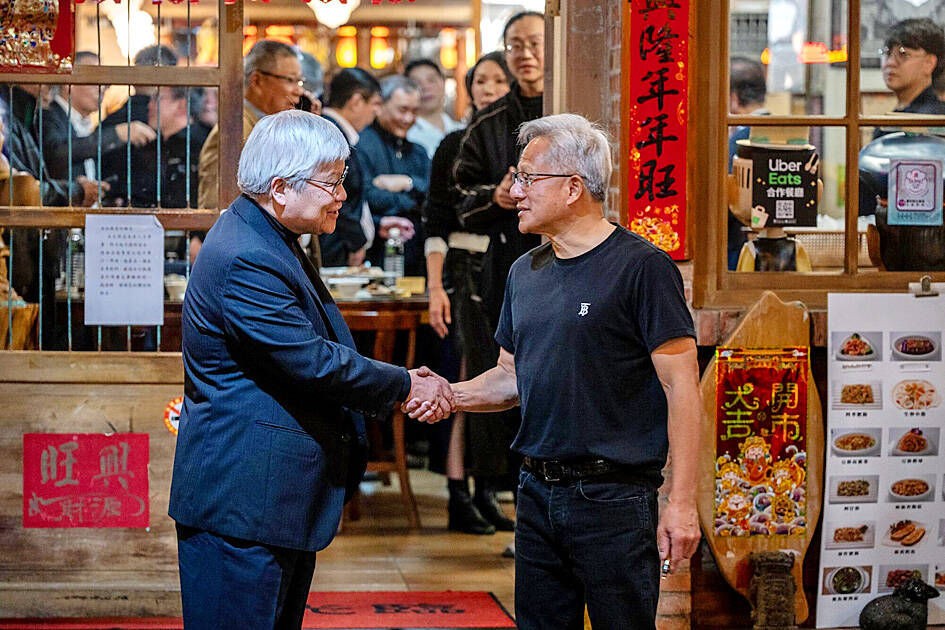
Photo: Lam Yik Fei, Bloomberg
“TSMC is doing an incredible job and they’re working very, very hard. We have a lot of demand this year,” he added after taking pictures with a beaming TSMC CEO C.C. Wei (魏哲家).
“Over the next 10 years, TSMC will likely increase their capacity by much more than 100 percent, and so this is a very substantial scale-up in the next decade,” he said.
Wei did not answer questions from reporters.
Last month, TSMC said capital spending could jump as much as 37 percent this year to US$56 billion, and would increase “significantly” in 2028 and 2029 given AI demand.
Huang, who emigrated to the US as a child, is met by a throng of adoring fans whenever he returns to Taiwan.
Huang cofounded California-based Nvidia in 1993. Last year, it became the first company to breach US$5 trillion in market value, continuing a meteoric rise that has firmly positioned it at the heart of the global AI revolution.
In Taipei, he expressed concern about supplies of memory chips, which support AI workloads, amid a production crunch.
“We need a lot of memory this year,” he said. “I think that the entire supply chain is challenging this year because demand is so much more.”
Huang periodically stepped out of the dinner, attended by two dozen executives, including Young Liu (劉揚偉), chairman of contract-electronics maker Hon Hai Precision Industry Co (鴻海), Nvidia’s biggest server maker, to greet his fans and sign autographs.
“We have so many partners here in Taiwan. Nvidia won’t be possible without Taiwan. There’s magic in this island. The companies here have extraordinary technology, they’ve incredible culture,” he said when asked about how he felt about his movie star-like fame whenever he visits. “I’m really proud of Taiwan.”
Other Taiwanese tech executives attending the dinner included Quanta Computer Inc (廣達) chairman Barry Lam (林百里), Asustek Computer Inc (華碩) chairman Jonney Shih (施崇棠), Pegatron Corp (和碩) chairman Tung Tzu-hsien (童子賢), Wistron Corp (緯創) chairman Simon Lin (林憲銘), MediaTek Inc (聯發科) CEO Rick Tsai (蔡力行), Acer Inc (宏碁) CEO Jason Chen (陳俊聖) and Inventec Corp (英業達) chairman Sam Yeh (葉力誠).

‘NO SECURITY RISK’: The Railway Bureau reassured the public that the technicians’ activities were limited to technical guidance and did not involve sensitive systems The Railway Bureau yesterday said it had invited eight Chinese technicians to assist with an airport MRT construction project. The bureau issued the confirmation after an Internet user said Chinese nationals had entered the construction zone of Taiwan Taoyuan International Airport’s Terminal 3 project. They asked why “individuals from an enemy state” were allowed access to such a major national infrastructure project, which raised serious concerns over Taiwan’s industrial safety, sensitive systems and information security. The bureau’s Northern Region Engineering Branch Office said subcontractor Taiwan Handle Industrial Co (台灣手把工業) of the Taoyuan airport MRT’s “Contract No. CU05 Project A14 Station Civil, MEP &

The National Chungshan Institute of Science and Technology yesterday showcased its locally developed variants of the Vision 60 robotic patrol dog, which it plans to deploy on the nation’s outlying territories in the South China Sea. The variants were produced under the Joint Lab project — created by the institute and domestic companies — and assembled with domestically produced motors, lenses and artificial intelligence (AI) systems alongside licensed tech from the US, Missile and Rocket Systems Research Division deputy director Jen Kuo-kang (任國光) told the media event at a military base in Taipei’s Dazhi (大直) area. Taiwan has built up its strengths

NOT IMMEDIATE: Taiwan has a chance to appeal the proposed 10 percent tariff before it starts, while other countries face a 12.5 percent tariff from the trade office Taiwan is among 60 economies determined by the US to have failed to impose or enforce a ban on the importation of goods produced with forced labor, according to a notice released on Tuesday by the Office of the US Trade Representative (USTR), which proposed imposing an additional 10 percent or more tariff on them. The USTR in a statement said that following an investigation, it had determined under Section 301 of the Trade Act of 1974 that the failure of the 60 economies to impose and effectively enforce a prohibition on the importation of goods produced with forced labor is

TIT-FOR-TAT: The US allegedly revoked the visa of a Chinese national working at Xinhua News Agency in the US in response to Beijing’s expulsion of Vivian Wang The Presidential Office yesterday condemned China for expelling a New York Times correspondent from Beijing following the newspaper’s interview with President William Lai (賴清德), saying the move highlighted Beijing’s suppression of press freedom and its threat to international news media. Taiwan has noted a series of recent incidents in which Beijing used similar tactics to “threaten and pressure international media outlets and journalists,” Presidential Office spokeswoman Karen Kuo (郭雅慧) said in a statement. “This concerns not only press freedom and freedom of expression, but also the safety of journalists, and Taiwan and relevant partners are paying close attention to the situation,” she


 RSS
RSS