


The armed forces are to start incorporating new conscripts into combined arms brigades this year to enhance combat readiness, the Executive Yuan’s latest policy report said.
The new policy would affect Taiwanese men entering the military for their compulsory service, which was extended to one year under reforms by then-president Tsai Ing-wen (蔡英文) in 2022.
The conscripts would be trained to operate machine guns, uncrewed aerial vehicles, anti-tank guided missile launchers and Stinger air defense systems, the report said, adding that the basic training would be lengthened to eight weeks.
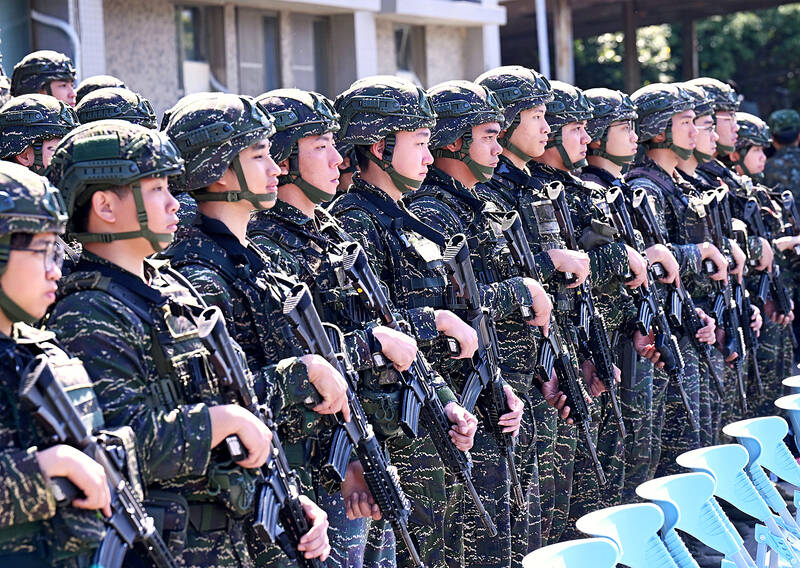
Photo: Fang Pin-chao, Taipei Times
After basic training, conscripts would be sorted into infantry battalions that would take part in the Lien Yung (聯勇) exercises, with a focus on “bind and strike” tactics, it said.
The drills feature ground troops, attack helicopters, fighter jets and warships fighting together, and emphasize positional defense, command and control, coordinated use of fire and maneuvering, combined arms tactics, and the ability of troops to function under physical and psychological hardship.
The training regime outlined by the document for the infantry battalion implies that conscripts would no longer be deployed exclusively in static defense, and are instead expected to fight alongside professional soldiers in mixed formations.
This means that some of the army’s new combined arms brigades would be able to utilize an infantry battalion of conscripts as a fixing force, while professional soldiers attack the enemy with tanks and armored infantry teams.
The enactment of the policy document would likely require the army to transform the 101st, 109th, 117th, 137th and 249th brigades from training units into combat formations assigned to the defense of key strategic areas in Taiwan proper.
The Executive Yuan also said it has ordered the military to ensure the humane treatment of service members, reduce recruitment standards within reasonable limits, and improve pay and benefits for troops to boost recruitment and retention.
Reforms along these lines have already led to improvements in the military’s staffing, it added.
Last year, the armed forces’ retention rate rose to 87.2 percent, up 5.2 percentage points from the previous year, while the number of active-duty volunteer service members grew by 3,000 compared with the same period, it said.
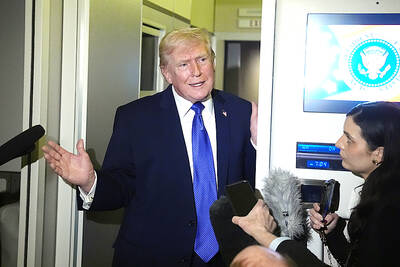
NON-NEGOTIABLE: The US president’s action ran counter to one of the US’ ‘six assurances’ on not consulting China about arms sales to Taiwan, US lawmakers said US President Donald Trump’s admission that he is discussing arms sales to Taiwan with Chinese President Xi Jinping (習近平) is “alarming and a blatant violation of US policy and the six assurances,” US Representative Ro Khanna said on Tuesday. Trump on Monday said he would decide soon on whether to send more weapons to Taiwan, after Xi warned him not to do so. “I’m talking to him about it. We had a good conversation, and we’ll make a determination pretty soon,” Trump told reporters aboard Air Force One when asked about warnings raised by Beijing during a phone call with Xi over

OPTIMISTIC: The DGBAS sharply upgraded its GDP growth estimate from 3.54 percent to 7.71 percent after the Taiwan-US trade agreement signing and given AI optimism The US imported more from Taiwan than China for the first time in decades, as US President Donald Trump’s tariffs reshape trade flows while a global boom in artificial intelligence (AI) fuels demand for tech products. US purchases of goods from China plunged almost 44 percent in December last year from 2024 to US$21.1 billion, US Department of Commerce data showed on Thursday. By contrast, shipments from Taiwan more than doubled during the same period to US$24.7 billion. The soaring Taiwanese shipments to the US reflect the huge expansion in supplies of chips and servers for AI companies, which has completely changed
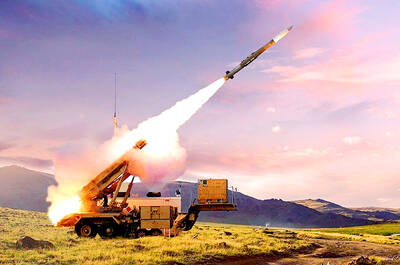
VACILLATING? Some US officials are concerned that Trump’s April visit to Beijing might be affected if Washington pushes through additional weapons sales to Taiwan A major US arms sales package for Taiwan is in limbo following pressure from Chinese President Xi Jinping (習近平) and concerns among some US officials that greenlighting the deal would derail US President Donald Trump’s upcoming visit to Bejing, the Wall Street Journal (WSJ) reported on Wednesday. Trump on Monday said that he would decide soon on whether to send more weapons to Taiwan, after Xi warned him not to do so. “I’m talking to him about it. We had a good conversation, and we’ll make a determination pretty soon,” Trump told reporters aboard Air Force One when asked about warnings raised
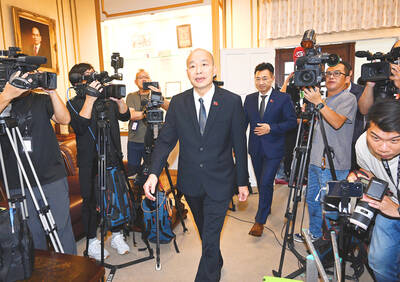
TEAMWORK: All parties should prioritize national defense and key security issues, which requires cooperation and long-term, stable support, the DPP’s Chen Pei-yu said A proposed NT$1.25 trillion (US$39.66 billion) special defense budget would be a top priority for the Legislative Yuan when it reconvenes after the Lunar New Year holiday, Legislative Speaker Han Kuo-yu (韓國瑜) said yesterday after a group of 37 US lawmakers sent letters to Taiwanese politicians expressing concern over the stalled budget. Chinese Nationalist Party (KMT) members Han and Deputy Legislative Speaker Johnny Chiang (江啟臣) in a statement said they would help party caucuses deliberate about the special defense budget, adding that they value open, candid and sincere exchanges with the US Congress and take US lawmakers’ concerns seriously. Taiwan-US relations are


 RSS
RSS