


US President Donald Trump’s admission that he is discussing arms sales to Taiwan with Chinese President Xi Jinping (習近平) is “alarming and a blatant violation of US policy and the six assurances,” US Representative Ro Khanna said on Tuesday.
Trump on Monday said he would decide soon on whether to send more weapons to Taiwan, after Xi warned him not to do so.
“I’m talking to him about it. We had a good conversation, and we’ll make a determination pretty soon,” Trump told reporters aboard Air Force One when asked about warnings raised by Beijing during a phone call with Xi over potential additional US arms sales to Taiwan.
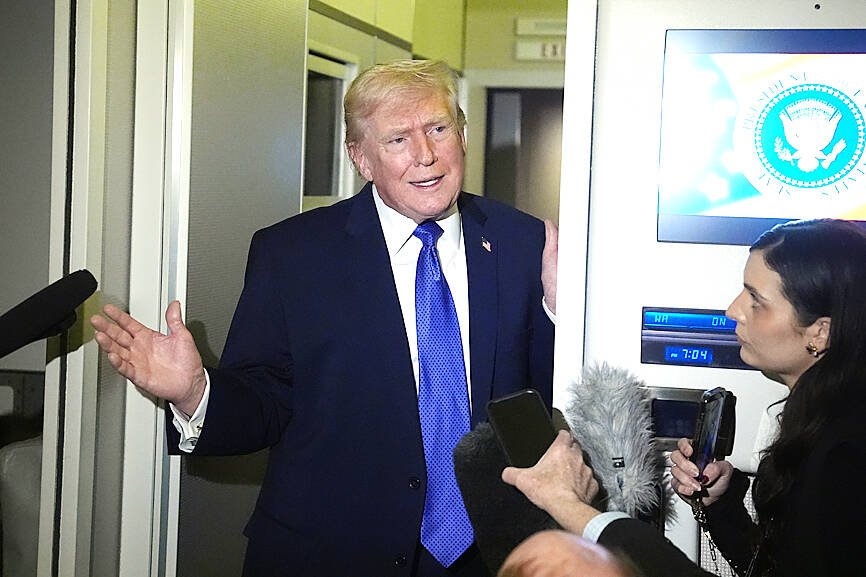
Photo: AP
“Trump’s statement showed how he treats Taiwan as a ‘bargaining chip” in trade negotiations with China,” Khanna, ranking member of the US House of Representatives’ Select Committee on the Strategic Competition Between the US and the Chinese Communist Party (CCP), said in a press release.
“It shows he is more eager to make bad deals with America’s strategic competitors than strengthen ties with long-standing friends like Taiwan,” he added, calling it “not only an affront to the security of Taiwan’s 23 million people, but a stain on America’s global credibility.”
“Taiwan must be off the table,” he said, urging Trump to reaffirm the US’ commitment to the “six assurances” and clarify that Washington’s policy on Taiwan has not changed.
US Senator Andy Kim also voiced his concern in a post on X.
“This isn’t just an admission by Trump, it’s a disturbing abandonment of our Taiwan policy, which has been key to stability for decades,” he wrote.
“Even if he decides to move forward with these sales, we’re in dangerous territory now,” he added. “Trump is putting our once non-negotiable commitments in doubt, and there will be real consequences.”
The “six assurances” stipulate the US will not set a date for ending arms sales to Taiwan; will not consult with China on such arms sales; will not revise the Taiwan Relations Act, which underpins the US’ Taiwan policy; will not change its official position on Taiwan’s sovereignty; and will not pressure Taiwan to negotiate these matters with China.
Unlike the Taiwan Relations Act, the “six assurances” have never become an official law dictating US-Taiwan relations.
The “six assurances,” issued in 1982 by then-US president Ronald Reagan, was presented to then-president Chiang Ching-kuo (蔣經國) by then-head of the American Institute in Taiwan James Lilley, in a private letter rather than an official government document.
The US Congress is working on legislation to codify these stabilizing principles through the “Six Assurances to Taiwan Act,” Khanna said on Tuesday.
In November last year, two US senators proposed the act, which would give the assurances the full force of law and ensure the US Congress must review any attempt to alter them.
In Taipei, an academic yesterday warned that Trump’s comments mark a significant departure from long-standing US policy and could have a lasting impact on Taipei-Washington security ties.
Over the past 44 years since the “six assurances” were issued, US officials have maintained a firm stance that the US would not consult the CCP when considering arms sales to Taiwan, said Chieh Chung (揭仲), an associate researcher at the Institute for National Defense and Security Research.
Trump’s comments were equivalent to overturning a stance upheld by the US government’s executive branch for years as an incumbent US president, he added.
While his comments might not have a huge impact on the US$11.1 billion potential arms sales announced in December, it might affect pending deals, including items that form the core of the military’s “T-Dome,” an integrated air defense network to counter ballistic missiles and other threats, he said.
The pending deals reportedly include Patriot Advanced Capability 3 missile systems, National Advanced Surface-to-Air Missile System, Link-22 secure data link systems and Integrated Battle Command Systems, he said.
In response to media queries for comment on Trump’s remarks, a White House official on Tuesday said: “There is no change to our policy with respect to Taiwan.”
Additional reporting by AFP
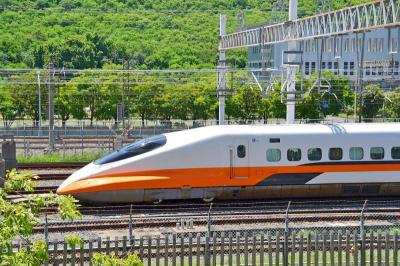
A signaling system malfunction disrupted high-speed rail (HSR) services beginning at 8am today, with trains temporarily reduced to three northbound and three southbound trains per hour as authorities conduct inspections. The malfunction occurred on a section of track in Miaoli County during pre-operation checks early this morning, forcing northbound and southbound trains to use a single track, the HSR operator said. The regular schedule has been replaced with three hourly trains offering only nonreserved seating in each direction, stopping at every station, it said, adding that business class cars would still have reserved seating. Departures from terminal stations are scheduled at the top
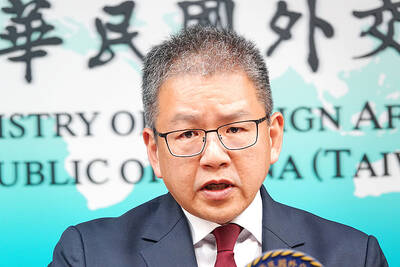
Taiwan is still in the process of assessing the possibility of recruiting workers from Eswatini, the Ministry of Foreign Affairs said yesterday, adding that its goal is to help Eswatini upgrade its vocational training centers. If there are plans to recruit workers from Eswatini, safeguarding national security, protecting public health and ensuring the employment rights of Taiwanese would be prerequisites, Department of West Asian and African Affairs Director-General Yen Chia-liang (顏嘉良) told a news conference. Key considerations would also include filling labor shortages in specific industries, and fostering bilateral professional and technical exchanges, he said. Yen was asked about the progress of labor
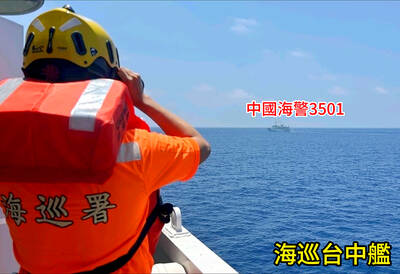
VERBOSE VESSELS: A CGA cutter and a China Coast Guard exchanged verbal barbs for more than a day in Taiwanese-controlled waters before the Chinese vessel left The Taiwanese and Chinese coast guards had a standoff near the strategically located Pratas Islands (Dongsha Islands, 東沙群島) in the north of the South China Sea, the Coast Guard Administration (CGA) said yesterday. The two sides engaged in intense radio exchanges over sovereignty claims during the 33-hour standoff. China Coast Guard vessel 3501 eventually left the restricted waters, 26.6 nautical miles (49.2km) west of the Pratas Islands, at 5pm yesterday, the CGA said. Lying approximately between southern Taiwan and Hong Kong, the Taiwan-controlled Pratas are seen by some security experts as vulnerable to Chinese attack due to their distance — more than

A US uncrewed surface vessel (USV) encountered multiple Chinese warships during an autonomous transit of the Taiwan Strait, US defense company Seasats said in a statement on Wednesday. Seasats announced that a Lightfish USV had completed the first autonomous transit of the Taiwan Strait. Over five days, the USV traversed the entire length of the Strait while constantly monitoring surface vessel traffic, the company said. The Lightfish encountered multiple Chinese warships, one of which was a Chinese People’s Liberation Army Navy (PLAN) Type 056 corvette, it said. The Chinese vessels were operating “well within Taiwan’s exclusive economic zone without transmitting their identity via the


 RSS
RSS