


Taiwan and the US on Thursday signed a trade agreement that caps US tariffs on Taiwanese goods at 15 percent and provides preferential market access for US industrial and agricultural exports, including cars, and beef and pork products.
The Taiwan-US Agreement on Reciprocal Trade confirms a 15 percent US tariff for Taiwanese goods, and grants Taiwanese semiconductors and related products the most-favorable-treatment under Section 232 of the Trade Expansion Act, the Executive Yuan said.
In addition, 2,072 items — representing nearly 20 percent of Taiwan’s total exports to the US — would be exempt from additional tariffs and be subject only to the standard most-favored-nation (MFN) rates, the Executive Yuan added.
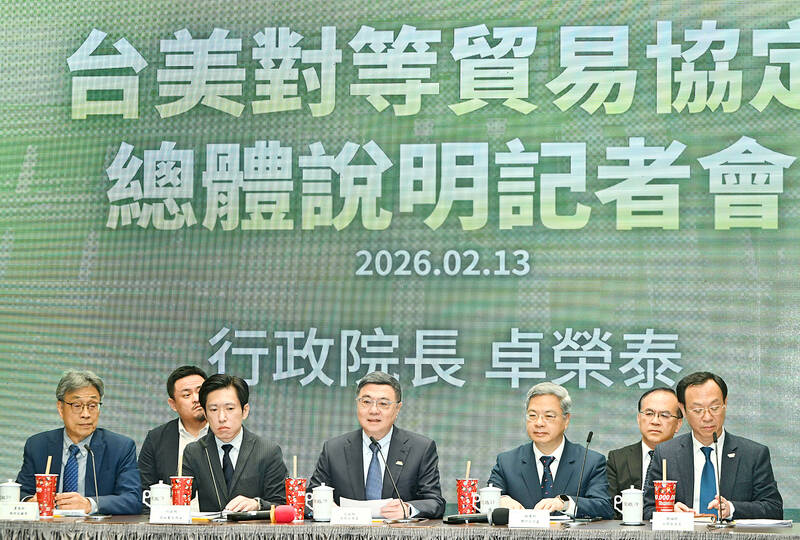
Photo: Tien Yu-hua, Taipei Times
The average US tariffs on Taiwanese goods would drop to 12.33 percent, significantly lower than the 35.78 percent that was in place when the trade negotiations began in April last year and the 23.78 percent recorded that August.
Under the exemptions, 42 percent of Taiwan’s agricultural exports and 36 percent of its industrial exports would avoid additional tariffs, the Cabinet said, adding that those included Taiwanese tea, orchids, tapioca flour and telecommunications equipment.
While US negotiators sought broader market access, Taiwan succeeded in maintaining existing tariffs on 27 US agricultural imports, such as rice and chicken, thus reducing the potential impact on farmers, it said.
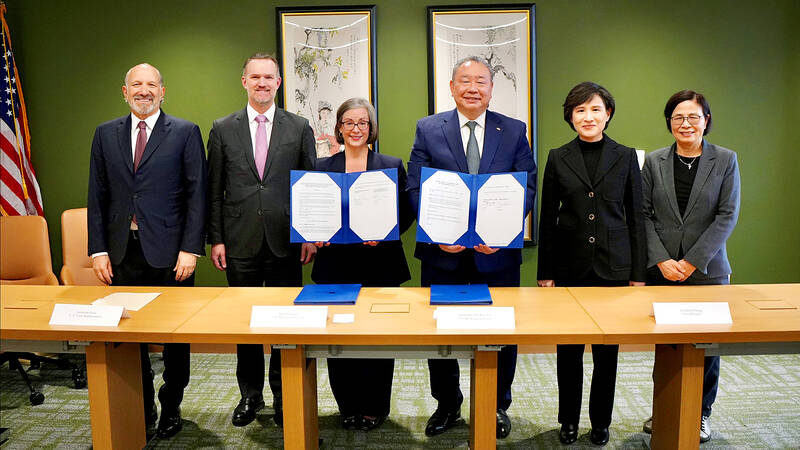
Photo courtesy of the US Office of the Trade Representative via CNA
Taiwan would cut tariffs on 15 US pork products by half over three years, while US ground beef and offal would also gain access to the Taiwanese market, it said, adding that guarantees about food safety controls would remain in place.
The trade agreement also covers industrial goods, removing all tariffs on US-made cars imported to Taiwan, but maintaining the rate on trucks.
The Office of the US Trade Representative said the agreement would eliminate or reduce 99 percent of tariff barriers for US industrial and agricultural goods exported to Taiwan.
"Taiwan plans to increase long-term purchases of US products, including US$44.4 billion of US liquefied natural gas and crude oil, US$25.2 billion of US power equipment, and US$14.2 billion of US civil aircraft and engines," it said.
US Trade Representative Jamieson Greer and US Secretary of Commerce Howard Lutnick attended the signing of the agreement, which occurred under the auspices of the American Institute in Taiwan, and the Taipei Economic and Cultural Representative Office in the US. Vice Premier Cheng Li-chiun (鄭麗君) and Minister Without Portfolio Yang Jen-ni (楊珍妮) also attended the signing.
“US President [Donald] Trump’s leadership in the Asia-Pacific region continues to generate prosperous trade ties for the United States with important partners across Asia, while further advancing the economic and national security interests of the American people,” Greer said.
At a news conference in Washington after the signing ceremony, Cheng, who led Taiwan’s trade negotiation team, said the agreement was “a milestone” for bilateral cooperation in trade, investment and technology.
Citing Lutnick, Cheng said Taiwan is “a unique partner” of the US, adding that the nation hoped the agreement would make it a strategic partner of the US “so as to jointly consolidate the democratic camp’s leading position in high technology.”
The Executive Yuan said the tariff rate set in the agreement allows local companies to compete on a level playing field with Japan, South Korea and the EU.
In a separate, but related deal, Taiwan would make investments worth US$250 billion in US industries, such as semiconductors, artificial intelligence applications and energy.
The government said it would provide up to US$250 billion in credit guarantees to help businesses invest in the US.
The agreement would now be sent to the legislature for review and approval. Speed would be crucial, given that Trump recently raised tariffs on South Korea after its parliament failed to quickly ratify a similar pact.
Cheng said the US negotiators had proposed making the agreement conditional on legislative approval, but her team had successfully pushed back on that idea.
“We encourage our lawmakers, however, to review and pass the agreement as soon as possible so the new tariff rates can take effect,” she said.

SILENCING CRITICS: In addition to blocking Taiwan, China aimed to prevent rights activists from speaking out against authoritarian states, a Cabinet department said The Ministry of Foreign Affairs (MOFA) yesterday condemned transnational repression by Beijing after RightsCon, a major digital human rights conference scheduled to be held in Zambia this week, was abruptly canceled due to Chinese pressure over Taiwanese participation. This year’s RightsCon, the world’s largest conference discussing issues “at the intersection of human rights and technology,” was scheduled to take place from tomorrow to Friday in Lusaka, and expected to draw 2,600 in-person attendees from 150 countries, along with 1,100 online participants. However, organizers were forced to cancel the event due to behind-the-scenes pressure from China, the ministry said, expressing its “strongest condemnation”
Taiwan’s economy grew far faster than expected in the first quarter, as booming demand for artificial intelligence (AI) applications drove a surge in exports, spilling over into investment and consumption, the Directorate-General of Budget, Accounting and Statistics (DGBAS) said yesterday. GDP growth was 13.69 percent year-on-year during the January-to-March period, beating the DGBAS’ February forecast by 2.23 percentage points and marking the most robust growth in nearly four decades, DGBAS senior official Chiang Hsin-yi (江心怡) told a news conference in Taipei. The result was powered by exports, which remain the backbone of Taiwan’s economy, Chiang said. Outbound shipments jumped 51.12 percent year-on-year to
DELAYED BUT DETERMINED: The president’s visit highlights Taiwan’s right to international engagement amid regional pressure from China President Willaim Lai (賴清德) yesterday arrived in Eswatini, more than a week after his planned visit to Taiwan’s sole African ally was suspended because of revoked overflight permits. “The visit, originally scheduled for April 22, was postponed due to unforeseen external factors,” Lai wrote on social media. “After several days of careful arrangements by our diplomatic and national security teams, we successfully arrived today.” Lai said he looked forward to further deepening Taiwan-Eswatini relations through closer cooperation in the economy, agriculture, culture and education, as well as advancing the nation’s international partnerships. The president was initially scheduled to arrive in time to celebrate
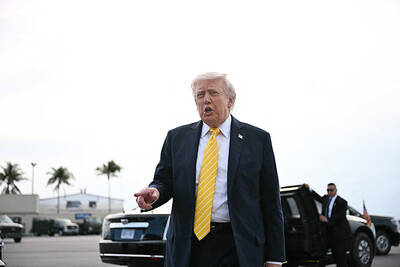
Iran’s Islamic Revolutionary Guard Corp (IRGC) yesterday said the US faced a choice between an “impossible” military operation or a “bad deal” with Tehran, after US President Donald Trump disparaged Iran’s latest peace proposal. Negotiations between the two countries have been deadlocked since a ceasefire came into effect on April 8, with only one round of direct peace talks held so far. Iran’s Tasnim and Fars news agencies reported that Tehran had submitted a 14-point proposal to mediator Pakistan, but Trump was quick to cast doubt on it. “I will soon be reviewing the plan that Iran has just sent to us, but


 RSS
RSS