


The Bangladesh Nationalist Party (BNP) yesterday celebrated a landslide victory in the first elections held since a deadly 2024 uprising, with party leader Tarique Rahman to become prime minister.
Bangladesh Election Commission figures showed that the BNP alliance had won 212 seats, compared with 77 for the Islamist-led Jamaat-e-Islami alliance.
The US embassy congratulated Rahman and the BNP for a “historic victory,” while India praised Rahman’s “decisive win” in a significant step after recent rocky relations with Bangladesh.
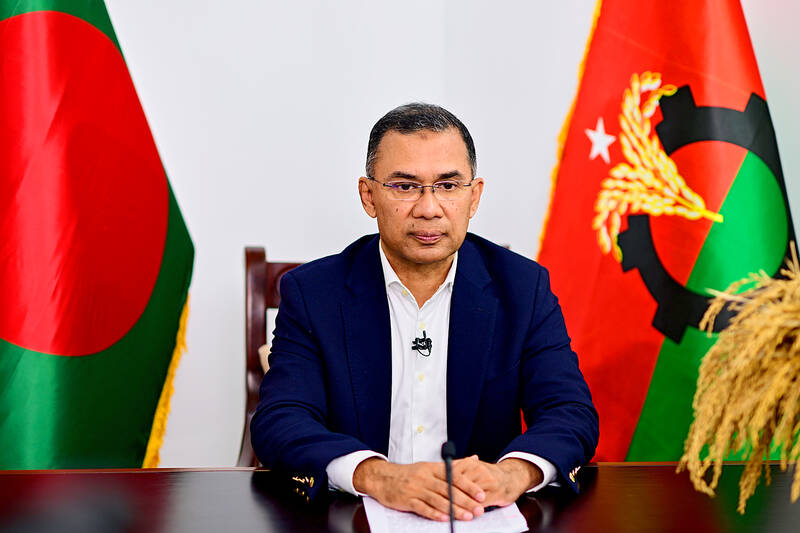
Photo: AP
China and Pakistan, which grew closer to Bangladesh since the uprising and the souring of ties with India, where ousted Bangladeshi prime minister Sheikh Hasina has sheltered since her ouster, also congratulated the BNP.
The vote passed largely peacefully and the country has been reported to have been calm since polling day.
Jamaat chief Shafiqur Rahman had mounted a grassroots campaign on a platform of justice and ending corruption.
His party said it was “not satisfied with the process surrounding the election results,” claiming it had logged “repeated inconsistencies and fabrications in unofficial result announcements,” without giving further details.
The commission said turnout was 59 percent across 299 constituencies out of 300 in which voting took place.
Senior BNP leader Ruhul Kabir Rizvi claimed a resounding win, calling for followers to give thanks in prayer rather than celebrate on the streets.
“There will be no victory rally despite the BNP’s sweeping victory,” Rizvi said.
Heavy deployments of security forces are posted countrywide, and UN experts warned ahead of the voting of “growing intolerance, threats and attacks” and a “tsunami of disinformation.”
Political clashes killed five people and injured more than 600 during campaigning, police records showed.
However, after a turbulent political period, Bangladesh has seemingly reacted to the result with calm.
Bangladesh interim leader Muhammad Yunus, who would step down once the new government takes power, has urged all to stay calm.
“We may have differences of opinion, but we must remain united in the greater national interest,” he said.
The election had “ended the nightmare and begun a new dream,” Yunus said.
Hasina, who was sentenced to death in absentia for crimes against humanity, issued a statement decrying an “illegal and unconstitutional election.”
Voters also endorsed proposals in a referendum that included prime ministerial term limits, a new upper house of parliament, stronger presidential powers and greater judicial independence, with 60 percent backing the changes.
Crisis Group analyst Thomas Kean said the that incoming government now faced “daunting challenges,” including “boosting the economy, ensuring security and continuing the reform process.”

A signaling system malfunction disrupted high-speed rail (HSR) services beginning at 8am today, with trains temporarily reduced to three northbound and three southbound trains per hour as authorities conduct inspections. The malfunction occurred on a section of track in Miaoli County during pre-operation checks early this morning, forcing northbound and southbound trains to use a single track, the HSR operator said. The regular schedule has been replaced with three hourly trains offering only nonreserved seating in each direction, stopping at every station, it said, adding that business class cars would still have reserved seating. Departures from terminal stations are scheduled at the top

Taiwan is still in the process of assessing the possibility of recruiting workers from Eswatini, the Ministry of Foreign Affairs said yesterday, adding that its goal is to help Eswatini upgrade its vocational training centers. If there are plans to recruit workers from Eswatini, safeguarding national security, protecting public health and ensuring the employment rights of Taiwanese would be prerequisites, Department of West Asian and African Affairs Director-General Yen Chia-liang (顏嘉良) told a news conference. Key considerations would also include filling labor shortages in specific industries, and fostering bilateral professional and technical exchanges, he said. Yen was asked about the progress of labor

A US uncrewed surface vessel (USV) encountered multiple Chinese warships during an autonomous transit of the Taiwan Strait, US defense company Seasats said in a statement on Wednesday. Seasats announced that a Lightfish USV had completed the first autonomous transit of the Taiwan Strait. Over five days, the USV traversed the entire length of the Strait while constantly monitoring surface vessel traffic, the company said. The Lightfish encountered multiple Chinese warships, one of which was a Chinese People’s Liberation Army Navy (PLAN) Type 056 corvette, it said. The Chinese vessels were operating “well within Taiwan’s exclusive economic zone without transmitting their identity via the

VERBOSE VESSELS: A CGA cutter and a China Coast Guard exchanged verbal barbs for more than a day in Taiwanese-controlled waters before the Chinese vessel left The Taiwanese and Chinese coast guards had a standoff near the strategically located Pratas Islands (Dongsha Islands, 東沙群島) in the north of the South China Sea, the Coast Guard Administration (CGA) said yesterday. The two sides engaged in intense radio exchanges over sovereignty claims during the 33-hour standoff. China Coast Guard vessel 3501 eventually left the restricted waters, 26.6 nautical miles (49.2km) west of the Pratas Islands, at 5pm yesterday, the CGA said. Lying approximately between southern Taiwan and Hong Kong, the Taiwan-controlled Pratas are seen by some security experts as vulnerable to Chinese attack due to their distance — more than


 RSS
RSS