


Chinese military aircraft incursions around Taiwan have surged nearly 15-fold over the past five years, according to a report released yesterday by the Democratic Progressive Party’s (DPP) Department of China Affairs.
Sorties in the Taiwan Strait were previously irregular, totaling 380 in 2020, but have since evolved into routine operations, the report showed.
“This demonstrates that the Taiwan Strait has become both the starting point and testing ground for Beijing’s expansionist ambitions,” it said.
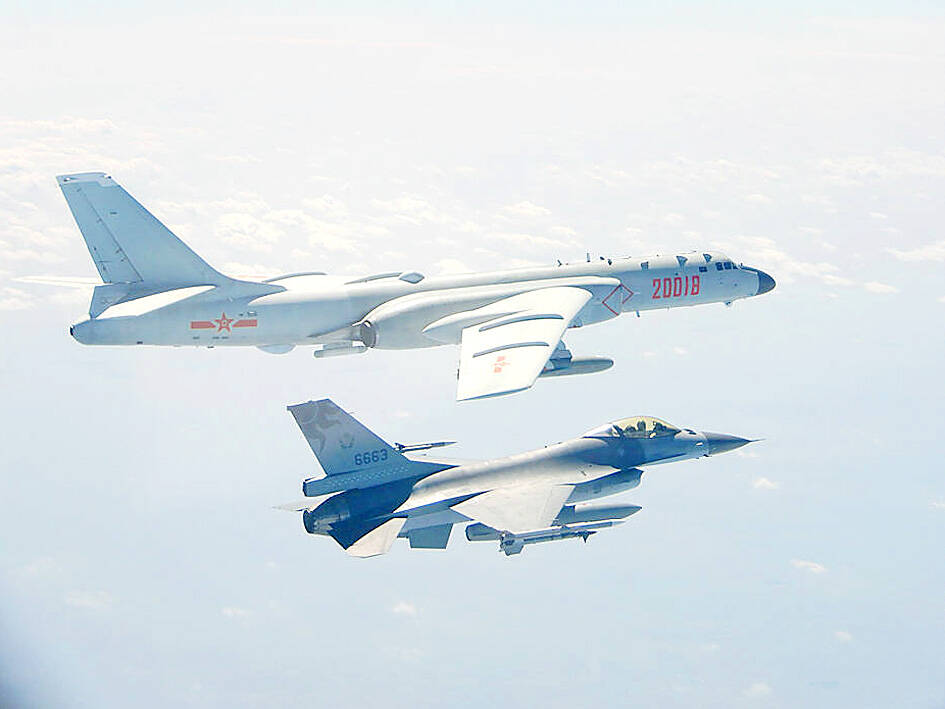
Photo courtesy of the Ministry of National Defense via EPA-EFE
Driven by military expansionism, China is systematically pursuing actions aimed at altering the regional “status quo,” the department said, adding that Taiwan represents the most critical link in China’s broader military strategy.
The increase in Chinese military aircraft incursions has been consistent and steep, the report said.
Sorties rose from 380 in 2020 to 960 in 2021, 1,738 in 2022, 4,734 in 2023, 5,107 in 2024 and 5,709 last year.
“The scale and tempo of the operations clearly show that the Taiwan Strait has become the core theater of China’s gray zone activities, used to test deterrence, drain Taiwan’s defensive resources and gradually push outward existing security boundaries,” it said.
Frequent military drills allow Beijing to translate its ambitions into sustained coercive pressure against Taiwan, it added.
The department cited China’s intensive large-scale exercises last year, which involved joint operations, sea and air blockades and precision strikes.
Exercise zones used in last year’s major drills — including the “Strait Thunder-2025A” exercises in April and the “Justice Mission 2025” drills in December — repeatedly approached Taiwan’s 12-nautical-mile (22.2km) territorial sea and airspace baselines, it said.
“Such actions pose a serious threat to peace in the Indo-Pacific region,” the department said, adding that China’s strategic objectives extend well beyond Taiwan.
In areas including the Diaoyutai Islands (釣魚台群島), the Sea of Japan, the Yellow Sea and the South China Sea, Beijing is simultaneously advancing high-intensity military and quasi-military operations, it said.
By operating below the threshold of war, China is steadily accumulating regional advantages, it said.
China’s “Victory Day Parade” on Sept. 3 last year also served to underscore Beijing’s military ambitions, the department said.
“Such events are intended to mobilize domestic audiences and constitute a public declaration that China now views military power as a primary tool for advancing its international ambitions,” it said.
China’s coercive military activities are not isolated incidents, but expressions of a single expansionist logic applied across multiple regions, increasing the risk of accidental conflict, it added.
The department said that the international community has become increasingly alert to China’s efforts to undermine the rules-based international order.
It cited the US’ latest security and defense documents, which state that China’s military development has shifted from a deterrence-focused posture to comprehensive war preparedness, alongside continued efforts to strengthen anti-access and area-denial capabilities.
Japan, Australia, the Philippines, the EU and G7 countries have also repeatedly warned that Beijing’s use of quasi-military and “gray zone” tactics to unilaterally change the “status quo” has become a major source of risk to Indo-Pacific security, it said.

RESILIENCE: Taiwan plays a key role in semiconductors, energy, information infrastructure and advanced manufacturing, AIT Director Raymond Greene said Taiwan’s continued investment in deterrence and resilience remains vital, especially in uncrewed systems and other emerging technologies, American Institute in Taiwan (AIT) Director Raymond Greene said yesterday. Greene made the remarks at the annual National Strategic Summit on Supply Chain Resilience held by the Research Institute for Democracy, Society and Emerging Technology (DSET), a government-backed think tank. As Taiwan last year became the US’ fourth-largest trading partner and supply chain security is becoming more important, cooperation in emerging technologies continues to deepen between the two countries, he said. The US is committed to accelerating innovation, building key infrastructure, strengthening cooperation

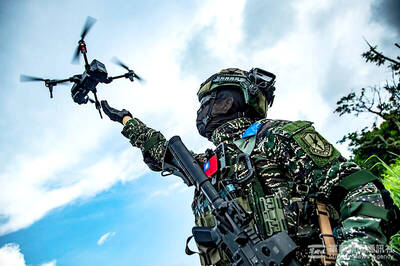
The National Chungshan Institute of Science and Technology yesterday showcased its locally developed variants of the Vision 60 robotic patrol dog, which it plans to deploy on the nation’s outlying territories in the South China Sea. The variants were produced under the Joint Lab project — created by the institute and domestic companies — and assembled with domestically produced motors, lenses and artificial intelligence (AI) systems alongside licensed tech from the US, Missile and Rocket Systems Research Division deputy director Jen Kuo-kang (任國光) told the media event at a military base in Taipei’s Dazhi (大直) area. Taiwan has built up its strengths

RIGHT DIRECTION: Taiwan’s efforts to prevent forced labor include a proposal to ‘fully prohibit’ employers from withholding workers’ documents, an official said Taiwan is to establish a mechanism to restrict imports of goods linked to forced labor, the Executive Yuan said yesterday, after the US proposed imposing additional tariffs on Taiwanese goods over labor concerns. “The Ministry of Labor and the Ministry of Economic Affairs are to establish an interministerial review procedure,” Executive Yuan spokesperson Michelle Lee (李慧芝) said at a news briefing in Taipei. “The government is to use the Foreign Trade Act [貿易法] as the legal basis to restrict imports of goods produced with forced labor” and bring its supply chain governance more in line with international standards on human rights, resilience
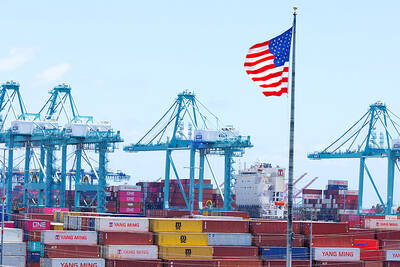
NOT IMMEDIATE: Taiwan has a chance to appeal the proposed 10 percent tariff before it starts, while other countries face a 12.5 percent tariff from the trade office Taiwan is among 60 economies determined by the US to have failed to impose or enforce a ban on the importation of goods produced with forced labor, according to a notice released on Tuesday by the Office of the US Trade Representative (USTR), which proposed imposing an additional 10 percent or more tariff on them. The USTR in a statement said that following an investigation, it had determined under Section 301 of the Trade Act of 1974 that the failure of the 60 economies to impose and effectively enforce a prohibition on the importation of goods produced with forced labor is


 RSS
RSS