


Former Taiwan People’s Party (TPP) chairman Ko Wen-je (柯文哲) was released on NT$70 million (US$2.29 million) bail yesterday, bringing an end to his year-long incommunicado detention as he awaits trial on corruption charges.
Under the conditions set by the Taipei District Court on Friday, Ko must remain at a registered address, wear a GPS-enabled ankle monitor and is prohibited from leaving the country.
He is also barred from contacting codefendants or witnesses.
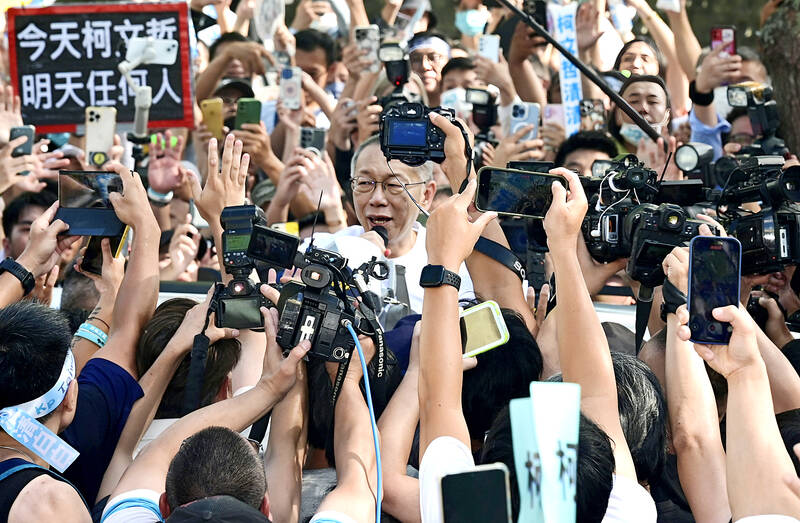
Photo: Wang Yi-sung, Taipei Times
After Ko’s wife, Peggy Chen (陳佩琪), posted bail, Ko was transported from the Taipei Detention Center to the Taipei District Court at 12:20pm, where he was fitted with the tracking device.
Two hours later, Ko emerged from the courthouse alongside Chen, TPP Chairman Huang Kuo-chang (黃國昌) and Internet personality Holger Chen (陳之漢), where he addressed reporters and about 700 supporters.
Ko began by thanking his supporters for standing by him during the past year, and said that prosecutors had come up empty despite sweeping searches of his home, family, aides and the TPP itself.
“The Democratic Progressive Party could not have dreamed that the TPP would be so clean,” Ko said, referring to Taiwan’s ruling party, which he has said is persecuting him for political reasons.
Ko described his year in incommunicado detention as a period of “suffering,” saying he rarely saw sunlight and had minimal contact with others.
He said the experience gave him time to reflect on his three decades as a surgeon and eight years as Taipei mayor, adding that he had at times been too unyielding and impatient, and could have done better.
Prison also exposed him to “a different side of Taiwanese society,” as he lived alongside inmates facing genuine hardship, including cellmates who “did not have a single dollar to their names,” he said.
“I hope Taiwan can be made better because of us, not torn apart by division, as it has been under [President William] Lai (賴清德),” Ko said, calling the case against him a “miscarriage of justice.”
As he left to board a vehicle, Ko shouted to his supporters that he would “keep working” and “not surrender.”
Ko plans to travel to Hsinchu to visit his mother and decide where to inter the ashes of his father, who died while Ko was in custody, Peggy Chen said.
Ko was detained on Sept. 5 last year and indicted in December on four charges, including allegedly accepting NT$17.1 million in bribes related to a property redevelopment case during his tenure as Taipei mayor, as well as embezzling political donations from his presidential campaign last year.
Prosecutors are seeking a combined sentence of 28-and-a-half years. Ko has denied guilt throughout the investigation and his ongoing trial.
Ten others were also indicted in the two anti-corruption cases, including former Taipei deputy mayor Pong Cheng-sheng (彭振聲), Taipei City Councilor Ying Hsiao-wei (應曉薇), Lee Wen-tsung (李文宗), finance chief of Ko’s presidential campaign office, and Sheen Ching-jing (沈慶京), founder and chairman of real-estate conglomerate Core Pacific Group (威京集團). Ying was released on Friday on NT$30 million bail.
Taiwan Semiconductor Manufacturing Co (TSMC, 台積電), the world’s largest foundry service provider, yesterday said that global semiconductor revenue is projected to hit US$1.5 trillion in 2030, after the figure exceeds US$1 trillion this year, as artificial intelligence (AI) demand boosts consumption of token and compute power. “We are still at the beginning of the AI revolution, but we already see a significant impact across the whole semiconductor ecosystem,” TSMC deputy cochief operating officer Kevin Zhang (張曉強) said at the company’s annual technology symposium in Hsinchu City. “It is fair to say that in the past decade, smartphones and other mobile devices were
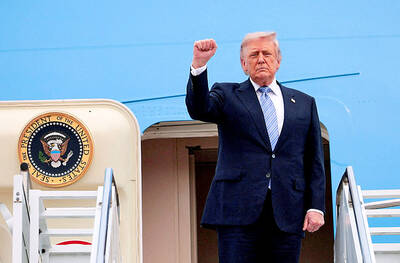
US-CHINA SUMMIT: MOFA welcomed US reassurance of no change in its Taiwan policy; Trump said he did not comment when Xi talked of opposing independence US President Donald Trump yesterday said he has not made a decision on whether to move forward with a major arms package for Taiwan after hearing concerns about it from Chinese President Xi Jinping (習近平). Trump’s comments on Taiwan came as he flew back to Washington after wrapping up critical talks in which both leaders said important progress was made in stabilizing US-China relations even as deep differences persist between the world’s two biggest powers on Iran and Taiwan. “I will make a determination,” Trump said, adding: “I’ll be making decisions. But, you know, I think the last thing we need right
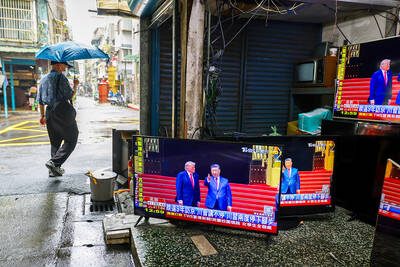
TAIWAN ISSUE: US treasury secretary Scott Bessent said on the first day of meetings that ‘it wouldn’t be a US-China summit without the Taiwan issue coming up’ There were no surprises on the first day of the summit between US President Donald Trump and Chinese President Xi Jinping (習近平), the Mainland Affairs Council (MAC) said yesterday, as the government reiterated that cross-strait stability is crucial to the Asia-Pacific region, as well as the world. As the two presidents met for a highly anticipated summit yesterday, Chinese state media reported that Xi warned Trump that missteps regarding Taiwan could push their two countries into “conflict.” Trump arrived in China with accolades for his host, calling Xi a “great leader” and “friend,” and extending an invitation to visit the White House
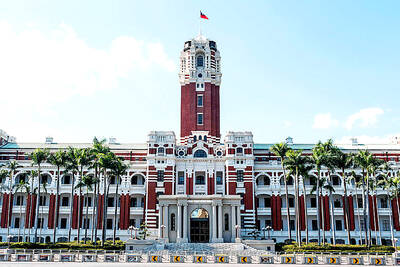
SECURITY: Taipei presses the US for arms supplies, saying the arms sales are not only a reflection of the US security commitment to Taiwan but also serve as a mutual deterrent against regional threats Taiwan is committed to preserving the cross-strait “status quo” and contributing to regional peace and stability, the Presidential Office said yesterday. “It is an undeniable fact that the Republic of China is a sovereign and independent democratic nation,” Presidential Office spokeswoman Karen Kuo (郭雅慧) reiterated, adding that Beijing has no right to claim sovereignty over Taiwan. The statements came after US President Donald Trump warned against Taiwanese independence. Trump wrapped up a state visit to Beijing on Friday, during which Chinese President Xi Jinping (習近平) had pressed him not to support Taiwan. Taiwan depends heavily on US security backing to deter China from carrying


 RSS
RSS