


The US sent Iran a proposal for a nuclear deal that the White House said is “acceptable” and in its “best interest” to accept, US media reported on Saturday.
It came shortly after a UN report said Iran had stepped up production of highly enriched uranium.
Iranian Minister of Foreign Affairs Abbas Araghchi said he was presented with “elements of a US proposal” by his Omani counterpart during his visit to Tehran on Saturday.

Photo: Reuters
“[US President Donald Trump’s] Special Envoy [to the Middle East Steve] Witkoff has sent a detailed and acceptable proposal to the Iranian regime, and it’s in their best interest to accept it,” White House press secretary Karoline Leavitt said, the New York Times reported.
The proposal was described as a series of bullet points rather than a full draft, the New York Times said, citing officials familiar with the diplomatic exchanges.
It calls on Iran to stop all enrichment of uranium and proposes creating a regional grouping to produce nuclear power, which would include Iran, Saudi Arabia and other Arab states, as well as the US.
Iran has held five rounds of talks with the US in search of a new agreement to replace the deal with major powers that Trump abandoned during his first term in 2018.
Araghchi on Saturday said that Iran considers nuclear weapons “unacceptable.”
His remarks came a day after Trump said Iran “cannot have a nuclear weapon,” while expressing hope of striking a deal soon.
Iran has sharply increased its stockpile of uranium enriched to up to 60 percent, close to the roughly 90 percent level needed for atomic weapons, the latest report by the International Atomic Energy Agency said.

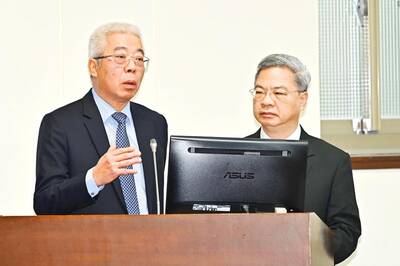
Taiwan has arranged for about 8 million barrels of crude oil, or about one-third of its monthly needs, to be shipped from the Red Sea this month to bypass the Strait of Hormuz and ease domestic supply pressures, CPC Corp, Taiwan (CPC, 台灣中油) said yesterday. The state-run oil company has worked with Middle Eastern suppliers to secure routes other than the Strait of Hormuz, through which about 20 percent of the world’s oil and liquefied natural gas typically passes, CPC chairman Fang Jeng-zen (方振仁) said at a meeting of the legislature’s Economics Committee in Taipei. Suppliers in Saudi Arabia have indicated they
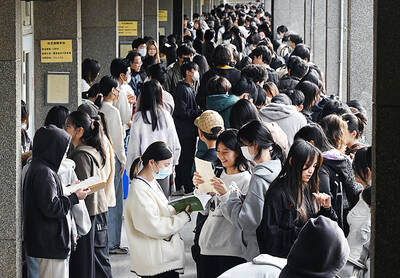
A global survey showed that 60 percent of Taiwanese had attained higher education, second only to Canada, the Ministry of the Interior said. Taiwan easily surpassed the global average of 43 percent and ranked ahead of major economies, including Japan, South Korea and the US, data from the Organisation for Economic Co-operation and Development (OECD) for 2024 showed. Taiwan has a high literacy rate, data released by the ministry showed. As of the end of last year, Taiwan had 20.617 million people aged 15 or older, accounting for 88.5 percent of the total population, with a literacy rate of 99.4 percent, the data
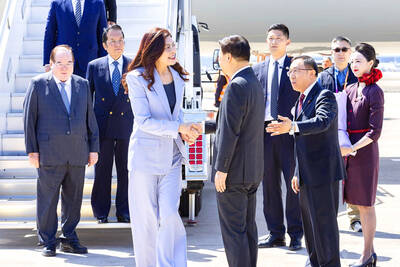
CCP ‘PAWN’? Beijing could use the KMT chairwoman’s visit to signal to the world that many people in Taiwan support the ‘one China’ principle, an academic said Chinese Nationalist Party (KMT) Chairwoman Cheng Li-wun (鄭麗文) yesterday arrived in China for a “peace” mission and potential meeting with Chinese President Xi Jinping (習近平), while a Taiwanese minister detailed the number of Chinese warships currently deployed around the nation. Cheng is visiting at a time of increased Chinese military pressure on Taiwan, as the opposition-dominated Legislative Yuan stalls a government plan for US$40 billion in extra defense spending. Speaking to reporters before going to the airport, Cheng said she was going on a “historic journey for peace,” but added that some people felt uneasy about her trip. “If you truly love Taiwan,

NEW LOW: The council in 2024 based predictions on a pessimistic estimate for the nation’s total fertility rate of 0.84, but last year that rate was 0.69, 17 percent lower An expected National Development Council (NDC) report expects the nation’s population to drop below 12 million by 2065, with the old-age dependency ratio to top 100 percent sooner than 2070, sources said yesterday. The council is slated to release its latest population projections in August, using an ultra-low fertility model, the sources said. The previous report projected that Taiwan’s population would fall to 14.37 million by 2070, but based on a new estimate of the total fertility rate (TFR) — the average number of children born to a woman over her lifetime — the population is expected to reach 12 million by


 RSS
RSS