


A group of US House of Representatives lawmakers has introduced legislation to replace the term “Chinese Taipei” with “Taiwan” across all federal agencies.
US Representative Byron Donalds announced the introduction of the “America supports Taiwan act,” which would mandate federal agencies adopt “Taiwan” in place of “Chinese Taipei,” a news release on his page on the US House of Representatives’ Web site said.
US representatives Mike Collins, Barry Moore and Tom Tiffany are cosponsors of the legislation, US political newspaper The Hill reported yesterday.
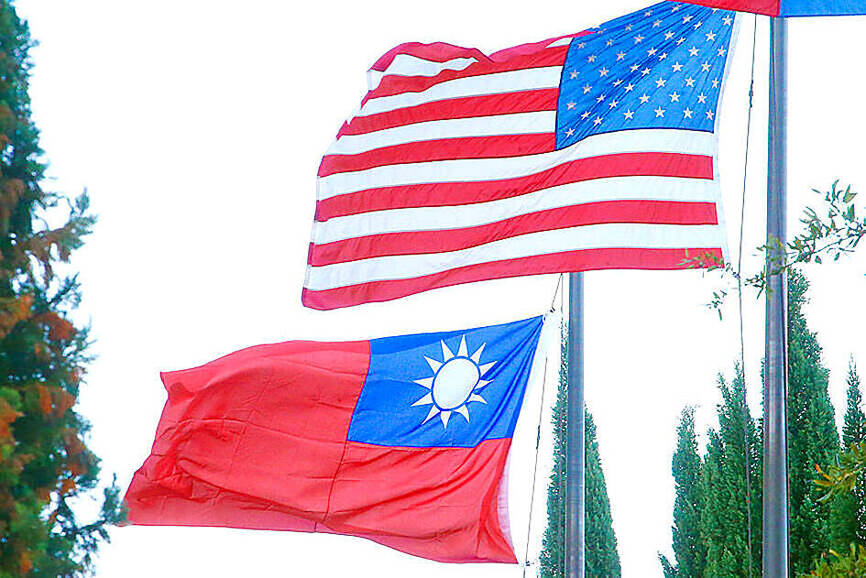
Photo: CNA
“The legislation is a push to normalize the position of Taiwan as an autonomous country, although the official US stance is not to recognize or advocate for Taiwan’s independence,” The Hill reported.
The US rarely uses the term “Chinese Taipei,” although it has appeared in some government communications, the newspaper said, adding that the bill aims to strengthen US policy supporting Taiwan against Chinese coercion and aggression, which threaten its sovereignty, it said.
The legislation “reconfirms the US Government’s support of an independent Taiwan, even though Chinese coercion and persuasion continues to escalate ... directs all federal agencies to use the term ‘Taiwan’ instead of the ‘Chinese Taipei’ nomenclature” and “requires all federal agencies to update their websites within 14 days after enactment,” it added.
The bill supports resolution of cross-strait differences “by peaceful means, free from coercion, in a manner acceptable to the people on both sides of the Strait,” it said.
“Taiwan is a key US strategic partner despite Chinese claims over their sovereignty. It’s important that we shoot straight with the American people, the world, and call things what they are,” the news release quoted Donalds as saying.
“The name ‘Chinese Taipei’ is nothing more than a tool of Beijing’s strategy of diplomatic coercion,” he said, adding that the legislation would correct this by standing with the US’ partner and resisting the Chinese Communist Party’s encroachment.
“There is no reason why the United States, the greatest and most powerful nation on the globe, should allow communist China to dictate the name of one of our greatest international allies,” the news release quoted Collins as saying.
“As China attempts to increase their influence on the world’s stage, it has become clear their sights are set on Taiwan,” it quoted Moore as saying. “It is time for the United States to show the people of Taiwan that we recognize their right to self-governance.”

National Taiwan University (NTU) yesterday said it disqualified a person from an entrance examination for using AI smart glasses to cheat, along with two others for making untruthful statements in their curriculum vitae. The three applicants were given null scores, Taiwan’s highest-ranked university said, calling on prospective students to be honest in the admissions process. NTU registrar Lee Hung-sen (李宏森) said that the cheating applicant wore a hat and thick-rimmed glasses to the second written exam for medical school, claiming that they felt cold. Suspicions were aroused when the applicant stared oddly at the test for long stretches while steadily bringing the paper

MILITARY ISSUES: A partisan divide between the Cabinet and the legislature ‘raised questions about Taiwan’s ability to adequately fund its defense,’ the report said Taiwan’s defense budget, military personnel numbers and resilience are challenges to its ability to meet national defense goals, the US Naval Institute said in a report published on Tuesday. In response to the perception of a growing military threat posed by China, Taiwan has embarked on an effort to enhance the capabilities needed to deter an attempt by Beijing to annex the nation by force, the institute said in the US Congressional Research Service report, titled Taiwan: Defense and Military Issues, which was filed on Thursday last week. Taiwan’s defense budget increased by about 7.5 percent from 2024 to last year, it

66 FIGHTER JETS: The aircraft is likely undergoing preparations for its transfer to Taiwan — a significant step forward in the nation’s modernization program, a lawmaker said The first of Taiwan’s order of F-16V Block 70 aircraft has been sighted in Texas ahead of delivery, Democratic Progressive Party (DPP) Legislator Wang Ting-yu (王定宇) said. Taiwan’s first F-16V Block 70 two-seat aircraft, tail number 6831, was seen flying from Lockheed Martin’s production facility in Greenville, South Carolina, to Naval Air Station Joint Reserve Base Fort Worth in Texas, Wang wrote on Facebook yesterday. The plane is likely undergoing preparations for its transfer to Taiwan, marking a significant step forward in the Republic of China Air Force’s modernization program, Wang said, citing military analysts. The F-16V Block 70 is a new-build version
NOT JUST NUMBERS: What matters to intelligence work is crucial, reliable information, so even a few credible leads can be highly valuable to national security, a legislator said The National Security Bureau (NSB) yesterday said it has finished the establishment of an information-reporting channel for Chinese nationals, the aim of which is to broaden intelligence gathering on China’s political, military, economic and social developments. Chinese nationals can submit information on the Web page, https://report.nsb.gov.tw, the NSB said in a statement. The move aims to expand the bureau’s diverse intelligence sources and is pursuant to the National Intelligence Services Act (國家情報工作法), it said, adding that it referenced practices adopted by intelligence agencies in the US, the UK and Israel. An increasing number of people are approaching Taiwanese agencies to provide information, as


 RSS
RSS