


South Korean prosecutors yesterday detained a former defense minister who allegedly recommended last week’s brief but stunning martial law imposition to South Korean President Yoon Suk-yeol, making him the first figure detained over the case.
The development came a day after Yoon avoided an opposition-led bid to impeach him in parliament, with most ruling party lawmakers boycotting a floor vote to prevent the two-thirds majority needed to suspend his presidential powers.
The main opposition Democratic Party said it would prepare a new impeachment motion against Yoon.
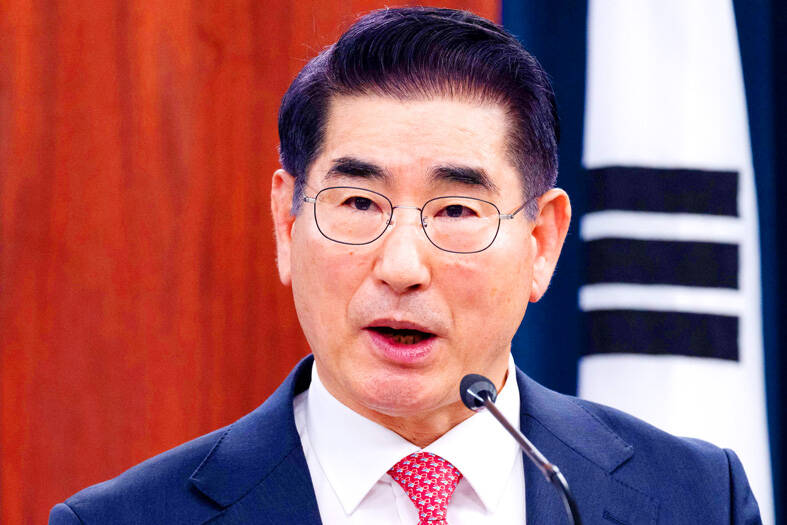
Photo: AFP
Yesterday, former South Korean Minister of National Defense Kim Yong-hyun was taken into custody at a Seoul detention facility after undergoing an investigation by prosecutors, a law enforcement official said, requesting anonymity in line with privacy rules.
The official gave no further details, but South Korean media reported that Kim voluntarily appeared at a Seoul prosecutors’ office, where he had his cellphone confiscated and was detained. The reports said police searched Kim’s former office and residence yesterday.
Repeated calls to Seoul prosecutors’ offices and police agency were unanswered.
Senior prosecutor Park Se-hyun in a televised statement yesterday said that authorities launched a 62-member special investigation team on the martial law case. Park, who would head the team, said the probe would “leave no suspicions.”
Yoon accepted Kim’s resignation offer on Thursday after opposition parties submitted a separate impeachment motion against him.
In Kim’s impeachment motion document, the Democratic Party and other opposition parties accused him of proposing martial law to Yoon.
South Korean Vice-Defense Minister Kim Seon-ho told parliament that Kim ordered the deployment of troops to the National Assembly.
IMPEACHEMENT TRIAL
Ruling People Power Party (PPP) leader Han Dong-hun yesterday said the PPP would work with the government to determine Yoon’s early and orderly exit from office in a way that minimizes confusion, but he did not say when that would happen.
He also said Yoon would not be involved in state affairs, including foreign policy.
The Democratic Party criticized Han Dong-hun’s comments, saying that the exclusion of an incumbent president from state affairs is not supported by the constitution.
It said authorities should immediately arrest Yoon and all others implicated in the case.
Yoon’s presidential office did not immediately respond to Han’s comments.
Lee Jae-myung, leader of the main opposition Democratic Party, yesterday said that they will try again on Saturday.
“Yoon, the principal culprit behind the insurrection and military coup that destroyed South Korea’s constitutional order, must either resign immediately or be impeached without delay,” Lee said.
“On December 14, our Democratic Party will impeach Yoon in the name of the people,” he added.
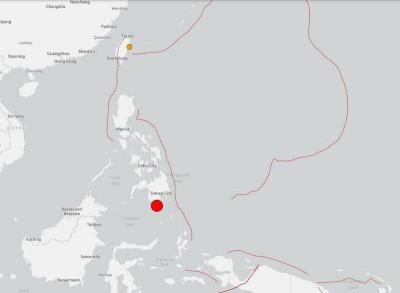
A magnitude 7.8 earthquake struck off the southern coast of Mindanao in the Philippines at 7:38am today, prompting the US Tsunami Warning System to issue an alert for neighboring countries, including Taiwan. The system issued a purple alert indicating a "tsunami threat." The potential threat zone includes Taiwan, the Philippines, Papua New Guinea, Yap and Palau. Philippine authorities were assessing the damage from the quake, with the office of civil defense seeking to verifying initial reports that 15 people had been killed and 129 injured in the region, mostly from falling debris. Arlene Hollero, disaster chief of Maasim town in the Philippines' Sarangani Province,

‘GRAY ZONE’ PRESSURE: Beijing’s activities are intended to create the deceitful impression that China has jurisdiction over the area around Taiwan, the CGA said Taiwan’s rights over its territorial waters and exclusive economic zone must not be violated by any country, the Mainland Affairs Council said yesterday, adding that it will not accept any unprovoked actions. The council issued the remarks in response to the China Coast Guard conducting maritime enforcement drills near eastern Taiwan and claiming to fully exercise China’s maritime administrative law enforcement authority. The Coast Guard Administration (CGA) has been closely monitoring the situation and is taking concrete steps to defend the nation’s sovereignty and secure its waters, the council said. China has no sovereign rights over the waters off eastern

RESILIENCE: Taiwan plays a key role in semiconductors, energy, information infrastructure and advanced manufacturing, AIT Director Raymond Greene said Taiwan’s continued investment in deterrence and resilience remains vital, especially in uncrewed systems and other emerging technologies, American Institute in Taiwan (AIT) Director Raymond Greene said yesterday. Greene made the remarks at the annual National Strategic Summit on Supply Chain Resilience held by the Research Institute for Democracy, Society and Emerging Technology (DSET), a government-backed think tank. As Taiwan last year became the US’ fourth-largest trading partner and supply chain security is becoming more important, cooperation in emerging technologies continues to deepen between the two countries, he said. The US is committed to accelerating innovation, building key infrastructure, strengthening cooperation

The National Chungshan Institute of Science and Technology yesterday showcased its locally developed variants of the Vision 60 robotic patrol dog, which it plans to deploy on the nation’s outlying territories in the South China Sea. The variants were produced under the Joint Lab project — created by the institute and domestic companies — and assembled with domestically produced motors, lenses and artificial intelligence (AI) systems alongside licensed tech from the US, Missile and Rocket Systems Research Division deputy director Jen Kuo-kang (任國光) told the media event at a military base in Taipei’s Dazhi (大直) area. Taiwan has built up its strengths


 RSS
RSS