


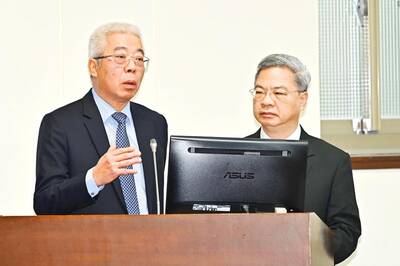
China’s seizure of a Taiwanese fishing vessel on Tuesday might be an act of psychological warfare by Beijing aiming to increase pressure on Taipei, National Security Bureau Director-General Tsai Ming-yen (蔡明彥) said yesterday.
Chinese officials boarded the boat and then took it to a port in China. It was fishing for squid in Chinese waters near Kinmen County.
China said the vessel violated a summer ban on fishing.

Photo: Tien Yu-hua, Taipei Times
Speaking to reporters at the legislature, Tsai said it was unusual for Chinese officials to board and then detain a Taiwanese fishing vessel, adding that China’s explanation was that it had been illegally fishing.
However, Beijing might have done this to demonstrate its jurisdiction over the Taiwan Strait and put pressure on Taipei, he added.
“We must continue to analyze whether this is a cognitive warfare operation, and will fully assess what the motivations are for the Chinese communists,” Tsai said.
China has seized Taiwanese fishing boats before for illegal fishing, but it released them after fining them, the Coast Guard Administration (CGA) said.
Late on Wednesday, China’s Taiwan Affairs Office said the seizure of the boat was an act of “normal law enforcement” to protect fishery resources and the environment.
“The relevant departments will deal with it in accordance with the law and regulations,” it said in a statement.
Three of the five fishers on board are Indonesian nationals, the CGA said.
Separately yesterday, Mainland Affairs Council Minister Chiu Chui-cheng (邱垂正) told reporters that the government would work as hard as possible to get the boat and its fishers released, and communicate with China via the semi-official Straits Exchange Foundation.
Chiu also urged Beijing to demonstrate goodwill and stop pressuring Taiwan.
China’s Association for Relations Across the Taiwan Straits in a letter to the foundation said that the boat was seized because it contravened Beijing’s regulations for the no-fishing season and that the holes of the nets they used to catch fish were too small, Chiu said.
White House spokeswoman Karine Jean-Pierre on Wednesday told reporters that Washington was closely monitoring the incident.
Meanwhile, Tsai told lawmakers that the Chinese Communist Party’s (CCP) infiltration of Taiwan can be categorized into four functions: intelligence-gathering, developing cells and organizations, tech-theft and headhunting, and election interference.
The CCP’s infiltration is becoming ever more insidious and is a severe challenge for national security agencies, Tsai said.
Taiwan’s democracy and freedom are being exploited, as the CCP is increasing its level of infiltration, Tsai said.
Officials have been working on 84 national security-related incidents since last year, of which 39 — a far greater number compared with previous years — have resulted in indictments, he said.
Tsai said that the CCP often builds up social networks and funds projects, promises commercial benefits or makes “special offers” to entice Taiwanese to visit China, where they begin working on them with “united front” rhetoric.
Additional reporting by Shelley Shan and Chen Yu-fu

Taiwan has arranged for about 8 million barrels of crude oil, or about one-third of its monthly needs, to be shipped from the Red Sea this month to bypass the Strait of Hormuz and ease domestic supply pressures, CPC Corp, Taiwan (CPC, 台灣中油) said yesterday. The state-run oil company has worked with Middle Eastern suppliers to secure routes other than the Strait of Hormuz, through which about 20 percent of the world’s oil and liquefied natural gas typically passes, CPC chairman Fang Jeng-zen (方振仁) said at a meeting of the legislature’s Economics Committee in Taipei. Suppliers in Saudi Arabia have indicated they
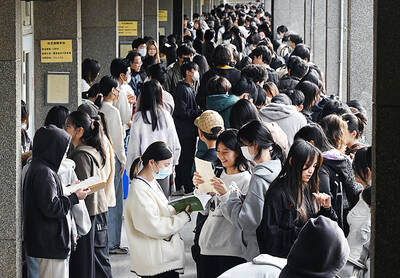
A global survey showed that 60 percent of Taiwanese had attained higher education, second only to Canada, the Ministry of the Interior said. Taiwan easily surpassed the global average of 43 percent and ranked ahead of major economies, including Japan, South Korea and the US, data from the Organisation for Economic Co-operation and Development (OECD) for 2024 showed. Taiwan has a high literacy rate, data released by the ministry showed. As of the end of last year, Taiwan had 20.617 million people aged 15 or older, accounting for 88.5 percent of the total population, with a literacy rate of 99.4 percent, the data

CCP ‘PAWN’? Beijing could use the KMT chairwoman’s visit to signal to the world that many people in Taiwan support the ‘one China’ principle, an academic said Chinese Nationalist Party (KMT) Chairwoman Cheng Li-wun (鄭麗文) yesterday arrived in China for a “peace” mission and potential meeting with Chinese President Xi Jinping (習近平), while a Taiwanese minister detailed the number of Chinese warships currently deployed around the nation. Cheng is visiting at a time of increased Chinese military pressure on Taiwan, as the opposition-dominated Legislative Yuan stalls a government plan for US$40 billion in extra defense spending. Speaking to reporters before going to the airport, Cheng said she was going on a “historic journey for peace,” but added that some people felt uneasy about her trip. “If you truly love Taiwan,

NEW LOW: The council in 2024 based predictions on a pessimistic estimate for the nation’s total fertility rate of 0.84, but last year that rate was 0.69, 17 percent lower An expected National Development Council (NDC) report expects the nation’s population to drop below 12 million by 2065, with the old-age dependency ratio to top 100 percent sooner than 2070, sources said yesterday. The council is slated to release its latest population projections in August, using an ultra-low fertility model, the sources said. The previous report projected that Taiwan’s population would fall to 14.37 million by 2070, but based on a new estimate of the total fertility rate (TFR) — the average number of children born to a woman over her lifetime — the population is expected to reach 12 million by


 RSS
RSS