


Japan’s top court yesterday ruled that a defunct eugenics law under which thousands of people were forcibly sterilized from 1948 to 1996 was unconstitutional.
The Japanese Supreme Court also declared that a 20-year statute of limitations could not be applied, paving the way for compensation claims from victims after years of legal battles.
“For the state to evade responsibility for damages payments would be extremely unfair and unjust, and absolutely intolerable,” the court in Tokyo said.
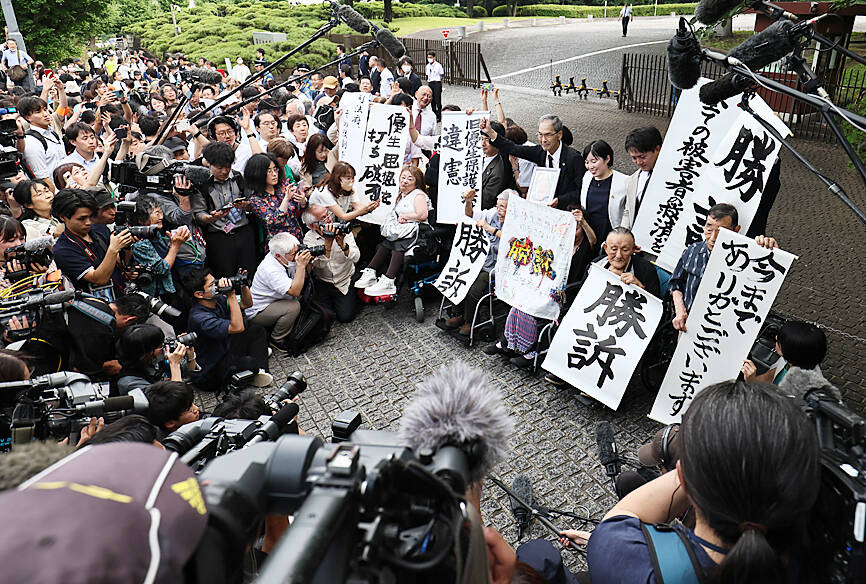
Photo: EPA-EFE
The Japanese government accepted that about 16,500 people were forcibly sterilized under the law that aimed to “prevent the generation of poor-quality descendants.”
An additional 8,500 people were sterilized with their consent, although lawyers say even those cases were likely “de facto forced” because of the pressure they faced.
A 1953 Japanese government notice said physical restraint, anaesthesia and even “deception” could be used for the operations.
“There are people who couldn’t be here today. There are those who died as well. I want to visit the grave of my parents and tell them we’ve won,” victim Saburo Kita, who uses a pseudonym, told reporters after the ruling.
Kita was convinced to undergo a vasectomy when he was 14 at a facility for troubled children. He only told his wife what had happened shortly before she died in 2013.
“But a complete resolution of this issue hasn’t been realized yet. Together with lawyers, I will continue to fight,” said Kita, one of several victims who celebrated outside the court, some in wheelchairs.
The number of operations in Japan slowed to a trickle in the 1980s and 1990s before the law was scrapped in 1996.
That dark history was thrust back under the spotlight in 2018 when a woman in her 60s sued the Japanese government over a procedure she had undergone at age 15.


Taiwan has arranged for about 8 million barrels of crude oil, or about one-third of its monthly needs, to be shipped from the Red Sea this month to bypass the Strait of Hormuz and ease domestic supply pressures, CPC Corp, Taiwan (CPC, 台灣中油) said yesterday. The state-run oil company has worked with Middle Eastern suppliers to secure routes other than the Strait of Hormuz, through which about 20 percent of the world’s oil and liquefied natural gas typically passes, CPC chairman Fang Jeng-zen (方振仁) said at a meeting of the legislature’s Economics Committee in Taipei. Suppliers in Saudi Arabia have indicated they
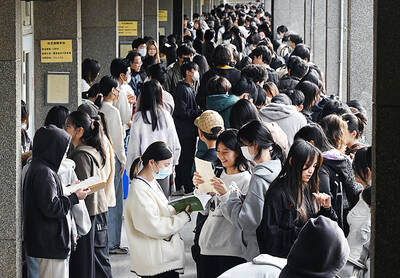
A global survey showed that 60 percent of Taiwanese had attained higher education, second only to Canada, the Ministry of the Interior said. Taiwan easily surpassed the global average of 43 percent and ranked ahead of major economies, including Japan, South Korea and the US, data from the Organisation for Economic Co-operation and Development (OECD) for 2024 showed. Taiwan has a high literacy rate, data released by the ministry showed. As of the end of last year, Taiwan had 20.617 million people aged 15 or older, accounting for 88.5 percent of the total population, with a literacy rate of 99.4 percent, the data

CCP ‘PAWN’? Beijing could use the KMT chairwoman’s visit to signal to the world that many people in Taiwan support the ‘one China’ principle, an academic said Chinese Nationalist Party (KMT) Chairwoman Cheng Li-wun (鄭麗文) yesterday arrived in China for a “peace” mission and potential meeting with Chinese President Xi Jinping (習近平), while a Taiwanese minister detailed the number of Chinese warships currently deployed around the nation. Cheng is visiting at a time of increased Chinese military pressure on Taiwan, as the opposition-dominated Legislative Yuan stalls a government plan for US$40 billion in extra defense spending. Speaking to reporters before going to the airport, Cheng said she was going on a “historic journey for peace,” but added that some people felt uneasy about her trip. “If you truly love Taiwan,

NEW LOW: The council in 2024 based predictions on a pessimistic estimate for the nation’s total fertility rate of 0.84, but last year that rate was 0.69, 17 percent lower An expected National Development Council (NDC) report expects the nation’s population to drop below 12 million by 2065, with the old-age dependency ratio to top 100 percent sooner than 2070, sources said yesterday. The council is slated to release its latest population projections in August, using an ultra-low fertility model, the sources said. The previous report projected that Taiwan’s population would fall to 14.37 million by 2070, but based on a new estimate of the total fertility rate (TFR) — the average number of children born to a woman over her lifetime — the population is expected to reach 12 million by


 RSS
RSS