


A rocket made by a Japanese company exploded seconds after launch yesterday in a spectacular failure for the start-up’s bid to put a satellite into orbit.
Tokyo-based Space One’s 18m Kairos rocket blasted off in Wakayama Prefecture in western Japan, carrying a small government test satellite.
However, about five seconds later, the solid-fuel rocket erupted in fire, sending white smoke billowing around the remote mountainous area as orange flames raged on the ground, live footage showed.
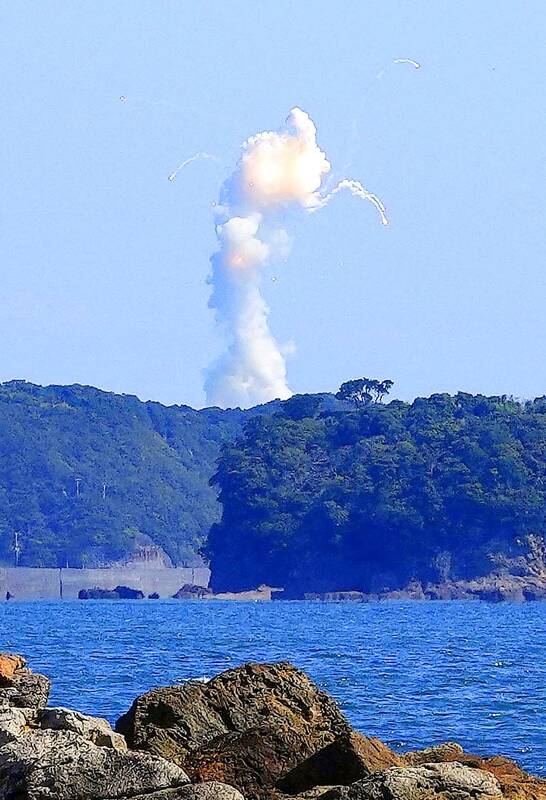
Photo: Kyodo / Reuters
Space One said that it had taken the decision to “abort the flight” and details were being investigated.
“We want to accept this outcome in a forward-looking manner and embark on our next challenge,” company president Masakazu Toyoda told reporters, adding that Space One does not use the term “failure.”
The company wishes to “contribute to the expansion of space-related services” through satellite launches by its rockets, Toyoda said.
Burning debris fell onto the surrounding slopes as sprinklers began spraying water, in dramatic scenes watched by hundreds of spectators gathered at public viewing areas including a nearby waterfront.
Space One is hoping to become Japan’s first private firm to put a satellite into orbit.
The plan had been for Kairos — an ancient Greek word meaning “the right moment” — to do so about 51 minutes after take-off yesterday morning.
The launch had already reportedly been postponed five times due to parts shortages and other problems, most recently on Saturday.
Katsumasa Tashima, the mayor of Kushimoto, the district in Wakayama where Space One’s launch site Spaceport Kii is, voiced his surprise and disappointment.
“I didn’t even imagine an outcome like this,” Tashima told reporters shortly after the explosion.
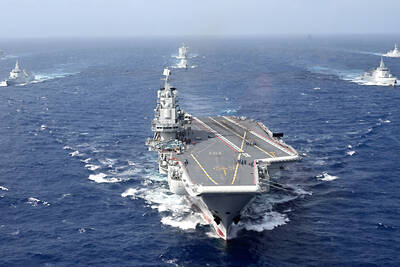
PROVOCATIVE: Chinese Deputy Ambassador to the UN Sun Lei accused Japan of sending military vessels to deliberately provoke tensions in the Taiwan Strait China denounced remarks by Japan and the EU about the South China Sea at a UN Security Council meeting on Monday, and accused Tokyo of provocative behavior in the Taiwan Strait and planning military expansion. Ayano Kunimitsu, a Japanese vice foreign minister, told the Council meeting on maritime security that Tokyo was seriously concerned about the situation in the East China and South China seas, and reiterated Japan’s opposition to any attempt to change the “status quo” by force, and obstruction of freedom of navigation and overflight. Stavros Lambrinidis, head of the EU delegation to the UN, also highlighted South China Sea
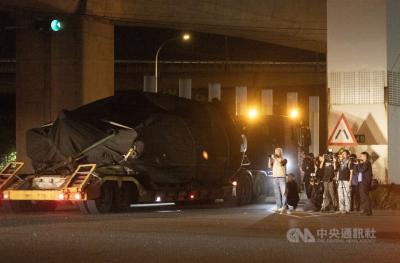
The final batch of 28 M1A2T Abrams tanks purchased from the US arrived at Taipei Port last night and were transported to the Armor Training Command in Hsinchu County’s Hukou Township (湖口), completing the military’s multi-year procurement of 108 of the tanks. Starting at 12:10am today, reporters observed more than a dozen civilian flatbed trailers departing from Taipei Port, each carrying an M1A2T tank covered with black waterproof tarps. Escorted by military vehicles, the convoy traveled via the West Coast Expressway to the Armor Training Command, with police implementing traffic control. The army operates about 1,000 tanks, including CM-11 Brave Tiger
Taiwan Semiconductor Manufacturing Co (TSMC, 台積電), the world’s largest contract chipmaker, said it expects its 2-nanometer (2nm) chip capacity to grow at a compound annual rate of 70 percent from this year to 2028. The projection comes as five fabs begin volume production of 2-nanometer chips this year — two in Hsinchu and three in Kaohsiung — TSMC senior vice president and deputy cochief operating officer Cliff Hou (侯永清) said at the company’s annual technology symposium in Silicon Valley, California, last week. Output in the first year of 2-nanometer production, which began in the fourth quarter of last year, is expected to
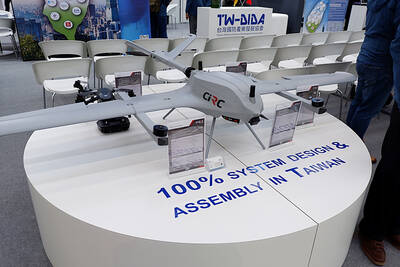
Taiwan’s drone exports surged past US$100 million in the first quarter, exceeding last year’s full-year total, with the Czech Republic emerging as the largest buyer, the Ministry of Economic Affairs said. Exports of complete drones reached US$115.85 million in the period, about 1.2 times the total recorded for all of last year, the ministry said in a report. Exports to the Czech Republic accounted for about US$100 million, far outpacing other markets. Poland, last year’s top destination, recorded about US$11.75 million in the first quarter. Taiwan’s drone exports have expanded rapidly in the past few years, with last year’s total


 RSS
RSS