


The US-Taiwan 21st Century Trade Initiative topped a list of key accomplishments and priorities in a release on US President Joe Biden’s trade policy agenda issued by the Office of the United States Trade Representative (USTR) on Friday.
“Trade is an integral part of our Administration’s vision to fundamentally shift our economic policies to focus on strengthening our middle class and working communities,” a release from the office quoted US Trade Representative Katherine Tai (戴琪) as saying.
“The 2024 Trade Policy Agenda and 2023 Annual Report include key accomplishments and priorities to realize this vision. We are creating new and innovative trade arrangements with our allies and partners, enforcing existing ones, and bringing more diverse voices to the table — to drive inclusive economic growth for more people across our society,” Tai said.
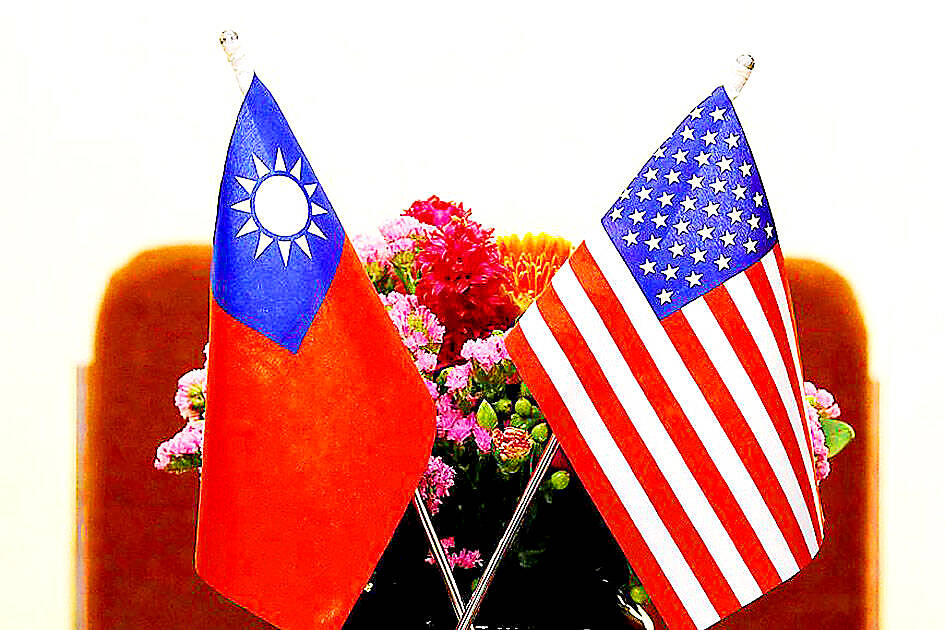
Photo: Tyrone Siu, Reuters
The US-Taiwan 21st Century Trade Initiative topped a list in the release below the words: “USTR is implementing the Biden-Harris Administration’s economic vision by negotiating historic trade arrangements with our allies and partners.”
“In June 2023, the United States and Taiwan, under the auspices of the American Institute in Taiwan (AIT) and the Taipei Economic and Cultural Representative Office in the United States (TECRO), signed the first agreement under the Initiative, which includes high-standard commitments and economically meaningful outcomes in a number of areas,” the release said.
“The United States and Taiwan, under the auspices of AIT and TECRO, will continue negotiating a second agreement covering other economically significant areas,” it said.
The US-Taiwan 21st Century Trade Initiative was listed second in Section I of the 2024 Trade Policy Agenda and 2023 Annual Report of the President of the United States on the Trade Agreements Program, after Indo-Pacific Economic Framework for Prosperity.
Other programs mentioned under the section — which was titled “Agreement, Negotiations, and Other Initiatives” — included the US-Kenya Strategic Trade and Investment Partnership, US-Kenya Strategic Trade and Investment Partnership, and US-Japan Critical Minerals Agreement.
The report said that the US and Taiwan would continue to hold follow-up negotiations on the US-Taiwan 21st Century Trade Initiative.
The US-Taiwan initiative “is intended to develop concrete ways to deepen the economic and trade relationship between the two economies, advance mutual trade priorities based on shared values, and promote innovation and inclusive economic growth for workers and businesses,” the report said.
In June last year, Taiwan and the US signed the first agreement under the initiative, which covers the areas of customs administration and trade facilitation, good regulatory practices, domestic regulation of services, fighting corruption and small and medium-sized enterprises.
“The United States places a high priority on partnering with Taiwan to further deepen and strengthen our trade and investment relationship,” the report said.
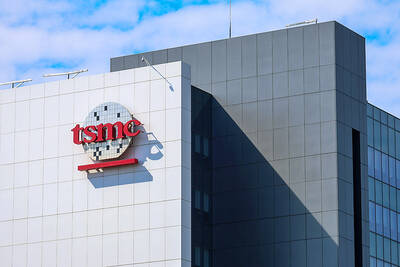
Taiwan Semiconductor Manufacturing Co (TSMC, 台積電), the world’s largest foundry service provider, yesterday said that global semiconductor revenue is projected to hit US$1.5 trillion in 2030, after the figure exceeds US$1 trillion this year, as artificial intelligence (AI) demand boosts consumption of token and compute power. “We are still at the beginning of the AI revolution, but we already see a significant impact across the whole semiconductor ecosystem,” TSMC deputy cochief operating officer Kevin Zhang (張曉強) said at the company’s annual technology symposium in Hsinchu City. “It is fair to say that in the past decade, smartphones and other mobile devices were
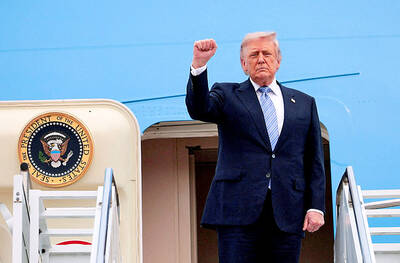
US-CHINA SUMMIT: MOFA welcomed US reassurance of no change in its Taiwan policy; Trump said he did not comment when Xi talked of opposing independence US President Donald Trump yesterday said he has not made a decision on whether to move forward with a major arms package for Taiwan after hearing concerns about it from Chinese President Xi Jinping (習近平). Trump’s comments on Taiwan came as he flew back to Washington after wrapping up critical talks in which both leaders said important progress was made in stabilizing US-China relations even as deep differences persist between the world’s two biggest powers on Iran and Taiwan. “I will make a determination,” Trump said, adding: “I’ll be making decisions. But, you know, I think the last thing we need right
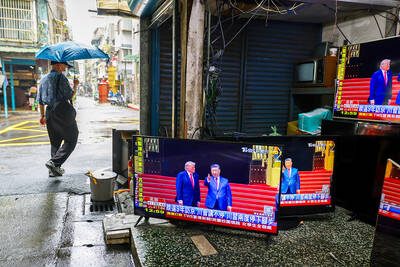
TAIWAN ISSUE: US treasury secretary Scott Bessent said on the first day of meetings that ‘it wouldn’t be a US-China summit without the Taiwan issue coming up’ There were no surprises on the first day of the summit between US President Donald Trump and Chinese President Xi Jinping (習近平), the Mainland Affairs Council (MAC) said yesterday, as the government reiterated that cross-strait stability is crucial to the Asia-Pacific region, as well as the world. As the two presidents met for a highly anticipated summit yesterday, Chinese state media reported that Xi warned Trump that missteps regarding Taiwan could push their two countries into “conflict.” Trump arrived in China with accolades for his host, calling Xi a “great leader” and “friend,” and extending an invitation to visit the White House
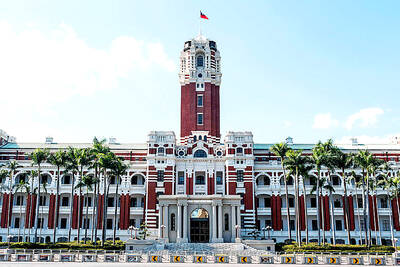
SECURITY: Taipei presses the US for arms supplies, saying the arms sales are not only a reflection of the US security commitment to Taiwan but also serve as a mutual deterrent against regional threats Taiwan is committed to preserving the cross-strait “status quo” and contributing to regional peace and stability, the Presidential Office said yesterday. “It is an undeniable fact that the Republic of China is a sovereign and independent democratic nation,” Presidential Office spokeswoman Karen Kuo (郭雅慧) reiterated, adding that Beijing has no right to claim sovereignty over Taiwan. The statements came after US President Donald Trump warned against Taiwanese independence. Trump wrapped up a state visit to Beijing on Friday, during which Chinese President Xi Jinping (習近平) had pressed him not to support Taiwan. Taiwan depends heavily on US security backing to deter China from carrying


 RSS
RSS