


Tens of thousands of people last night flocked to noisy, colorful rallies to support the three parties in Taiwan with presidential tickets as they made their final push for votes ahead of today’s presidential and legislative elections.
Today’s presidential election is being closely watched around the world, as the winner will lead the strategically important nation — a major producer of vital semiconductors — as it manages ties with China.
Democratic Progressive Party (DPP) heavyweights headed motorcades during the day before two major election-eve rallies, one in the north and one in the south, to boost support for its ticket of Vice President William Lai (賴清德) and his running mate, former representative to the US Hsiao Bi-khim (蕭美琴).
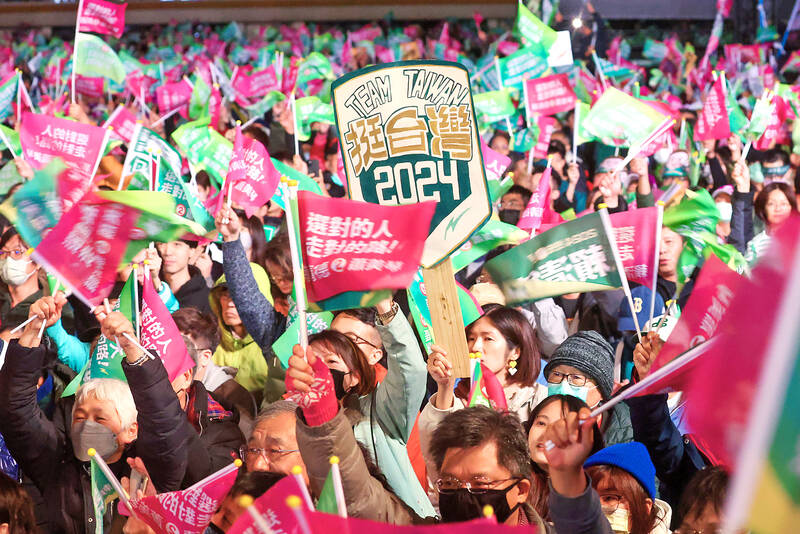
Photo: CNA
At the first DPP rally in Tainan, Lai shared the stage with his wife, the six DPP legislative candidates in the city and city officials.
He urged supporters to vote for the party’s candidates.
“Each of your ballots will help safeguard Taiwan,” Lai told the crowd. “Every vote would help unify our nation and make progress on the road.”
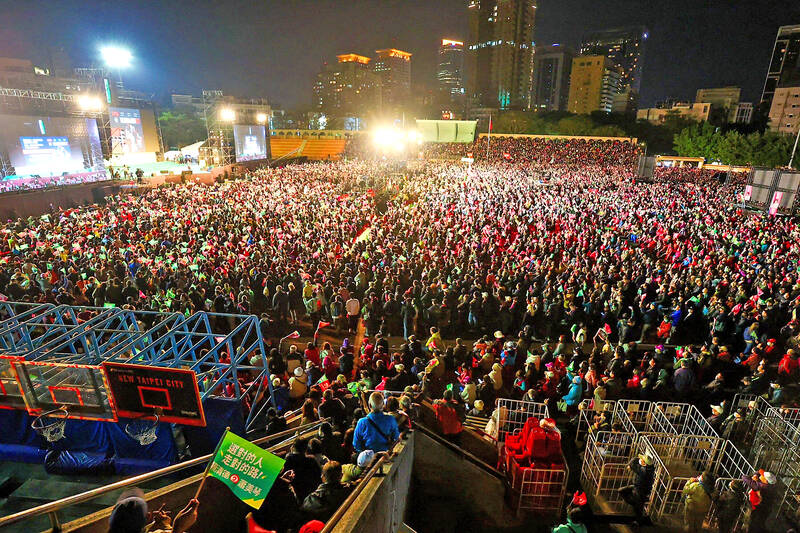
Photo: CNA
“Together we can win to safeguard Taiwan’s democracy and freedom,” he said. “Let us usher in a new era tomorrow [today].”
Speaking mainly in Hoklo (also known as Taiwanese), Lai said that Tainan is his adopted hometown, as he started his political career in the city and served it as a legislator and a two-term mayor.
Moreover, Hsiao’s family is from Tainan and she grew up in the city, he said.
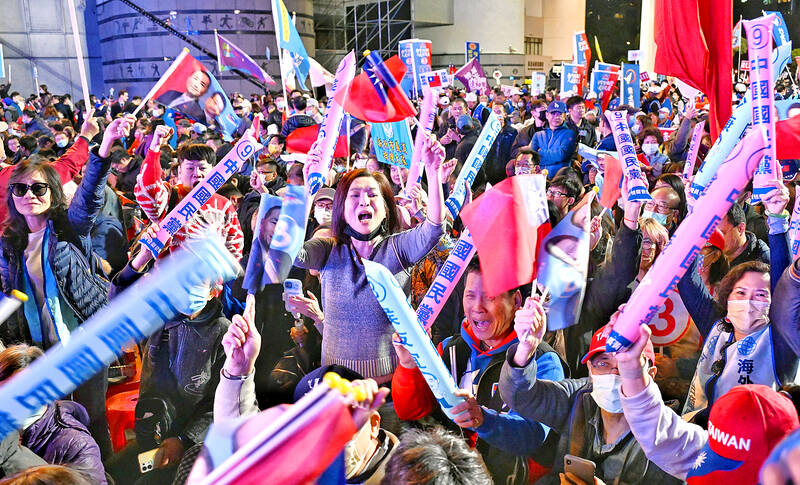
Photo: Fang Pin-chao, Taipei Times
“Let us ensure that for the first time in Taiwan’s history, the president and vice president will be from Tainan,” he said.
Lai and Hsiao traveled to New Taipei City’s Second Stadium in Banciao District (板橋) for the second rally.
Event organizers said that 50,000 people attended the Tainan rally and more than 250,000 were at the New Taipei City event.
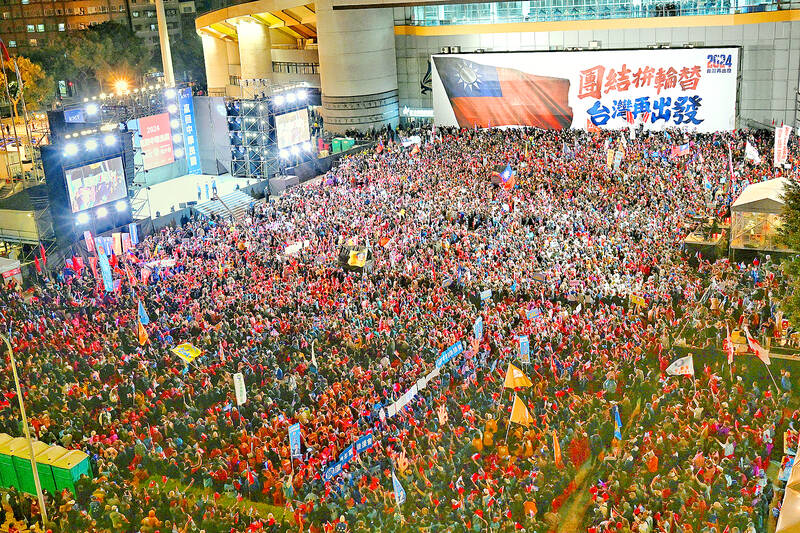
Photo: Fang Pin-chao, Taipei Times
The Chinese Nationalist Party (KMT) also held its rally in Banciao, with the theme “winning back the Republic of China.”
“We want peace, not war,” supporters chanted. “Vote out the DPP.”
Event organizers said that about 250,000 people attended the rally
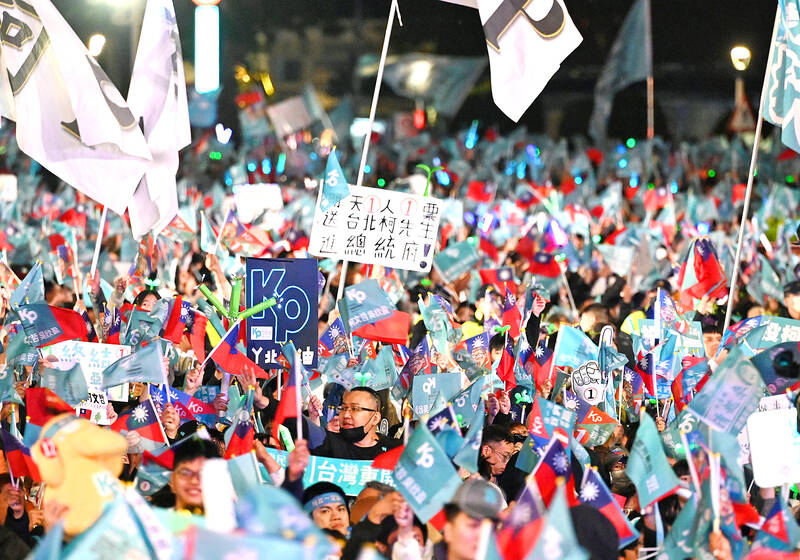
Photo: Wang Yi-sung, Taipei Times
Former legislative speaker Wang Jin-pyng (王金平) told the crowd that their ballots would decide Taiwan’s fate and whether there was peace or war.
Former Kaohsiung mayor Han Kuo-yu (韓國瑜) said that he has only one mission as the top name on the party’s list of legislator-at-large nominees — to “give the ROC and Taiwan a clean government.”
Taipei Mayor Chiang Wan-an (蔣萬安) said that people should be clear that their decision today will decide Taiwan’s future.
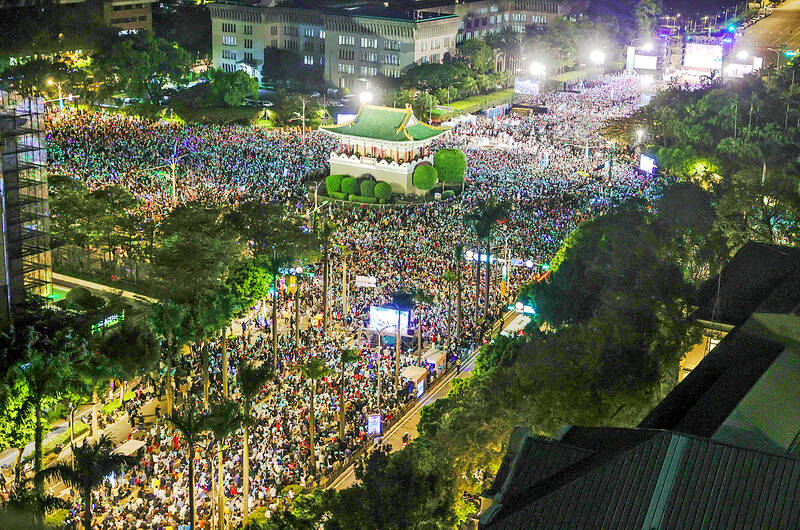
Photo: CNA
New Taipei City Mayor Hou You-yi (侯友宜), the KMT’s presidential candidate, his running mate, Jaw Shaw-kong (趙少康), and KMT Chairman Eric Chu (朱立倫) took the stage at about 9pm.
Hou said that the rule of law was a core aspect of governance, something that the DPP lacked.
Lai represents the possibility of war, he said, adding that voters should choose peace and prosperity.
In Taipei, the Taiwan People’s Party (TPP) held its rally on Ketagalan Boulevard.
Supporters of TPP Chairman and presidential candidate Ko Wen-je (柯文哲) said in front of the Presidential Office Building that “Taiwan’s choice is Ko Wen-je.”
Ko has said that the other two candidates are caught in an ideological deadlock and make people sick with their talk about China.
Presenters and TPP legislative candidates on stage said Ko is independent of the “two-party system.”
Internet celebrity Holger Chen (陳之漢) was among the influencers who spoke at the rally.
Four years ago, figures from the pan-blue and pan-green camps were vying for time on his show, but they have not delivered on their promises of housing justice and judicial reform, Chen said.
“We will give the nation back to the people. We will send Ko to the Presidential Office for the next four years and change Taiwan’s political culture,” he said.
“Love for Taiwan is not patented by the DPP,” he said, before leading the crowd in a chant of “Pull the DPP from the shelves.”
“The DPP and the KMT have shared the presidency for the past 24 years, but have your lives improved?” asked Legislator Cynthia Wu (吳欣盈), Ko’s running mate.
The two-party system has left the nation at a standstill, Wu said.
“We are walking the last mile to victory and I ask you to stay the course,” Ko said.
Event organizers said the attendance was about 300,000 people.

‘NO SECURITY RISK’: The Railway Bureau reassured the public that the technicians’ activities were limited to technical guidance and did not involve sensitive systems The Railway Bureau yesterday said it had invited eight Chinese technicians to assist with an airport MRT construction project. The bureau issued the confirmation after an Internet user said Chinese nationals had entered the construction zone of Taiwan Taoyuan International Airport’s Terminal 3 project. They asked why “individuals from an enemy state” were allowed access to such a major national infrastructure project, which raised serious concerns over Taiwan’s industrial safety, sensitive systems and information security. The bureau’s Northern Region Engineering Branch Office said subcontractor Taiwan Handle Industrial Co (台灣手把工業) of the Taoyuan airport MRT’s “Contract No. CU05 Project A14 Station Civil, MEP &

A US uncrewed surface vessel (USV) encountered multiple Chinese warships during an autonomous transit of the Taiwan Strait, US defense company Seasats said in a statement on Wednesday. Seasats announced that a Lightfish USV had completed the first autonomous transit of the Taiwan Strait. Over five days, the USV traversed the entire length of the Strait while constantly monitoring surface vessel traffic, the company said. The Lightfish encountered multiple Chinese warships, one of which was a Chinese People’s Liberation Army Navy (PLAN) Type 056 corvette, it said. The Chinese vessels were operating “well within Taiwan’s exclusive economic zone without transmitting their identity via the
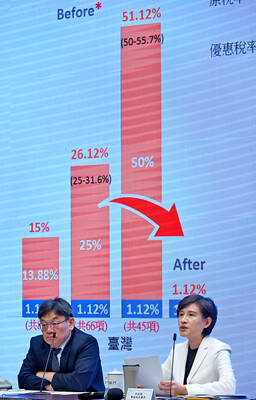
GREATER REACH? Auto parts and wood products would face tariffs of up to 15%, matching those targeting the EU, Japan and South Korea, Vice Premier said The US has announced that preferential tariff treatment for Taiwan’s non-semiconductor Section 232 goods would take effect retroactively from May 1, the Executive Yuan said yesterday. The US government yesterday posted a notice on the Federal Register’s public inspection Web site previewing tariff concessions for Taiwan under a memorandum of understanding (MOU) on Taiwan-US investment after two months of negotiations. The MOU signed on Jan. 15 stipulated three major preferential tariff arrangements: a 15 percent “reciprocal” tariff rate for Taiwan without stacking most-favored nation (MFN) rates; preferential Section 232 treatment for semiconductors and related products; and preferential Section 232 treatment for non-semiconductor

TIT-FOR-TAT: The US allegedly revoked the visa of a Chinese national working at Xinhua News Agency in the US in response to Beijing’s expulsion of Vivian Wang The Presidential Office yesterday condemned China for expelling a New York Times correspondent from Beijing following the newspaper’s interview with President William Lai (賴清德), saying the move highlighted Beijing’s suppression of press freedom and its threat to international news media. Taiwan has noted a series of recent incidents in which Beijing used similar tactics to “threaten and pressure international media outlets and journalists,” Presidential Office spokeswoman Karen Kuo (郭雅慧) said in a statement. “This concerns not only press freedom and freedom of expression, but also the safety of journalists, and Taiwan and relevant partners are paying close attention to the situation,” she


 RSS
RSS