


US Secretary of State Antony Blinken warned China not to repeat its “irresponsible act” of sending a spy balloon into US airspace, as he held rare talks late on Saturday with Chinese Central Foreign Affairs Commission Director Wang Yi (王毅).
The highly anticipated meeting of the two senior officials came on the sidelines of the Munich Security Conference amid growing tensions between Washington and Beijing.
The US has been in a state of alarm since a large white balloon from China was spotted over several restricted secret nuclear weapons sites, before being shot down just off the east coast on Feb. 4. The incident led Blinken to abruptly call off a rare trip to China.
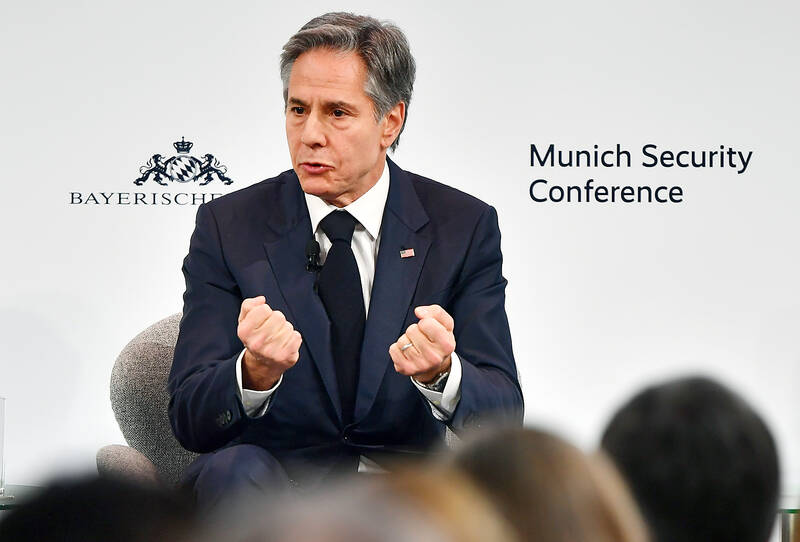
Photo: EPA-EFE
Beijing denies it uses spy balloons and says the craft was for weather research.
Subsequently, it accused Washington of sending its own espionage balloons over Chinese territory, which the US has denied.
During their encounter on Saturday, Blinken “directly spoke to the unacceptable violation of US sovereignty and international law by [China’s] high-altitude surveillance balloon in US territorial airspace, underscoring that this irresponsible act must never again occur,” US Department of State spokesman Ned Price said.
“The secretary made clear the United States will not stand for any violation of our sovereignty,” he added.
He also warned Wang “about the implications and consequences if China provides material support to Russia or assistance with systemic sanctions evasion,” Price said.
Blinken was “very direct and candid” during the talks, which lasted about an hour, a senior state department official said, adding that he was also “quite blunt” when they spoke about Russia.
In turn, Wang told Blinken that their countries’ relations had been damaged by how Washington reacted to the balloon.
Wang “made clear China’s solemn position on the so-called airship incident,” and “urged the US side to change course, acknowledge and repair the damage that its excessive use of force caused to China-US relations,” Xinhua news agency reported.
Speaking earlier on Saturday at the gathering of world leaders in Munich, Germany, Wang had condemned the US’ reaction to the balloon as “hysterical and absurd.”
In uncharacteristically strong remarks against Washington, Wang said US President Joe Biden’s administration had a “misguided” perception of Beijing.
He accused the US of trying to “smear” China, while implementing policies that ran counter to its paradigms, such as free trade.
“There are many balloons from many countries in the sky. Do you want to down ... every one of them?” Wang said. “We urge the United States not to do such preposterous things simply to divert attention from its own domestic problems.”
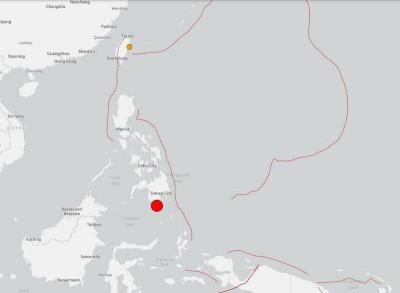
A magnitude 7.8 earthquake struck off the southern coast of Mindanao in the Philippines at 7:38am today, prompting the US Tsunami Warning System to issue an alert for neighboring countries, including Taiwan. The system issued a purple alert indicating a "tsunami threat." The potential threat zone includes Taiwan, the Philippines, Papua New Guinea, Yap and Palau. Philippine authorities were assessing the damage from the quake, with the office of civil defense seeking to verifying initial reports that 15 people had been killed and 129 injured in the region, mostly from falling debris. Arlene Hollero, disaster chief of Maasim town in the Philippines' Sarangani Province,
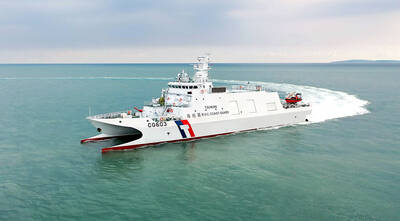
‘GRAY ZONE’ PRESSURE: Beijing’s activities are intended to create the deceitful impression that China has jurisdiction over the area around Taiwan, the CGA said Taiwan’s rights over its territorial waters and exclusive economic zone must not be violated by any country, the Mainland Affairs Council said yesterday, adding that it will not accept any unprovoked actions. The council issued the remarks in response to the China Coast Guard conducting maritime enforcement drills near eastern Taiwan and claiming to fully exercise China’s maritime administrative law enforcement authority. The Coast Guard Administration (CGA) has been closely monitoring the situation and is taking concrete steps to defend the nation’s sovereignty and secure its waters, the council said. China has no sovereign rights over the waters off eastern
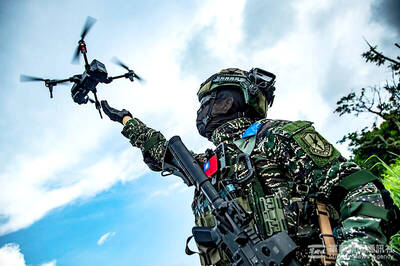
RESILIENCE: Taiwan plays a key role in semiconductors, energy, information infrastructure and advanced manufacturing, AIT Director Raymond Greene said Taiwan’s continued investment in deterrence and resilience remains vital, especially in uncrewed systems and other emerging technologies, American Institute in Taiwan (AIT) Director Raymond Greene said yesterday. Greene made the remarks at the annual National Strategic Summit on Supply Chain Resilience held by the Research Institute for Democracy, Society and Emerging Technology (DSET), a government-backed think tank. As Taiwan last year became the US’ fourth-largest trading partner and supply chain security is becoming more important, cooperation in emerging technologies continues to deepen between the two countries, he said. The US is committed to accelerating innovation, building key infrastructure, strengthening cooperation

The National Chungshan Institute of Science and Technology yesterday showcased its locally developed variants of the Vision 60 robotic patrol dog, which it plans to deploy on the nation’s outlying territories in the South China Sea. The variants were produced under the Joint Lab project — created by the institute and domestic companies — and assembled with domestically produced motors, lenses and artificial intelligence (AI) systems alongside licensed tech from the US, Missile and Rocket Systems Research Division deputy director Jen Kuo-kang (任國光) told the media event at a military base in Taipei’s Dazhi (大直) area. Taiwan has built up its strengths


 RSS
RSS