


Maintaining peace and stability in the Taiwan Strait is the consensus of democracies, the Ministry of Foreign Affairs (MOFA) said yesterday, after a meeting of US and EU officials on the Indo-Pacific region.
The ministry’s remarks followed a joint statement on Friday by US Deputy Secretary of State Wendy Sherman and European External Action Service Secretary-General Stefano Sannino that expressed concern about China’s provocations in the Strait.
The US, the EU and other like-minded countries have over the past few months made many public statements about upholding peace and stability in the Strait, showing that cross-strait peace is a consensus among democracies, the ministry said.
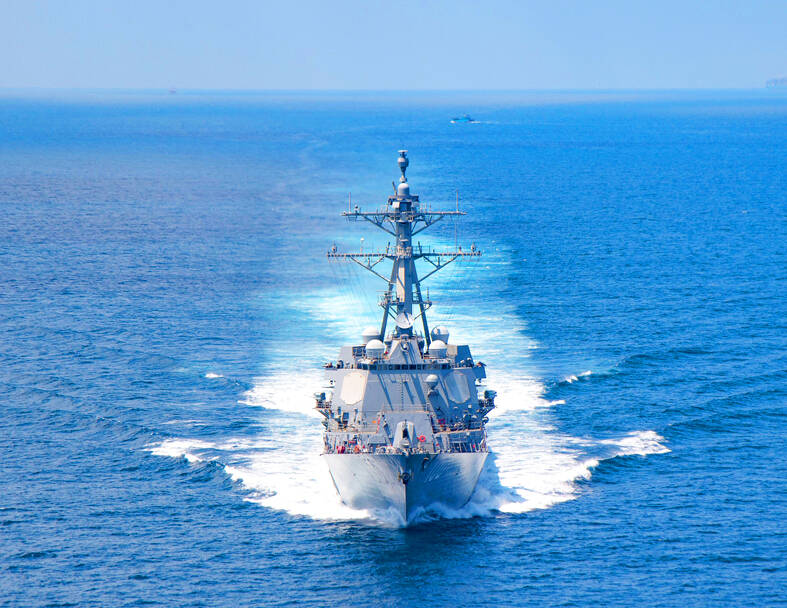
Photo: AFP
The statement was issued following the conclusion of the fourth high-level US-EU Dialogue on China on Thursday and a third meeting of the US-EU high-level consultations on the Indo-Pacific region on Friday.
The two sides “expressed concern about China’s provocations that increase the risk of crisis in the Strait, which would not only undermine peace and stability across the Strait, but also have serious impacts on the broader region and jeopardize global prosperity,” the joint statement said.
“They reiterated their commitment to maintaining the status quo and opposition to any unilateral actions which undermine it,” it added.

Photo: Reuters
Tensions across the Strait have escalated, in particular since a visit to Taipei by US House of Representatives Speaker Nancy Pelosi in early August, which was followed by China increasing its military exercises around Taiwan.
Since then, sorties by Chinese military planes into Taiwan’s air defense identification zone have become more frequent, and, unlike in the past, the aircraft sometimes cross the median line of the Taiwan Strait.
MOFA yesterday said it welcomed and thanked the US and the EU for their support, and for drawing attention to China’s provocative actions in the Strait.
The US’ and the EU’s constant vigilance on developments in the Strait and the Indo-Pacific region while authoritarian regimes are publicly challenging the international order is proof that democratic countries are resolved to work together to uphold a rules-based order, the ministry said.
As a member of the “democratic alliance” responsible for the Indo-Pacific region, Taiwan would continue to work with like-minded countries to uphold peace and stability in the Strait and the Indo-Pacific region, it added.
In the US-EU statement, the two sides reiterated their concerns about human rights in China, particularly in Xinjiang, Tibet, Inner Mongolia and Hong Kong.
They also discussed efforts to press Beijing to urge Moscow to end the war in Ukraine, it said.
At a separate meeting on Friday about their respective engagements in the Indo-Pacific region, US and EU officials expressed their intention to further pursue coordination and complementary work for regional maritime security, it said.
The two sides are planning to hold joint US-EU naval exercises in the first half of next year, while “pursuing joint capacity in the maritime domain to support freedom of navigation and other internationally lawful uses of the sea in the Indo-Pacific,” it added.

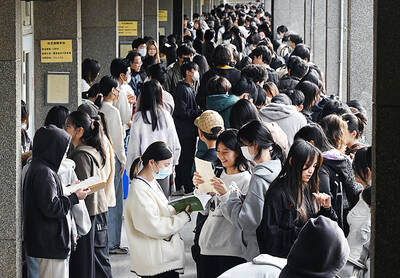
A global survey showed that 60 percent of Taiwanese had attained higher education, second only to Canada, the Ministry of the Interior said. Taiwan easily surpassed the global average of 43 percent and ranked ahead of major economies, including Japan, South Korea and the US, data from the Organisation for Economic Co-operation and Development (OECD) for 2024 showed. Taiwan has a high literacy rate, data released by the ministry showed. As of the end of last year, Taiwan had 20.617 million people aged 15 or older, accounting for 88.5 percent of the total population, with a literacy rate of 99.4 percent, the data

NEW LOW: The council in 2024 based predictions on a pessimistic estimate for the nation’s total fertility rate of 0.84, but last year that rate was 0.69, 17 percent lower An expected National Development Council (NDC) report expects the nation’s population to drop below 12 million by 2065, with the old-age dependency ratio to top 100 percent sooner than 2070, sources said yesterday. The council is slated to release its latest population projections in August, using an ultra-low fertility model, the sources said. The previous report projected that Taiwan’s population would fall to 14.37 million by 2070, but based on a new estimate of the total fertility rate (TFR) — the average number of children born to a woman over her lifetime — the population is expected to reach 12 million by
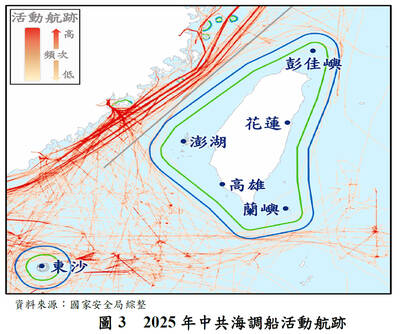
INTENSIFYING THREATS: Beijing’s tactics include massive attacks on the government service network, aircraft and naval vessel incursions and damaging undersea cables China is prepared to interfere in November’s nine-in-one local elections by launching massive attacks on the Taiwanese government’s service network (GSN), a report published by the National Security Bureau showed. The report was submitted to the Legislative Yuan ahead of the bureau’s scheduled briefing at the Foreign Affairs and National Defense Committee tomorrow. The national security team has identified about 13,000 suspicious Internet accounts and 860,000 disputed messages, the bureau said of China’s cognitive warfare against Taiwan. The disputed messages focus on major foreign affairs, national defense and economic issues, which were produced using generative artificial intelligence (AI) and distributed through Chinese

COUNTERING HOSTILITY: The draft bill would require the US to increase diplomatic pressure on China and would impose sanctions on those who sabotage undersea cable networks US lawmakers on Thursday introduced a bipartisan bill to bolster the resilience of Taiwan’s submarine cables to counter China’s hostile activities. The proposal, titled the critical undersea infrastructure resilience initiative act, was cosponsored by Republican representatives Mike Lawler and Greg Stanton, and Democratic Representative Dave Min. US Senators John Curtis and Jacky Rosen also introduced a companion bill in the US Senate, which has passed markup at the chamber’s Committee on Foreign Relations. The House’s version of the bill would prioritize the deployment of sensors to detect disruptions or potential sabotage in real-time and enhance early warning capabilities through global intelligence sharing frameworks,


 RSS
RSS