


Prompted by communication blackouts during the war in Ukraine and heightened military tensions across the Taiwan Strait, the Executive Yuan has launched drills to test the handling of critical infrastructure in the event of war, a person familiar with the matter said.
The Executive Yuan since June has been conducting drills, to run until the end of this month, to test the resilience of trains, ports, harbors, power plants, liquefied natural gas terminals, broadcasting towers, cable television stations and other parts of the nation’s infrastructure, the person said.
The drills were based on a worst-case scenario, in which all critical infrastructure points were simultaneously attacked, the source said.
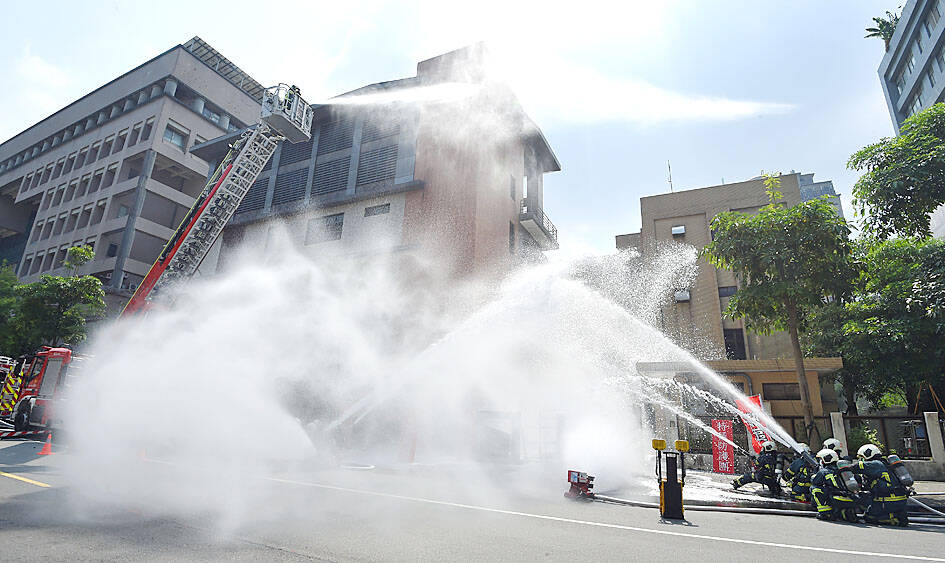
Photo: Liao Chen-hui, Taipei Times
Part of the goal was to train staff how to react in the event of war, and how to initiate emergency systems and resume operations in the shortest amount of time, the person said.
The administration of President Tsai Ing-wen (蔡英文) has over the past few years been incorporating emergency drills into its disaster prevention efforts to enhance its responses to natural and human emergencies, the source said.
Separately, the navy conducted a “111-2” joint exercise on intercepting operations in waters off Hualien and Taitung counties on Wednesday, the Chinese-language Youth Daily News and the Military News Agency said.
The exercise involved the mobile Hai Feng Shore-Based Anti-ship Missile Squadron, the Marine Corps’ 99th Marine Brigade and the Hualien County Military Police unit. It simulated foreign hostile undercover agents hijacking mobile missile launcher trucks to interrupt communication links, the reports said.
The defending troops fended off the simulated attack using truck-mounted 20mm cannons and 40mm grenade launchers, they said.
The joint exercise with the marines verfied cross-unit support capabilities, while drills using the military’s soldiers, vehicles and arms helped provide a “live” experience to evaluate and enhance troop capabilities for shore-based anti-surface operations, the military said.

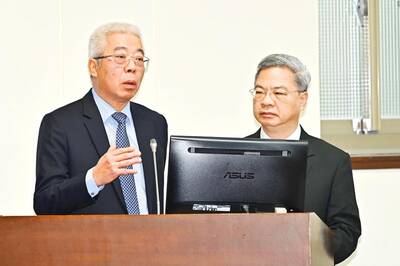
Taiwan has arranged for about 8 million barrels of crude oil, or about one-third of its monthly needs, to be shipped from the Red Sea this month to bypass the Strait of Hormuz and ease domestic supply pressures, CPC Corp, Taiwan (CPC, 台灣中油) said yesterday. The state-run oil company has worked with Middle Eastern suppliers to secure routes other than the Strait of Hormuz, through which about 20 percent of the world’s oil and liquefied natural gas typically passes, CPC chairman Fang Jeng-zen (方振仁) said at a meeting of the legislature’s Economics Committee in Taipei. Suppliers in Saudi Arabia have indicated they
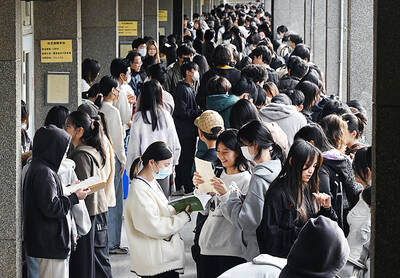
A global survey showed that 60 percent of Taiwanese had attained higher education, second only to Canada, the Ministry of the Interior said. Taiwan easily surpassed the global average of 43 percent and ranked ahead of major economies, including Japan, South Korea and the US, data from the Organisation for Economic Co-operation and Development (OECD) for 2024 showed. Taiwan has a high literacy rate, data released by the ministry showed. As of the end of last year, Taiwan had 20.617 million people aged 15 or older, accounting for 88.5 percent of the total population, with a literacy rate of 99.4 percent, the data

CCP ‘PAWN’? Beijing could use the KMT chairwoman’s visit to signal to the world that many people in Taiwan support the ‘one China’ principle, an academic said Chinese Nationalist Party (KMT) Chairwoman Cheng Li-wun (鄭麗文) yesterday arrived in China for a “peace” mission and potential meeting with Chinese President Xi Jinping (習近平), while a Taiwanese minister detailed the number of Chinese warships currently deployed around the nation. Cheng is visiting at a time of increased Chinese military pressure on Taiwan, as the opposition-dominated Legislative Yuan stalls a government plan for US$40 billion in extra defense spending. Speaking to reporters before going to the airport, Cheng said she was going on a “historic journey for peace,” but added that some people felt uneasy about her trip. “If you truly love Taiwan,

NEW LOW: The council in 2024 based predictions on a pessimistic estimate for the nation’s total fertility rate of 0.84, but last year that rate was 0.69, 17 percent lower An expected National Development Council (NDC) report expects the nation’s population to drop below 12 million by 2065, with the old-age dependency ratio to top 100 percent sooner than 2070, sources said yesterday. The council is slated to release its latest population projections in August, using an ultra-low fertility model, the sources said. The previous report projected that Taiwan’s population would fall to 14.37 million by 2070, but based on a new estimate of the total fertility rate (TFR) — the average number of children born to a woman over her lifetime — the population is expected to reach 12 million by


 RSS
RSS