


Eligibility to receive a second COVID-19 vaccine booster is to be expanded to include adults aged 50 or older from tomorrow, the Central Epidemic Command Center (CECC) said yesterday.
Eligibility is to be expanded from people aged 65 or older, residents of long-term care facilities, immunocompromised or immunosuppressed people who are 18 or older, healthcare providers, and people working at ports of entry, said Deputy Minister of Health and Welfare Victor Wang (王必勝), who heads the center.
“The second booster shot should be administered at least five months — or 150 days — after the first booster shot, while people who have had COVID-19 should get the shot at least three months after infection,” Wang said.
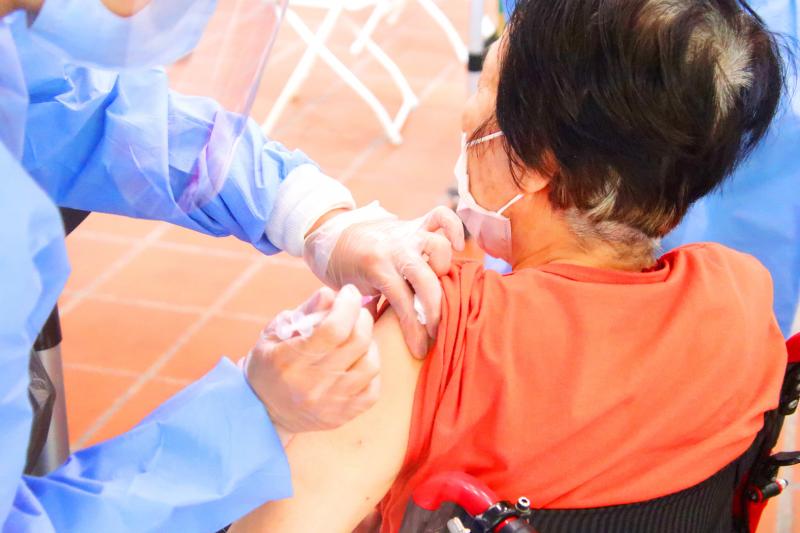
Photo: CNA
The policy has been approved by the Advisory Committee on Immunization Practices, he added.
From today, the center and local governments would begin vaccinations of children aged six months to five years with the Moderna COVID-19 vaccine, Wang added.
Local governments have been asked to arrange comfortable vaccination venues — avoiding exposure to sun or rain — that have enough space for social distancing and proper flow of people, he said, adding that evening or weekend sessions should be offered for the convenience of working parents.
Local governments are encouraged to contact the center if they need assistance with vaccination procedures, he said.
Centers for Disease Control (CDC) Director-General Chou Jih-haw (周志浩), head of the CECC’s disease surveillance division, said that 26,943 new local infections and 253 imported cases were confirmed yesterday, as well as 57 deaths.
Of the 57 deaths, the youngest was a woman in her 40s who had rheumatic disorders and was on immunosuppressive drugs, said CDC Deputy Director-General Philip Lo (羅一鈞), deputy head of the CECC’s medical response division.
The woman was unvaccinated and had coughing and shortness of breath for a few days before she died, but did not seek medical attention, Lo said.
She was found in a coma at home on Sunday and went into cardiac arrest before arriving at a hospital, where she tested positive for COVID-19 after emergency treatment failed, he said.
Regarding a previous case who tested positive for the Omicron BA.5 subvariant of SARS-CoV-2 — a woman in her 20s who had not traveled abroad in the prior six months — Lo said that genome sequencing was conducted on virus samples from her parents, but sequencing was unsuccessful, as their viral loads were too low.
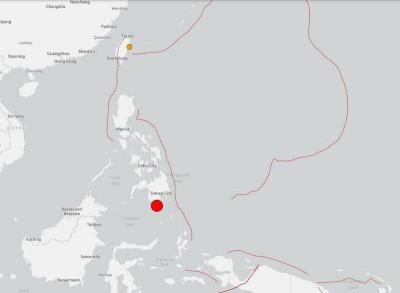
A magnitude 7.8 earthquake struck off the southern coast of Mindanao in the Philippines at 7:38am today, prompting the US Tsunami Warning System to issue an alert for neighboring countries, including Taiwan. The system issued a purple alert indicating a "tsunami threat." The potential threat zone includes Taiwan, the Philippines, Papua New Guinea, Yap and Palau. Philippine authorities were assessing the damage from the quake, with the office of civil defense seeking to verifying initial reports that 15 people had been killed and 129 injured in the region, mostly from falling debris. Arlene Hollero, disaster chief of Maasim town in the Philippines' Sarangani Province,
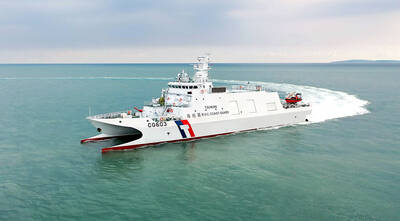
‘GRAY ZONE’ PRESSURE: Beijing’s activities are intended to create the deceitful impression that China has jurisdiction over the area around Taiwan, the CGA said Taiwan’s rights over its territorial waters and exclusive economic zone must not be violated by any country, the Mainland Affairs Council said yesterday, adding that it will not accept any unprovoked actions. The council issued the remarks in response to the China Coast Guard conducting maritime enforcement drills near eastern Taiwan and claiming to fully exercise China’s maritime administrative law enforcement authority. The Coast Guard Administration (CGA) has been closely monitoring the situation and is taking concrete steps to defend the nation’s sovereignty and secure its waters, the council said. China has no sovereign rights over the waters off eastern
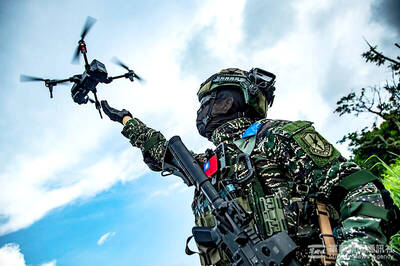
RESILIENCE: Taiwan plays a key role in semiconductors, energy, information infrastructure and advanced manufacturing, AIT Director Raymond Greene said Taiwan’s continued investment in deterrence and resilience remains vital, especially in uncrewed systems and other emerging technologies, American Institute in Taiwan (AIT) Director Raymond Greene said yesterday. Greene made the remarks at the annual National Strategic Summit on Supply Chain Resilience held by the Research Institute for Democracy, Society and Emerging Technology (DSET), a government-backed think tank. As Taiwan last year became the US’ fourth-largest trading partner and supply chain security is becoming more important, cooperation in emerging technologies continues to deepen between the two countries, he said. The US is committed to accelerating innovation, building key infrastructure, strengthening cooperation

The National Chungshan Institute of Science and Technology yesterday showcased its locally developed variants of the Vision 60 robotic patrol dog, which it plans to deploy on the nation’s outlying territories in the South China Sea. The variants were produced under the Joint Lab project — created by the institute and domestic companies — and assembled with domestically produced motors, lenses and artificial intelligence (AI) systems alongside licensed tech from the US, Missile and Rocket Systems Research Division deputy director Jen Kuo-kang (任國光) told the media event at a military base in Taipei’s Dazhi (大直) area. Taiwan has built up its strengths


 RSS
RSS