


The Central Epidemic Command Center (CECC) yesterday said that it would probably list monkeypox as a category 2 notifiable communicable disease today or tomorrow.
The WHO is to convene an emergency committee meeting today in accordance with the International Health Regulations to discuss whether the spread of monkeypox to 39 countries, including 32 non-endemic countries, constitutes a public health emergency of international concern.
On Tuesday, the Singaporean Ministry of Health confirmed its first imported case of monkeypox, which is also the first case reported in Southeast Asia.
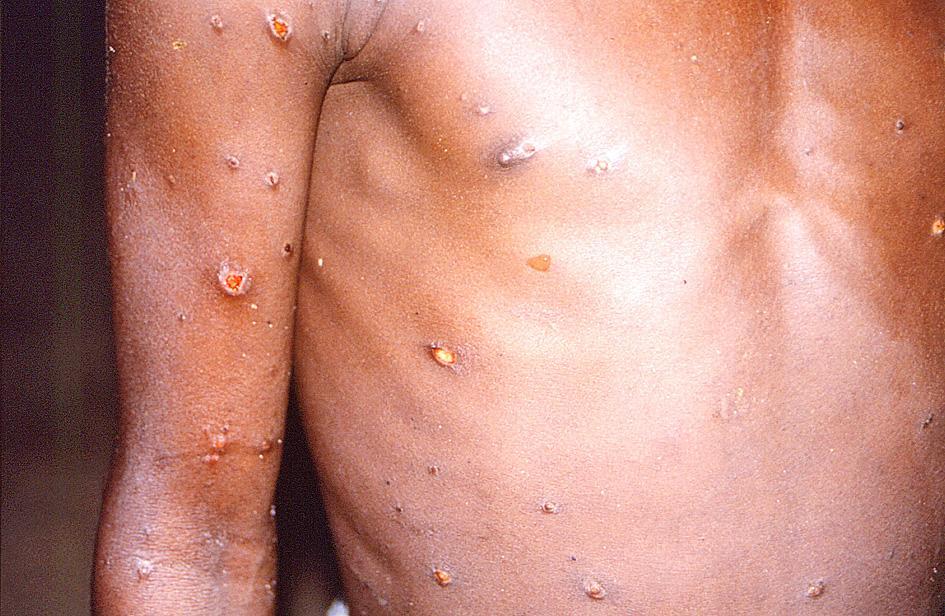
Photo: Reuters
South Korea yesterday reported its first confirmed case of monkeypox — a South Korean national who returned to the country on Tuesday.
Asked if Taiwan would step up its preventive measures against the disease, Centers for Disease Control Deputy Director-General Chuang Jen-hsiang (莊人祥), who is the CECC’s spokesman, said that health officials are discussing whether to list the viral infection as a notifiable communicable disease and are at the final approval stage.
Monkeypox is likely to be listed as a category 2 notifiable communicable disease and, if approved, the policy would be announced today or tomorrow at the earliest, Chuang said.
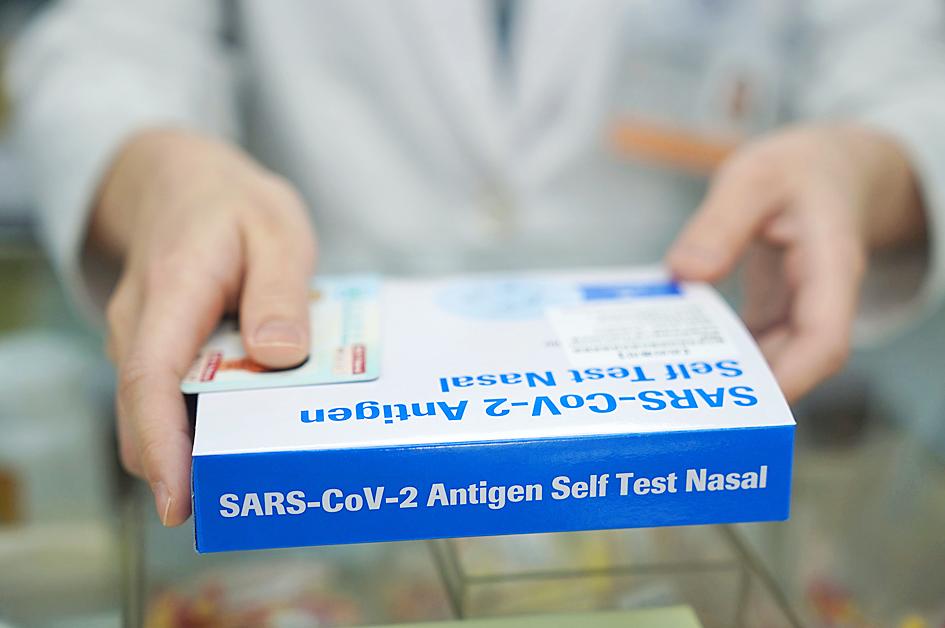
Photo: CNA
A man who last week returned to Taiwan from a trip to Europe had blisters and skin eruptions, but tested negative for monkeypox, Chuang said.
Separately, Chuang said that the definition of a confirmed COVID-19 case has been revised to include people who test positive with an at-home polymerase chain reaction (PCR) nucleic acid test that has been confirmed by a doctor.
Starting yesterday, people who test positive with a Food and Drug Administration-approved at-home PCR test and are confirmed to have the disease by a doctor would be considered a confirmed COVID-19 case, he said.
People who test positive with an at-home rapid antigen test and receive a doctor’s confirmation have been accepted as confirmed cases since May 26, he said.
The sensitivity and specificity of PCR tests are higher than rapid antigen tests, and the revision was made after a review by specialists, Chuang said.
People who test positive with either kind of test should write their name and test date on the test cassette, take a photograph of the cassette alongside their National Health Insurance card, and show it to a doctor during a telemedicine consultation, he said.
They should place the test cassette in a zipper bag if they are to see a doctor in person, Chuang said, adding that they are prohibited from taking public transport and are required to wear a mask throughout the trip.
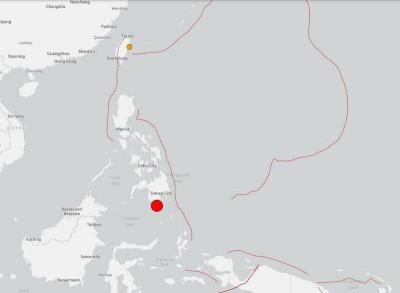
A magnitude 7.8 earthquake struck off the southern coast of Mindanao in the Philippines at 7:38am today, prompting the US Tsunami Warning System to issue an alert for neighboring countries, including Taiwan. The system issued a purple alert indicating a "tsunami threat." The potential threat zone includes Taiwan, the Philippines, Papua New Guinea, Yap and Palau. Philippine authorities were assessing the damage from the quake, with the office of civil defense seeking to verifying initial reports that 15 people had been killed and 129 injured in the region, mostly from falling debris. Arlene Hollero, disaster chief of Maasim town in the Philippines' Sarangani Province,
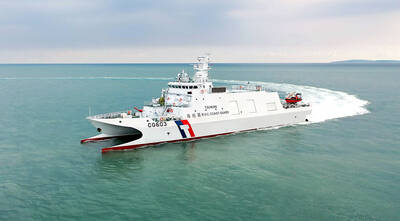
‘GRAY ZONE’ PRESSURE: Beijing’s activities are intended to create the deceitful impression that China has jurisdiction over the area around Taiwan, the CGA said Taiwan’s rights over its territorial waters and exclusive economic zone must not be violated by any country, the Mainland Affairs Council said yesterday, adding that it will not accept any unprovoked actions. The council issued the remarks in response to the China Coast Guard conducting maritime enforcement drills near eastern Taiwan and claiming to fully exercise China’s maritime administrative law enforcement authority. The Coast Guard Administration (CGA) has been closely monitoring the situation and is taking concrete steps to defend the nation’s sovereignty and secure its waters, the council said. China has no sovereign rights over the waters off eastern
RESILIENCE: Taiwan plays a key role in semiconductors, energy, information infrastructure and advanced manufacturing, AIT Director Raymond Greene said Taiwan’s continued investment in deterrence and resilience remains vital, especially in uncrewed systems and other emerging technologies, American Institute in Taiwan (AIT) Director Raymond Greene said yesterday. Greene made the remarks at the annual National Strategic Summit on Supply Chain Resilience held by the Research Institute for Democracy, Society and Emerging Technology (DSET), a government-backed think tank. As Taiwan last year became the US’ fourth-largest trading partner and supply chain security is becoming more important, cooperation in emerging technologies continues to deepen between the two countries, he said. The US is committed to accelerating innovation, building key infrastructure, strengthening cooperation

The National Chungshan Institute of Science and Technology yesterday showcased its locally developed variants of the Vision 60 robotic patrol dog, which it plans to deploy on the nation’s outlying territories in the South China Sea. The variants were produced under the Joint Lab project — created by the institute and domestic companies — and assembled with domestically produced motors, lenses and artificial intelligence (AI) systems alongside licensed tech from the US, Missile and Rocket Systems Research Division deputy director Jen Kuo-kang (任國光) told the media event at a military base in Taipei’s Dazhi (大直) area. Taiwan has built up its strengths


 RSS
RSS