


Taiwan is on Thursday next week to raise concerns over China’s unilateral import bans on Taiwanese agricultural and fishery products at a meeting of the WTO’s Agreement on the Application of Sanitary and Phytosanitary Measures (SPS), Democratic Progressive Party Legislator Chen Ting-fei (陳亭妃) said yesterday.
“Since Beijing banned imports of Taiwanese pineapples and wax apples last year, we have filed complaints with the WTO saying that the bans were not based on relevant evidence. Unfortunately, we have not yet received a response from the organization,” she said.
“Between November last year and March, we have also requested at two SPS meetings that China provide scientific evidence backing its claims and settle disputes through trade talks with us,” she said. “China did not provide scientific evidence at either meeting.”
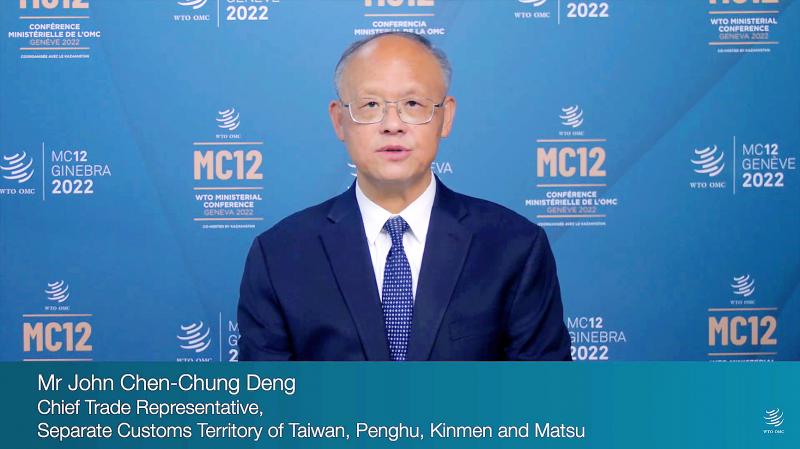
Photo: Lu Yi-hsuan, Taipei Times
“This clearly shows that China has all along been trying to hurt our fishers and farmers, as well as their products, which is unacceptable,” she said.
Minister Without Portfolio John Deng (鄧振中), Taiwan’s top trade negotiator, on Sunday urged all WTO members to pay attention to “arbitrary, untransparent measures” that harm the rules-based multilateral trading system at the global trade organization’s ministerial conference in Geneva, Switzerland.
Deng, head of the Office of Trade Negotiations, said in a statement that all members must play by the rules to uphold free and fair trade, and that no member should arbitrarily prevent the importation of certain products without timely notification or a justifiable reason.
His remarks came after China unexpectedly banned imports of Taiwanese pineapples, wax apples and sugar apples last year, and yesterday bluntly suspended grouper imports from Taiwan, which Taipei condemned as Beijing imposing unjustified barriers on imports in disregard of international trade rules.
The minister did not specifically name China in the statement.
Deng, who represents Taiwan in this year’s WTO ministerial meeting from Sunday to tomorrow, said Taiwan registered GDP growth of 6.45 percent last year despite the challenges of the COVID-19 pandemic, with exports and imports reaching US$446.4 billion and US$381.5 billion respectively, both up more than 30 percent from a year earlier.
Last year, Taiwan kept its market and trade open and free even during the peak of the pandemic, while continuing to deepen trade and economic ties with partners, he said, citing the nation’s application to join the Comprehensive and Progressive Agreement for Trans-Pacific Partnership, as well as its work to build economic partnerships with numerous trading partners.
Deng said Taiwan has been a strong supporter of the rules-based multilateral trading system and backs any proposals that restore a fully functioning dispute settlement mechanism under the WTO.
However, to revitalize the system and ensure that trade remains a growth driver, Deng said no member should be exempted from the rules.
“Transparency is key to the faithful implementation of the WTO agreement,” he said.
Separately, Taiwan joined more than 50 other WTO members in signing a statement supporting Ukraine’s access to trade and warning of the ongoing impact on global food security of Russian military blockades.
The countries issued the declaration on the opening day of the WTO ministerial meeting in Geneva.
In the statement, the nations said that the destruction of Ukraine’s infrastructure is substantially impeding its ability to produce, export and import key commodities, with potentially global consequences.
“We are also deeply concerned by numerous reports of grain being plundered from Ukraine,” they said.
The situation could have “dramatic” implications for food security, as Ukraine is a top exporter of wheat, corn, barley and sunflower oil, and a major supplier to the UN’s World Food Programme, they said.
Ukraine accounts for about 9 percent of global wheat exports, 42 percent of the world’s sunflower oil and 16 percent of the world’s corn.
“The impact of the war, including the blockage of Ukraine’s access to the Black Sea, is seriously jeopardizing food supply in some of the most vulnerable parts of the world [and] risks pushing millions of people into food insecurity,” the statement said.
In this context, the nations said they would “seek to support Ukraine and facilitate its exports,” such as by “facilitating the use of infrastructure or facilitating and simplifying customs procedures.”
Fifty-six nations signed the statement, including the US, most European countries, Japan, South Korea and Australia, accounting for one-third of the WTO’s 164 members.
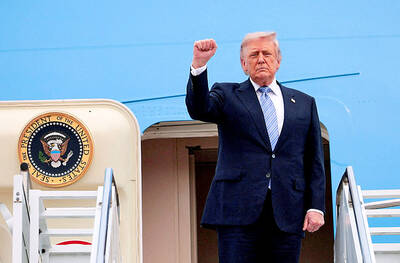
US-CHINA SUMMIT: MOFA welcomed US reassurance of no change in its Taiwan policy; Trump said he did not comment when Xi talked of opposing independence US President Donald Trump yesterday said he has not made a decision on whether to move forward with a major arms package for Taiwan after hearing concerns about it from Chinese President Xi Jinping (習近平). Trump’s comments on Taiwan came as he flew back to Washington after wrapping up critical talks in which both leaders said important progress was made in stabilizing US-China relations even as deep differences persist between the world’s two biggest powers on Iran and Taiwan. “I will make a determination,” Trump said, adding: “I’ll be making decisions. But, you know, I think the last thing we need right
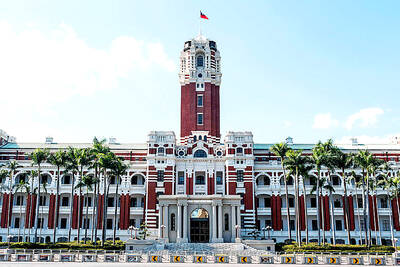
SECURITY: Taipei presses the US for arms supplies, saying the arms sales are not only a reflection of the US security commitment to Taiwan but also serve as a mutual deterrent against regional threats Taiwan is committed to preserving the cross-strait “status quo” and contributing to regional peace and stability, the Presidential Office said yesterday. “It is an undeniable fact that the Republic of China is a sovereign and independent democratic nation,” Presidential Office spokeswoman Karen Kuo (郭雅慧) reiterated, adding that Beijing has no right to claim sovereignty over Taiwan. The statements came after US President Donald Trump warned against Taiwanese independence. Trump wrapped up a state visit to Beijing on Friday, during which Chinese President Xi Jinping (習近平) had pressed him not to support Taiwan. Taiwan depends heavily on US security backing to deter China from carrying
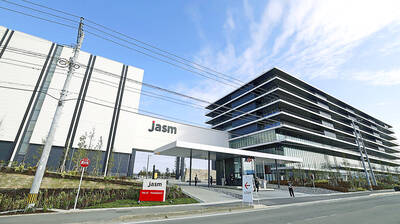
The subsidiary of Taiwan Semiconductor Manufacturing Co (TSMC, 台積電) in Kumamoto, Japan, turned a profit in the first quarter of this year, marking the first time the first fab of the unit has become profitable since mass production started at the end of 2024. According to the contract chipmaker’s financial statement released on Friday, Japan Advanced Semiconductor Manufacturing Inc (JASM), a joint venture running the fab in Kumamoto, posted NT$951 million (US$30.19 million) in profit in the January-to-March period, compared with a loss of NT$1.39 billion in the previous quarter, and a loss of NT$3.25 billion in the first quarter of
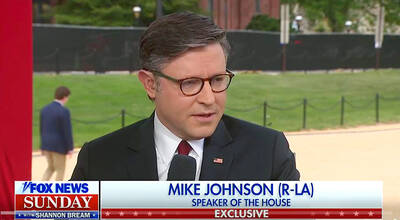
RESOLUTE BACKING: Two Republican senators are planning to introduce legislation that would impose immediate sanctions on China if it attempts to invade Taiwan US House of Representatives Speaker Mike Johnson on Sunday reaffirmed US congressional support for Taiwan, saying the US and “all freedom-loving people” have a stake in preventing China from seizing Taiwan by force. Johnson made the remarks in an interview with Fox News Sunday on US President Donald Trump’s summit with Chinese President Xi Jinping (習近平) last week. In an interview that aired on Friday on Fox News, just as Trump wrapped up a high-stakes visit to China, he said he has yet to green-light a new US$14 billion arms package to Taiwan and that it “depends on China.” “It’s a very good


 RSS
RSS