


The TAIEX yesterday rode the momentum from a session earlier to close above 18,000 points at a historic high, with the bellwether electronics sector, in particular semiconductor stocks, leading the upturn.
“Rotational buying continued to dictate the local main board,” Mega International Investment Services Corp (兆豐國際投顧) analyst Alex Huang (黃國偉) said. “Today, high-priced integrated circuit [IC] designers were spotlighted.”
The TAIEX closed the day up 87.30 points, or 0.49 percent, at 18,048.94, surpassing its previous record close of 18,034.19 on July 15.
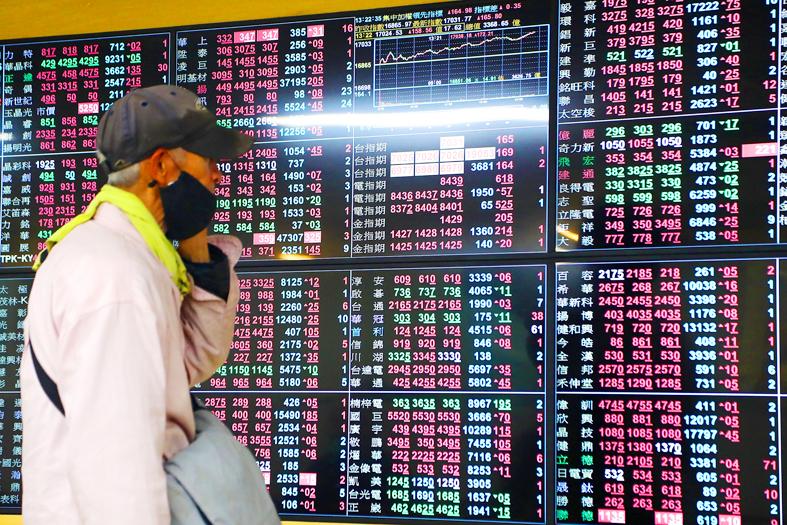
Photo: CNA
The gauge has risen 22.51 percent so far this year, poised for a third annual gain and outperforming most of its Asian peers.
“Today’s gains have boosted market sentiment, so I expect local institutional investors will continue to buy at a time when many foreign institutional investors are absent, but stiff technical resistance could be seen ahead of 18,250 points,” Huang said.
Despite the absence of many foreign institutional investors during the Christmas and New Year holidays, the market received support from local investors who ramped up their leveraged bets on a bull run.
“Taiwan stocks are likely to rise further next year due to ample funding and a positive tech outlook,” Shin Kong Investment Trust Co (新光投信) chairman Quincy Liu (劉坤錫) said. “Wafer and foundry industries are expected to remain healthy next year.”
Turnover yesterday was relatively thin at NT$236.446 billion (US$8.53 billion), with foreign institutional investors buying a net NT$11.17 billion of shares on the main board, Taiwan Stock Exchange data showed.
The electronics sector rose 0.62 percent, while the semiconductor sub-index was up 0.59 percent.
Leading the semiconductor sector’s upturn, shares of smartphone chip designer MediaTek Inc (聯發科) rose 2.23 percent to close at NT$1,145 amid optimism on shipments of the company’s flagship 5G Dimensity 9000 chip.
That spurred buying of other high-priced IC designers, with shares of power management IC designer Silergy Corp (矽力杰) soaring 4.79 percent to close at NT$5,030 and those of application-specific IC designer Alchip Technologies Ltd (世芯) rising 3.43 percent to close at NT$1,025.
Shares of the world’s largest contract chipmaker, Taiwan Semiconductor Manufacturing Co (TSMC, 台積電), rose 0.33 percent to close at NT$606.
The gains boosted TSMC’s market capitalization by NT$51.8 billion to NT$15.71 trillion and contributed about 14 points to the TAIEX’s upturn, although a low turnover limited the gains, dealers said.
Among other semiconductor stocks, those of contract chipmaker United Microelectronics Corp (聯電) closed unchanged at NT$64.30, while shares of DRAM chip supplier Nanya Technology Corp (南亞科技) rose 1.19 percent to close at NT$76.60.
“As the tech sector served as a driver to the TAIEX, many old-economy stocks appeared marginalized,” Huang said.
The transportation sector rose 0.49 percent on the back of gains in airline stocks, with those of China Airlines Ltd (中華航空) up 3.05 percent to NT$27 and EVA Airways Corp (長榮航空) shares rising 2.24 percent to close at NT$27.40.
However, shipping stocks were mixed.
Evergreen Marine Corp (長榮海運) shares closed up 0.36 percent at NT$139.50, while those of rivals Yang Ming Marine Transport Corp (陽明海運) and Wan Hai Lines Ltd (萬海航運) closed unchanged at NT$122.50 and NT$199 respectively.
Additional reporting by Bloomberg

A signaling system malfunction disrupted high-speed rail (HSR) services beginning at 8am today, with trains temporarily reduced to three northbound and three southbound trains per hour as authorities conduct inspections. The malfunction occurred on a section of track in Miaoli County during pre-operation checks early this morning, forcing northbound and southbound trains to use a single track, the HSR operator said. The regular schedule has been replaced with three hourly trains offering only nonreserved seating in each direction, stopping at every station, it said, adding that business class cars would still have reserved seating. Departures from terminal stations are scheduled at the top

Taiwan is still in the process of assessing the possibility of recruiting workers from Eswatini, the Ministry of Foreign Affairs said yesterday, adding that its goal is to help Eswatini upgrade its vocational training centers. If there are plans to recruit workers from Eswatini, safeguarding national security, protecting public health and ensuring the employment rights of Taiwanese would be prerequisites, Department of West Asian and African Affairs Director-General Yen Chia-liang (顏嘉良) told a news conference. Key considerations would also include filling labor shortages in specific industries, and fostering bilateral professional and technical exchanges, he said. Yen was asked about the progress of labor

A US uncrewed surface vessel (USV) encountered multiple Chinese warships during an autonomous transit of the Taiwan Strait, US defense company Seasats said in a statement on Wednesday. Seasats announced that a Lightfish USV had completed the first autonomous transit of the Taiwan Strait. Over five days, the USV traversed the entire length of the Strait while constantly monitoring surface vessel traffic, the company said. The Lightfish encountered multiple Chinese warships, one of which was a Chinese People’s Liberation Army Navy (PLAN) Type 056 corvette, it said. The Chinese vessels were operating “well within Taiwan’s exclusive economic zone without transmitting their identity via the

VERBOSE VESSELS: A CGA cutter and a China Coast Guard exchanged verbal barbs for more than a day in Taiwanese-controlled waters before the Chinese vessel left The Taiwanese and Chinese coast guards had a standoff near the strategically located Pratas Islands (Dongsha Islands, 東沙群島) in the north of the South China Sea, the Coast Guard Administration (CGA) said yesterday. The two sides engaged in intense radio exchanges over sovereignty claims during the 33-hour standoff. China Coast Guard vessel 3501 eventually left the restricted waters, 26.6 nautical miles (49.2km) west of the Pratas Islands, at 5pm yesterday, the CGA said. Lying approximately between southern Taiwan and Hong Kong, the Taiwan-controlled Pratas are seen by some security experts as vulnerable to Chinese attack due to their distance — more than


 RSS
RSS