


The Central Epidemic Command Center (CECC) yesterday reported 37 locally transmitted COVID-19 cases and two deaths as it said that people who hold a “Notice for Release From Isolation Treatment” (解除隔離治療通知書) should not be asked to provide a negative COVID-19 test result at certain venues.
Minister of Health and Welfare Chen Shih-chung (陳時中), who heads the center, said the daily COVID-19 case counts have been falling, adding that there were two imported cases yesterday.
Of the 37 local cases, 13 tested positive during quarantine or upon ending quarantine, he said.

Photo: Peter Lo, Taipei Times
Eighteen cases were reported in Taipei, followed by New Taipei City with 11, Taoyuan and Changhua County with three each, and Yilan County with two cases, Chen said.
The two fatalities are a woman in her 70s and a man in his 80s, and both had underlying health conditions, he said.
The imported cases are a woman who returned from Cambodia and a man who returned from Indonesia, the CECC said.

Photo: CNA
They tested positive upon arriving at the airport, it said.
Regarding expanded testing at Taipei’s wholesale markets, Chen said 96 cases were confirmed at the First Fruit and Vegetable Wholesale Market (第一果菜批發市場) in Wanhua District (萬華), 23 cases at the Second Fruit and Vegetable Wholesale Market (第二果菜批發市場) in Zhongshan District (中山) and 110 cases at Huannan Market (環南市場) in Wanhua.
He said 182 close contacts of 41 cases at Huannan Market confirmed on Thursday have been isolated, and expanded testing of 787 people at a nearby poultry market and local residents found three more people who tested positive on Friday and Saturday, while contact tracing is ongoing.
The testing station at Huannan Market would continue to operate today, Chen said, adding that the outbreak at the market “is not out of control,” but contact tracing and testing must be enhanced, and COVID-19 screening must be repeated a few times to ensure the situation remains under control.
He said that 3,140 people were tested at the First Fruit and Vegetable Wholesale Market on Friday and Saturday, and 12 among them tested positive, but a screening of local residents found no infections.
Separately yesterday, Taipei Mayor Ko Wen-je (柯文哲) announced that a special COVID-19 vaccination program for about 18,880 vendors at the city’s traditional markets would begin today, starting from the markets in Wanhua and Zhongzheng (中正) districts.
Regarding Ko’s decision last week to reopen some night markets in the city, Chen yesterday said that some local governments had previously closed down night markets, so they may conditionally reopen them while conforming to level 3 COVID-19 alert restrictions, given that they also follow a few key control measures.
The measures include reducing entrance and exit points; registering contact information; implementing crowd control by letting people in on alternating days based on the last digit of their national identification card; and ensuring a crowd density of one person per 2.25m2.
Meanwhile, Centers for Disease Control Deputy Director-General Philip Lo (羅一鈞), deputy head of the CECC’s medical response division, said some people who recovered from COVID-19 have been unable to return to work, or enter nursing homes or certain venues, because they were asked to provide a negative test result from within seven days or a certificate of having received two doses of a COVID-19 vaccine.
While not considered contagious, recovered people might still test positive three to four months after ending isolation, and they cannot be vaccinated for six months after being diagnosed with COVID-19, he said.
The CECC urges businesses not to put recovered people in a difficult position, Lo said, adding that they should accept the Notice for Release From Isolation Treatment as a certificate of recovery from COVID-19, and not ask people for a negative test result.

‘NO SECURITY RISK’: The Railway Bureau reassured the public that the technicians’ activities were limited to technical guidance and did not involve sensitive systems The Railway Bureau yesterday said it had invited eight Chinese technicians to assist with an airport MRT construction project. The bureau issued the confirmation after an Internet user said Chinese nationals had entered the construction zone of Taiwan Taoyuan International Airport’s Terminal 3 project. They asked why “individuals from an enemy state” were allowed access to such a major national infrastructure project, which raised serious concerns over Taiwan’s industrial safety, sensitive systems and information security. The bureau’s Northern Region Engineering Branch Office said subcontractor Taiwan Handle Industrial Co (台灣手把工業) of the Taoyuan airport MRT’s “Contract No. CU05 Project A14 Station Civil, MEP &

A US uncrewed surface vessel (USV) encountered multiple Chinese warships during an autonomous transit of the Taiwan Strait, US defense company Seasats said in a statement on Wednesday. Seasats announced that a Lightfish USV had completed the first autonomous transit of the Taiwan Strait. Over five days, the USV traversed the entire length of the Strait while constantly monitoring surface vessel traffic, the company said. The Lightfish encountered multiple Chinese warships, one of which was a Chinese People’s Liberation Army Navy (PLAN) Type 056 corvette, it said. The Chinese vessels were operating “well within Taiwan’s exclusive economic zone without transmitting their identity via the

Taiwan is still in the process of assessing the possibility of recruiting workers from Eswatini, the Ministry of Foreign Affairs said yesterday, adding that its goal is to help Eswatini upgrade its vocational training centers. If there are plans to recruit workers from Eswatini, safeguarding national security, protecting public health and ensuring the employment rights of Taiwanese would be prerequisites, Department of West Asian and African Affairs Director-General Yen Chia-liang (顏嘉良) told a news conference. Key considerations would also include filling labor shortages in specific industries, and fostering bilateral professional and technical exchanges, he said. Yen was asked about the progress of labor
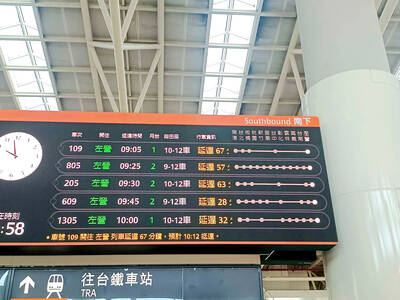
The nation’s usually punctual high-speed rail system yesterday was hit by major disruptions after all scheduled services were canceled and replaced with three hourly trains offering only non-reserved seating, affecting more than 200,000 passengers. Preliminary findings indicate the disruption was caused by a faulty power module in a track switch control cabinet, Taiwan High-Speed Rail Corp (THSRC) said, adding that as a full system inspection could only be conducted after operations end for the day, a decision on whether normal service would resume today would be announced before the first train departs. During a routine inspection early yesterday, a switch signal abnormality


 RSS
RSS