


The Central Epidemic Command Center (CECC) yesterday reported three locally transmitted cases of COVID-19, and antibodies against the virus were detected in family members of China Airlines pilots who had also tested positive.
Minister of Health and Welfare Chen Shih-chung (陳時中), who heads the center, said that the first local case — No. 1,112 — is a Taiwanese man in his 70s who had a short period of close contact with his elder brother (case No. 1,068), who tested positive, during quarantine, as did his wife (case No. 1,106).
The man had been bringing meals to the couple when they were quarantined at home after returning from Canada on April 9, and he entered the home on one occasion for about half an hour after his brother had a fall, Chen said.
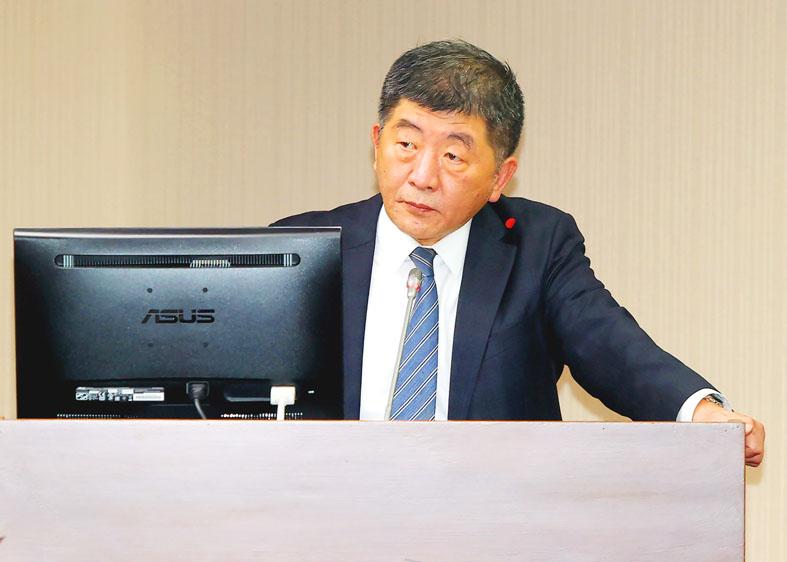
Photo: CNA
Case No. 1,112 was tested on Monday, with the result being positive, and so far 190 close contacts have been ordered into isolation, while people who have been to public spaces he visited when he was likely contagious should practice self-health management, Chen said.
Asked whether case No. 1,112 had broken quarantine rules by entering the home, and whether he should have reported the incident, Deputy Minister of the Interior Chen Tsung-yen (陳宗彥), deputy head of the center, said that the situation was difficult to avoid, as the man could not have left his brother lying on the ground.
The man should have reported the incident, so the center would consider making rules to require the reporting of unavoidable contact with quarantined people, he said.
Case No. 1,113 is a Taiwanese teenager and the son of a China Airlines pilot who tested negative for COVID-19, but positive for the immunoglobulin M antibody, Chen Shih-chung said, adding that the teen had low viral loads in tests on Monday and Tuesday.
Case No. 1,114 is a woman in her 40s and the wife of another China Airlines pilot, who had also tested negative for COVID-19, but positive for the antibody, he said.
She tested positive for the virus with a low viral load on Monday and negative on Tuesday, he said.
Two other family members of case No. 1,113 and a family member of case No. 1,114 tested negative for COVID-19, but positive for the antibody, indicating a previous infection, he said.
CECC specialist advisory panel convener Chang Shan-chwen (張上淳) said that case Nos. 1,113 and 1,114 were likely in the late stage of a COVID-19 infection, and are unlikely to be contagious.
More than 80 percent of China Airlines’ pilots have undergone polymerase chain reaction and antibody tests in an expanded testing program launched last week, and the center does not yet see a clear link between the nine pilots who have tested positive for COVID-19, Chen Shih-chung said.
The center believes they contracted the disease in other countries, where infection risks are much higher than in Taiwan, he said, adding that further analysis would be done after testing finishes.
Chen Tsung-yen said that discussions were under way over whether China Airlines’ flight crew members should be quarantined “one person per household.”
The policy would mainly be to protect family members, but it has not yet been finalized, he said.
Centers for Disease Control (CDC) Deputy Director-General Chuang Jen-hsiang (莊人祥), who is CECC spokesperson, said that 2,723 people received a vaccine shot on Tuesday, 1,748 self-paid and 975 government-funded, while 48,180 people have received their first shot of the AstraZeneca vaccine.
The CECC might expand eligibility for government-funded vaccines soon, Chen Shih-chung said, adding that family members of flight crew might be added to a priority group.
The CECC reported three new imported cases of COVID-19 yesterday, two students from India and a Taiwanese man who returned from India.

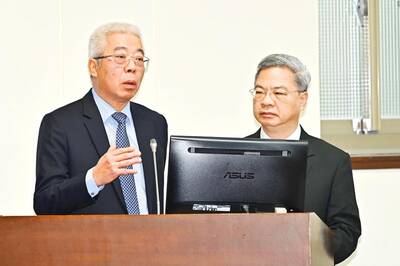
Taiwan has arranged for about 8 million barrels of crude oil, or about one-third of its monthly needs, to be shipped from the Red Sea this month to bypass the Strait of Hormuz and ease domestic supply pressures, CPC Corp, Taiwan (CPC, 台灣中油) said yesterday. The state-run oil company has worked with Middle Eastern suppliers to secure routes other than the Strait of Hormuz, through which about 20 percent of the world’s oil and liquefied natural gas typically passes, CPC chairman Fang Jeng-zen (方振仁) said at a meeting of the legislature’s Economics Committee in Taipei. Suppliers in Saudi Arabia have indicated they
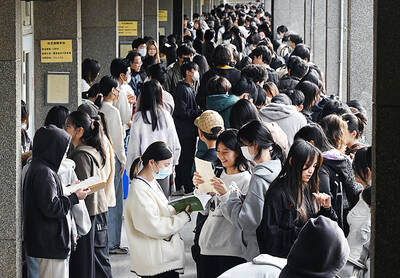
A global survey showed that 60 percent of Taiwanese had attained higher education, second only to Canada, the Ministry of the Interior said. Taiwan easily surpassed the global average of 43 percent and ranked ahead of major economies, including Japan, South Korea and the US, data from the Organisation for Economic Co-operation and Development (OECD) for 2024 showed. Taiwan has a high literacy rate, data released by the ministry showed. As of the end of last year, Taiwan had 20.617 million people aged 15 or older, accounting for 88.5 percent of the total population, with a literacy rate of 99.4 percent, the data
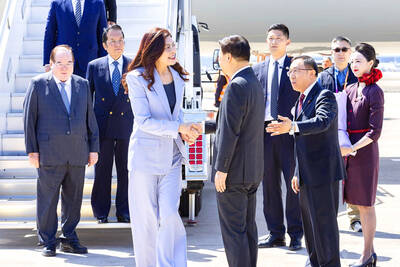
CCP ‘PAWN’? Beijing could use the KMT chairwoman’s visit to signal to the world that many people in Taiwan support the ‘one China’ principle, an academic said Chinese Nationalist Party (KMT) Chairwoman Cheng Li-wun (鄭麗文) yesterday arrived in China for a “peace” mission and potential meeting with Chinese President Xi Jinping (習近平), while a Taiwanese minister detailed the number of Chinese warships currently deployed around the nation. Cheng is visiting at a time of increased Chinese military pressure on Taiwan, as the opposition-dominated Legislative Yuan stalls a government plan for US$40 billion in extra defense spending. Speaking to reporters before going to the airport, Cheng said she was going on a “historic journey for peace,” but added that some people felt uneasy about her trip. “If you truly love Taiwan,

NEW LOW: The council in 2024 based predictions on a pessimistic estimate for the nation’s total fertility rate of 0.84, but last year that rate was 0.69, 17 percent lower An expected National Development Council (NDC) report expects the nation’s population to drop below 12 million by 2065, with the old-age dependency ratio to top 100 percent sooner than 2070, sources said yesterday. The council is slated to release its latest population projections in August, using an ultra-low fertility model, the sources said. The previous report projected that Taiwan’s population would fall to 14.37 million by 2070, but based on a new estimate of the total fertility rate (TFR) — the average number of children born to a woman over her lifetime — the population is expected to reach 12 million by


 RSS
RSS