


Democratic Progressive Party (DPP) lawmakers yesterday called on regulators to block Chinese media corporations from establishing a foothold in Taiwan, after the Chinese-language Liberty Times (sister newspaper of the Taipei Times) reported that Tencent Holdings (騰訊) and Youku Tudou (優酷) plan to start offering local video streaming services in May.
Given free rein, Chinese state-backed media enterprises such as Tencent and Youku could corner the Taiwanese market and mold the nation’s language and culture, DPP caucus secretary-general Cheng Yun-peng (鄭運鵬) told a news conference.
“It is disconcerting that Tencent chairman Pony Ma (馬化騰) is known to walk in public wearing a [Chinese] People’s Liberation Army uniform,” Cheng said.
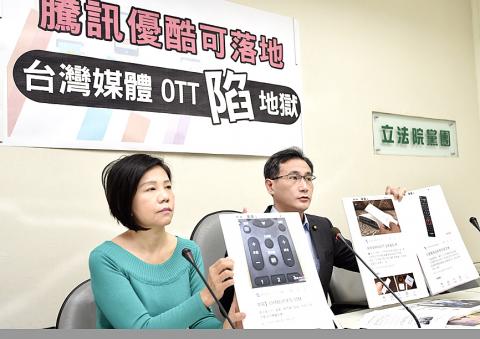
Photo: Chien Jung-fong, Taipei Times
“Tencent employs about 30,000 to 40,000 people, more than 7,000 of whom are also Chinese Communist Party workers,” he said.
By entering the nation’s media market, Tencent and Youku are exploiting a legal loophole that allows Chinese corporations to distribute video and audio through an agent registered in Taiwan, as online video streaming platform iQiyi has done, Cheng said.
Such content is the jurisdiction of the Ministry of Culture and not subject to the Act Governing Relations Between the People of the Taiwan Area and the Mainland Area (臺灣地區與大陸地區人民關係條例), he said.
Many of the nation’s cable companies provide their users access to iQiyi programs, which include children’s shows featuring simplified Chinese characters, he said.
“The zaoan (早安) and wan (晚) that we are used to saying are being replaced by zaoshanghao (早上好) and wanshanghao (晚上好),” he said, referring to morning and evening greetings, with the former pair being more common in Taiwan and the latter in China.
“These shows are slowly influencing Taiwanese culture and idioms,” Cheng said. “They [the companies] are not in Taiwan to make money, they are here to control the market. Think about Taiwan’s children.”
Fake social media accounts in China could be expected to use Tencent services to engage in propaganda campaigns and abuse Taiwan’s freedom of speech, he said.
In 2016, iQiyi established its Taiwanese Web site through a business agent registered as OTT Entertainment (歐銻銻), after its application to create a Taiwanese subsidiary was turned down by the Ministry of Economic Affairs.
National Communications Commission Chairwoman Nicole Chan (詹婷怡) yesterday said that the commission would today discuss the regulation of cable and Web-based streaming services with the Ministry of Culture.
The two agencies would discuss any subject pertaining to streaming platforms, including Tencent and Youku’s reported attempts to enter the nation’s market, she said.
Foreign streaming service providers have an advantage in capital over Taiwanese companies and they are aggressively expanding market share, said Chien Ta-wei (錢大衛), president of the Taiwan Over-the-Top Media Services Association and a former senior vice president of technology and licensing at TiVo.
The government should require all foreign companies to register their business agents, consumer service representatives and subsidiaries in Taiwan as a condition to provide streaming services in Taiwan, he said.
Additional reporting by CNA
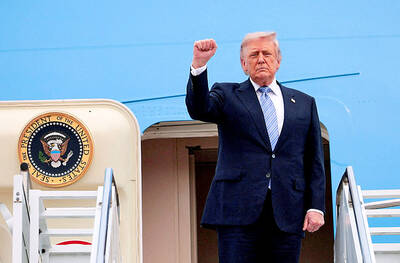
US-CHINA SUMMIT: MOFA welcomed US reassurance of no change in its Taiwan policy; Trump said he did not comment when Xi talked of opposing independence US President Donald Trump yesterday said he has not made a decision on whether to move forward with a major arms package for Taiwan after hearing concerns about it from Chinese President Xi Jinping (習近平). Trump’s comments on Taiwan came as he flew back to Washington after wrapping up critical talks in which both leaders said important progress was made in stabilizing US-China relations even as deep differences persist between the world’s two biggest powers on Iran and Taiwan. “I will make a determination,” Trump said, adding: “I’ll be making decisions. But, you know, I think the last thing we need right
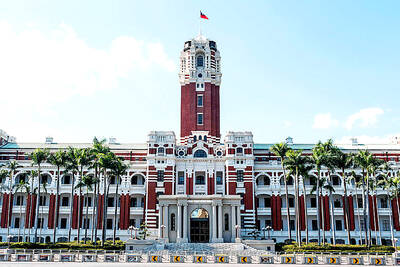
SECURITY: Taipei presses the US for arms supplies, saying the arms sales are not only a reflection of the US security commitment to Taiwan but also serve as a mutual deterrent against regional threats Taiwan is committed to preserving the cross-strait “status quo” and contributing to regional peace and stability, the Presidential Office said yesterday. “It is an undeniable fact that the Republic of China is a sovereign and independent democratic nation,” Presidential Office spokeswoman Karen Kuo (郭雅慧) reiterated, adding that Beijing has no right to claim sovereignty over Taiwan. The statements came after US President Donald Trump warned against Taiwanese independence. Trump wrapped up a state visit to Beijing on Friday, during which Chinese President Xi Jinping (習近平) had pressed him not to support Taiwan. Taiwan depends heavily on US security backing to deter China from carrying
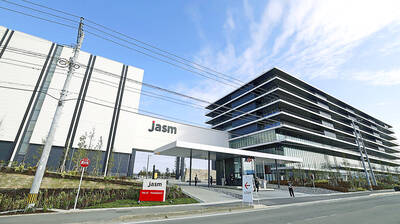
The subsidiary of Taiwan Semiconductor Manufacturing Co (TSMC, 台積電) in Kumamoto, Japan, turned a profit in the first quarter of this year, marking the first time the first fab of the unit has become profitable since mass production started at the end of 2024. According to the contract chipmaker’s financial statement released on Friday, Japan Advanced Semiconductor Manufacturing Inc (JASM), a joint venture running the fab in Kumamoto, posted NT$951 million (US$30.19 million) in profit in the January-to-March period, compared with a loss of NT$1.39 billion in the previous quarter, and a loss of NT$3.25 billion in the first quarter of
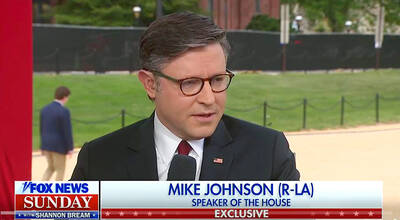
RESOLUTE BACKING: Two Republican senators are planning to introduce legislation that would impose immediate sanctions on China if it attempts to invade Taiwan US House of Representatives Speaker Mike Johnson on Sunday reaffirmed US congressional support for Taiwan, saying the US and “all freedom-loving people” have a stake in preventing China from seizing Taiwan by force. Johnson made the remarks in an interview with Fox News Sunday on US President Donald Trump’s summit with Chinese President Xi Jinping (習近平) last week. In an interview that aired on Friday on Fox News, just as Trump wrapped up a high-stakes visit to China, he said he has yet to green-light a new US$14 billion arms package to Taiwan and that it “depends on China.” “It’s a very good


 RSS
RSS