


Starting next month, broadcast media can only air commercials featuring alcoholic beverages between 9pm and 6am, the National Communications Commission (NCC) said yesterday.
The policy would apply to radio stations and channels on both terrestrial TV stations and cable TV systems, NCC spokesperson Wong Po-tsung (翁柏宗) said, adding that it would not differentiate between commercials for beer, wine, spirits or medicinal wine.
Although television channels currently air commercials for alcoholic beverages between 9pm and 6am, radio stations can broadcast this type of commercial between 9am and 5pm on school days, only needing to switch to between 9:30pm and 6am on weekends, national holidays, and during winter and summer vacations.

Photo: Tsai Shu-yuan, Taipei Times
“The time slots stipulated are different for radio stations than for television channels, and the commission decided that all broadcast media should follow the same rule, broadcasting commercials for alcoholic beverages during identical time slots,” he said.
Implementing the policy would safeguard children and young people, Wong said, adding that cable channel operators would face a fine of between NT$400,000 and NT$2 million (US$13,004 and US$65,020) for contravening the policy, in accordance with the Satellite Broadcasting Act (衛星廣播電視法).
The Radio and Television Act (廣播電視法) stipulates that terrestrial TV stations that breach the regulations on broadcasting commercials are to pay NT$200,000 to NT$2 million, while radio operators that contrave the act are to pay NT$9,000 to NT$90,000, he said.
Commercials featuring alcoholic beverages must still contain consumer warnings — such as “Do not drink and drive” — and list possible health hazards associated with the overconsumption of alcohol.
In other developments, Taiwan Mobile Co (台灣大哥大) and Asia Pacific Telecom Co (APT, 亞太電信) were each fined NT$3 million for illegally sharing the use of a 4G network.
In 2015, it was uncovered that APT had not built its own network to offer 4G service, but was using Taiwan Mobile’s core network, which was at odds with the business plan that it had submitted to the NCC.
Both companies were informed that they would accumulate fines until the situation was fixed. Having accrued eight cycles of fines, each company must pay NT$14.7 million.
“Even though APT has built its own 4G network, part of its voice communication service is still offered on Taiwan Mobile’s 3G network through a circuit-switched fallback technique, which shows that it is still sharing a network with Taiwan Mobile,” Wong said.

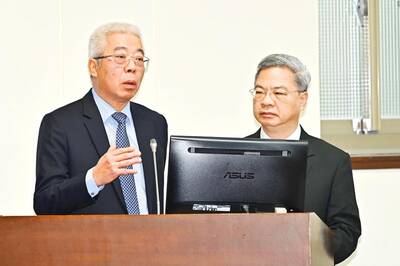
Taiwan has arranged for about 8 million barrels of crude oil, or about one-third of its monthly needs, to be shipped from the Red Sea this month to bypass the Strait of Hormuz and ease domestic supply pressures, CPC Corp, Taiwan (CPC, 台灣中油) said yesterday. The state-run oil company has worked with Middle Eastern suppliers to secure routes other than the Strait of Hormuz, through which about 20 percent of the world’s oil and liquefied natural gas typically passes, CPC chairman Fang Jeng-zen (方振仁) said at a meeting of the legislature’s Economics Committee in Taipei. Suppliers in Saudi Arabia have indicated they
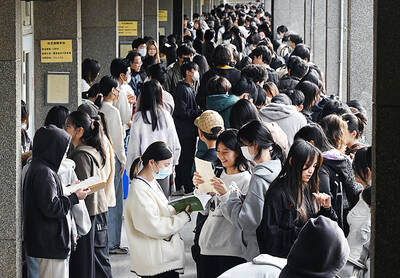
A global survey showed that 60 percent of Taiwanese had attained higher education, second only to Canada, the Ministry of the Interior said. Taiwan easily surpassed the global average of 43 percent and ranked ahead of major economies, including Japan, South Korea and the US, data from the Organisation for Economic Co-operation and Development (OECD) for 2024 showed. Taiwan has a high literacy rate, data released by the ministry showed. As of the end of last year, Taiwan had 20.617 million people aged 15 or older, accounting for 88.5 percent of the total population, with a literacy rate of 99.4 percent, the data

CCP ‘PAWN’? Beijing could use the KMT chairwoman’s visit to signal to the world that many people in Taiwan support the ‘one China’ principle, an academic said Chinese Nationalist Party (KMT) Chairwoman Cheng Li-wun (鄭麗文) yesterday arrived in China for a “peace” mission and potential meeting with Chinese President Xi Jinping (習近平), while a Taiwanese minister detailed the number of Chinese warships currently deployed around the nation. Cheng is visiting at a time of increased Chinese military pressure on Taiwan, as the opposition-dominated Legislative Yuan stalls a government plan for US$40 billion in extra defense spending. Speaking to reporters before going to the airport, Cheng said she was going on a “historic journey for peace,” but added that some people felt uneasy about her trip. “If you truly love Taiwan,

NEW LOW: The council in 2024 based predictions on a pessimistic estimate for the nation’s total fertility rate of 0.84, but last year that rate was 0.69, 17 percent lower An expected National Development Council (NDC) report expects the nation’s population to drop below 12 million by 2065, with the old-age dependency ratio to top 100 percent sooner than 2070, sources said yesterday. The council is slated to release its latest population projections in August, using an ultra-low fertility model, the sources said. The previous report projected that Taiwan’s population would fall to 14.37 million by 2070, but based on a new estimate of the total fertility rate (TFR) — the average number of children born to a woman over her lifetime — the population is expected to reach 12 million by


 RSS
RSS