


Premier William Lai (賴清德) yesterday stressed the importance of immigrants in addressing the nation’s shortage of workers, as the Cabinet revealed its plan for the immigration of workers from nations targeted by the government’s New Southbound Policy.
Lai made the remarks in the last of five news conferences held this week to address the nation’s “five industrial shortages” — land, water, electricity, talent and workers.
“It is impossible to talk about talent recruitment without touching upon immigration policy,” Lai said, adding that the Cabinet would discuss how to create a friendly immigration environment before revealing its new policy.
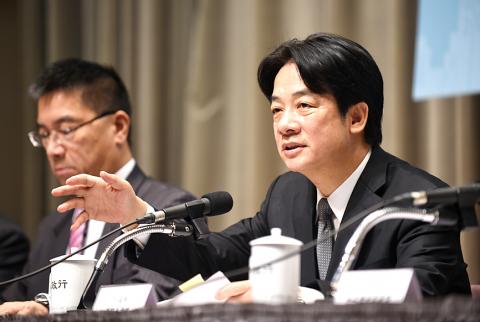
Photo: Liu Hsin-de, Taipei Times
Most of the nation’s immigrants obtain their status through marriage or a biological relationship, which is rare internationally, Minister Without Portfolio Lin Wan-i (林萬億) said.
“So we must consider the perspective of how to get the type of talented people the nation needs to stay when we devise a new immigration policy,” Lin said.
The tentative plan is to implement a labor immigration program to attract talented workers from the 18 nations targeted by the New Southbound Policy — the 10 ASEAN nations, India, Pakistan, Bangladesh, Sri Lanka, Nepal, Bhutan, New Zealand and Australia.
Singling out the agricultural, fishing and long-term care sectors, which he said severely lack workers, Lin said the nation could allow foreign students to attend senior-high schools or colleges, allowing them to acquire the necessary employment and language skills before issuing them a work visa.
“If they prove to be law-abiding citizens and fit the needs of a certain industry, we should let these people migrate to Taiwan and permanently live here,” Lin said.
Students from the target nations could study at schools that have the necessary faculty and equipment while interning at farms and farmers’ associations, Lin said.
The nation’s fishing industry employs more than 1,000 Chinese workers and 20,000 from Southeast Asia, but they often leave, taking their skills with them, Lin said.
The problem facing the long-term care industry is that the government needs to think about how to protect the rights of foreign caretakers, most of whom are skilled workers allowed to work in Taiwan for up to 14 years.
“We have started deliberating how to transform short-term employment to long-term employment and immigration. Our goal is to replace the importation of foreign workers with a coherent immigration policy,” Lin said, adding that the policy shift could also help reduce the numbers of foreign workers who abscond.
The Executive Yuan plans to retain talented people by amending the Income Tax Act (所得稅法) to lower the ceiling on personal income taxes from 45 to 40 percent and offer other tax incentives.
As of February, local industries reported a shortage of 233,000 workers, Lai said.
The Cabinet plans to increase the labor force participation rate by amending laws to increase the chances of people finding employment, he said.
Deputy Minister of Labor Liao Huei-fang (廖蕙芳) said the ministry is holding public hearings about its draft employment act for the middle to senior aged population and would send it to the Executive Yuan for review as soon as possible.
Lai also stressed the importance of profit-sharing, calling on companies to increase the starting salaries of their employees.
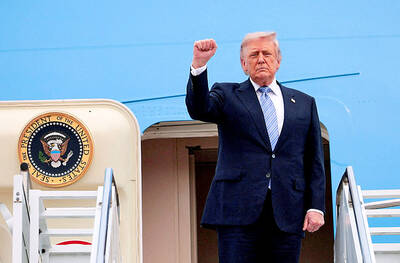
US-CHINA SUMMIT: MOFA welcomed US reassurance of no change in its Taiwan policy; Trump said he did not comment when Xi talked of opposing independence US President Donald Trump yesterday said he has not made a decision on whether to move forward with a major arms package for Taiwan after hearing concerns about it from Chinese President Xi Jinping (習近平). Trump’s comments on Taiwan came as he flew back to Washington after wrapping up critical talks in which both leaders said important progress was made in stabilizing US-China relations even as deep differences persist between the world’s two biggest powers on Iran and Taiwan. “I will make a determination,” Trump said, adding: “I’ll be making decisions. But, you know, I think the last thing we need right
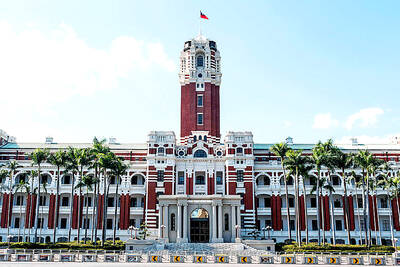
SECURITY: Taipei presses the US for arms supplies, saying the arms sales are not only a reflection of the US security commitment to Taiwan but also serve as a mutual deterrent against regional threats Taiwan is committed to preserving the cross-strait “status quo” and contributing to regional peace and stability, the Presidential Office said yesterday. “It is an undeniable fact that the Republic of China is a sovereign and independent democratic nation,” Presidential Office spokeswoman Karen Kuo (郭雅慧) reiterated, adding that Beijing has no right to claim sovereignty over Taiwan. The statements came after US President Donald Trump warned against Taiwanese independence. Trump wrapped up a state visit to Beijing on Friday, during which Chinese President Xi Jinping (習近平) had pressed him not to support Taiwan. Taiwan depends heavily on US security backing to deter China from carrying
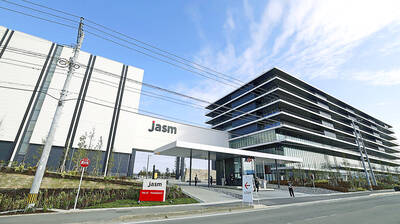
The subsidiary of Taiwan Semiconductor Manufacturing Co (TSMC, 台積電) in Kumamoto, Japan, turned a profit in the first quarter of this year, marking the first time the first fab of the unit has become profitable since mass production started at the end of 2024. According to the contract chipmaker’s financial statement released on Friday, Japan Advanced Semiconductor Manufacturing Inc (JASM), a joint venture running the fab in Kumamoto, posted NT$951 million (US$30.19 million) in profit in the January-to-March period, compared with a loss of NT$1.39 billion in the previous quarter, and a loss of NT$3.25 billion in the first quarter of
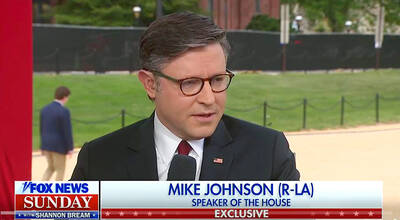
RESOLUTE BACKING: Two Republican senators are planning to introduce legislation that would impose immediate sanctions on China if it attempts to invade Taiwan US House of Representatives Speaker Mike Johnson on Sunday reaffirmed US congressional support for Taiwan, saying the US and “all freedom-loving people” have a stake in preventing China from seizing Taiwan by force. Johnson made the remarks in an interview with Fox News Sunday on US President Donald Trump’s summit with Chinese President Xi Jinping (習近平) last week. In an interview that aired on Friday on Fox News, just as Trump wrapped up a high-stakes visit to China, he said he has yet to green-light a new US$14 billion arms package to Taiwan and that it “depends on China.” “It’s a very good


 RSS
RSS