


The discovery of gravitational waves on Aug. 17 resulted from a merger of two neutron stars, a National Central University (NCU) researcher said yesterday while discussing the results of joint research by Taiwanese scientists and the US-based Global Relay of Observatories Watching Transients Happen (GROWTH).
The discovery of gravitational waves with light, named GW170817, was made by the US-based Laser Interferometer Gravitational Wave Observatory (LIGO) and the Europe-based Virgo detector, which started a race among scientists to find the source.
The next day, a team led by Ryan Foley at Las Campanas Observatory in Chile identified the gravitational waves’ source in the NGC 4993 galaxy about 130 million light years away.
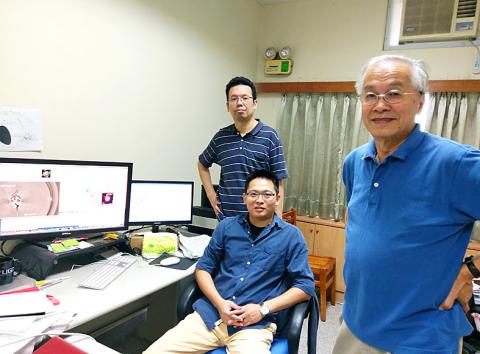
Photo courtesy of National Central University
Taiwanese researchers made contributions by studying the formation of the galaxy as part of the GROWTH team of scientists from Taiwan, the US, Japan, Germany, the UK, Sweden, Israel and India.
They agreed that the new gravitational waves are different from the four previous discoveries —GW150914, GW151226, GW170104 and GW170814, NCU Institute of Astronomy researcher Yu Po-chieh (俞伯傑) told a news conference in Taipei yesterday.
The nature of the gravitational waves indicate that they did not result from a merger of black holes or a clash between a black hole and a neutron star, but a merger of neutron stars, Yu said.
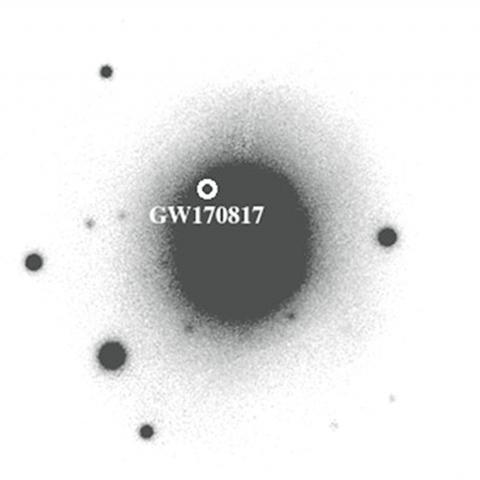
Photo courtesy of National Central University
“Researchers worldwide arrived at the same conclusion,” he said. “This is the first time that humankind has found that some gravitational waves can emit light.”
Their findings were documented in a paper titled Illuminating Gravitational Waves: A Concordant Picture of Photons from a Neutron Star Merger, which has been published in the journal Science.
Studying the collision of neutron stars can help scientists explore the origin of gold and other heavier elements in the cosmos, Yu said.
As the merger of neutron stars produced a “kilonova” brighter than any other previously discovered stars, scientists around the world are watching it for any changes, he said.
NCU’s Lulin Observatory (鹿林) on the boundary of Chiayi and Nantou counties is one of the 18 observatories in the GROWTH program that is engaging in round-the-clock observation of the cosmic event.
Given that its telescope has a 1m resolution similar to one in a Chilean observatory, Lulin Observatory could have been the first to identify the source had the weather permitted, NCU associate professor Jao Chao-tsung (饒兆聰) said.
The discovery of the optical counterpart of the gravitational waves should be accredited to the this year’s Nobel Prize in Physics laureates — Rainer Weiss, Barry Barish and Kip Thorne — who made contributions to the LIGO detector and observation of gravitational waves, Yu said.
US-CHINA SUMMIT: MOFA welcomed US reassurance of no change in its Taiwan policy; Trump said he did not comment when Xi talked of opposing independence US President Donald Trump yesterday said he has not made a decision on whether to move forward with a major arms package for Taiwan after hearing concerns about it from Chinese President Xi Jinping (習近平). Trump’s comments on Taiwan came as he flew back to Washington after wrapping up critical talks in which both leaders said important progress was made in stabilizing US-China relations even as deep differences persist between the world’s two biggest powers on Iran and Taiwan. “I will make a determination,” Trump said, adding: “I’ll be making decisions. But, you know, I think the last thing we need right
SECURITY: Taipei presses the US for arms supplies, saying the arms sales are not only a reflection of the US security commitment to Taiwan but also serve as a mutual deterrent against regional threats Taiwan is committed to preserving the cross-strait “status quo” and contributing to regional peace and stability, the Presidential Office said yesterday. “It is an undeniable fact that the Republic of China is a sovereign and independent democratic nation,” Presidential Office spokeswoman Karen Kuo (郭雅慧) reiterated, adding that Beijing has no right to claim sovereignty over Taiwan. The statements came after US President Donald Trump warned against Taiwanese independence. Trump wrapped up a state visit to Beijing on Friday, during which Chinese President Xi Jinping (習近平) had pressed him not to support Taiwan. Taiwan depends heavily on US security backing to deter China from carrying
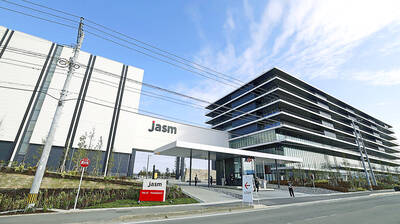
The subsidiary of Taiwan Semiconductor Manufacturing Co (TSMC, 台積電) in Kumamoto, Japan, turned a profit in the first quarter of this year, marking the first time the first fab of the unit has become profitable since mass production started at the end of 2024. According to the contract chipmaker’s financial statement released on Friday, Japan Advanced Semiconductor Manufacturing Inc (JASM), a joint venture running the fab in Kumamoto, posted NT$951 million (US$30.19 million) in profit in the January-to-March period, compared with a loss of NT$1.39 billion in the previous quarter, and a loss of NT$3.25 billion in the first quarter of
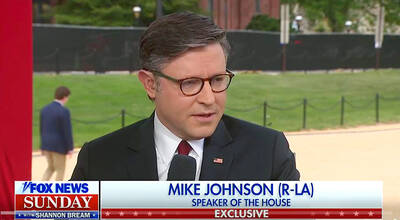
RESOLUTE BACKING: Two Republican senators are planning to introduce legislation that would impose immediate sanctions on China if it attempts to invade Taiwan US House of Representatives Speaker Mike Johnson on Sunday reaffirmed US congressional support for Taiwan, saying the US and “all freedom-loving people” have a stake in preventing China from seizing Taiwan by force. Johnson made the remarks in an interview with Fox News Sunday on US President Donald Trump’s summit with Chinese President Xi Jinping (習近平) last week. In an interview that aired on Friday on Fox News, just as Trump wrapped up a high-stakes visit to China, he said he has yet to green-light a new US$14 billion arms package to Taiwan and that it “depends on China.” “It’s a very good


 RSS
RSS