


US President Barack Obama on Tuesday declared that the US has turned the page on years of war and economic hardship, in a populist-tinged State of the Union address that set up the battle to succeed him, but Republicans quickly said the speech was more about politics than leadership.
Emboldened by a stronger economy and better approval ratings, Obama called for a new chapter in US history that ushers in a fairer economy with a better shake for the middle class.
“We are 15 years into this new century. Fifteen years that dawned with terror touching our shores; that unfolded with a new generation fighting two long and costly wars; that saw a vicious recession spread across our nation and the world,” Obama said. “It has been, and still is, a hard time for many, but tonight we turn the page.”
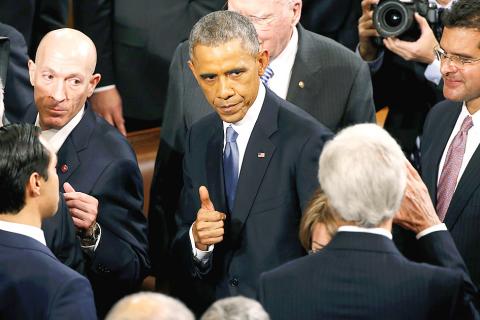
Photo: Reuters
He heralded the “growing economy, shrinking deficits, bustling industry and booming energy production” that have also helped revive his political fortunes as his time in the White House nears its end.
For six years Obama’s presidency was often subsumed by an economic crisis that stymied efforts to narrow inequality and put other liberal policy priorities on the back burner.
Appealing to Democrats determined to retain the White House next year, Obama on Tuesday called for an increase in the minimum wage, equal pay for women and tax breaks for the middle class.
Drawing a stark contrast with tax-averse Republicans, he dared his foes to oppose proposed tax increases for the rich that would pay for middle class breaks.
“We have risen from recession freer to write our own future than any other nation on Earth. It’s now up to us to choose who we want to be over the next 15 years and for decades to come,” he said. “Will we accept an economy where only a few of us do spectacularly well? Or will we commit ourselves to an economy that generates rising incomes and chances for everyone who makes the effort?”
Obama’s Republican opponents have branded such talk as little more than class warfare and will use their majority in both houses of US Congress to make sure the plans never become law.
Republican Senator Joni Ernst, who was tasked with rebutting Obama’s speech, said Americans are still suffering from “stagnant wages and lost jobs.”
She also decried Obama’s “failed policies” and a “stale mindset” that led to “political talking points, not serious solutions.”
Mitt Romney, a past and potential future Republican presidential candidate, said: “True to form, the president in his State of the Union speech is more interested in politics than in leadership.”
Obama also used the speech to call on the US Congress to authorize the use of force against the Islamic State group, formerly known as the Islamic State of Iraq and the Levant (ISIL).
“In Iraq and Syria, American leadership — including our military power — is stopping ISIL’s advance,” he said. “This effort will take time. It will require focus, but we will succeed.”
Just days after attacks in Paris killed 17, Obama said “deplorable anti-Semitism ... has resurfaced in certain parts of the world.”
“We stand united with people around the world who’ve been targeted by terrorists — from a school in Pakistan to the streets of Paris,” he said.
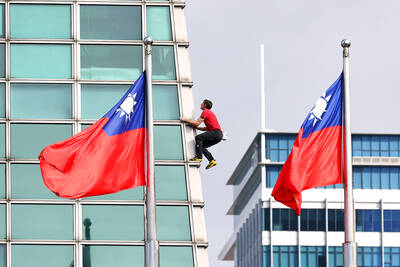
DAREDEVIL: Honnold said it had always been a dream of his to climb Taipei 101, while a Netflix producer said the skyscraper was ‘a real icon of this country’ US climber Alex Honnold yesterday took on Taiwan’s tallest building, becoming the first person to scale Taipei 101 without a rope, harness or safety net. Hundreds of spectators gathered at the base of the 101-story skyscraper to watch Honnold, 40, embark on his daredevil feat, which was also broadcast live on Netflix. Dressed in a red T-shirt and yellow custom-made climbing shoes, Honnold swiftly moved up the southeast face of the glass and steel building. At one point, he stepped onto a platform midway up to wave down at fans and onlookers who were taking photos. People watching from inside
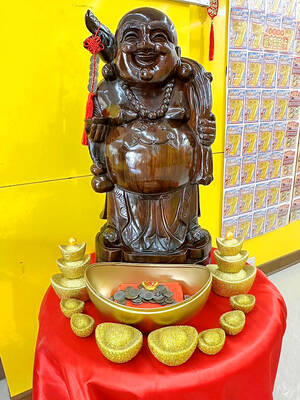
A Vietnamese migrant worker yesterday won NT$12 million (US$379,627) on a Lunar New Year scratch card in Kaohsiung as part of Taiwan Lottery Co’s (台灣彩券) “NT$12 Million Grand Fortune” (1200萬大吉利) game. The man was the first top-prize winner of the new game launched on Jan. 6 to mark the Lunar New Year. Three Vietnamese migrant workers visited a Taiwan Lottery shop on Xinyue Street in Kaohsiung’s Gangshan District (崗山), a store representative said. The player bought multiple tickets and, after winning nothing, held the final lottery ticket in one hand and rubbed the store’s statue of the Maitreya Buddha’s belly with the other,
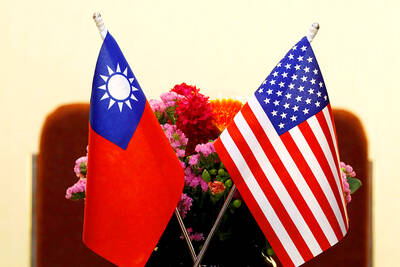
‘NATO-PLUS’: ‘Our strategic partners in the Indo-Pacific are facing increasing aggression by the Chinese Communist Party,’ US Representative Rob Wittman said The US House of Representatives on Monday released its version of the Consolidated Appropriations Act, which includes US$1.15 billion to support security cooperation with Taiwan. The omnibus act, covering US$1.2 trillion of spending, allocates US$1 billion for the Taiwan Security Cooperation Initiative, as well as US$150 million for the replacement of defense articles and reimbursement of defense services provided to Taiwan. The fund allocations were based on the US National Defense Authorization Act for fiscal 2026 that was passed by the US Congress last month and authorized up to US$1 billion to the US Defense Security Cooperation Agency in support of the
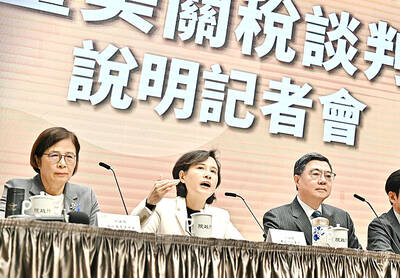
HIGH-TECH DEAL: Chipmakers that expand in the US would be able to import up to 2.5 times their new capacity with no extra tariffs during an approved construction period Taiwan aims to build a “democratic” high-tech supply chain with the US and form a strategic artificial intelligence (AI) partnership under the new tariffs deal it sealed with Washington last week, Taipei’s top negotiator in the talks said yesterday. US President Donald Trump has pushed Taiwan, a major producer of semiconductors which runs a large trade surplus with the US, to invest more in the US, specifically in chips that power AI. Under the terms of the long-negotiated deal, chipmakers such as Taiwan Semiconductor Manufacturing Co (TSMC, 台積電) that expand US production would incur a lower tariff on semiconductors or related manufacturing


 RSS
RSS