


An experimental program run by the Greater Kaohsiung Government in its battle against dengue fever that uses seawater to flood drainage pipes appears to have been a success, city health officials said yesterday.
The city’s Department of Health said almost all of the 200 larvae of Aedes aegypti mosquito, the main carrier of the dengue virus, died in less than 12 hours after being immersed in seawater-filled drains.
Kaohsiung is battling the worst outbreak of the disease in recent memory, with 10,138 confirmed cases in the city, out of the 10,600 nationwide this year.
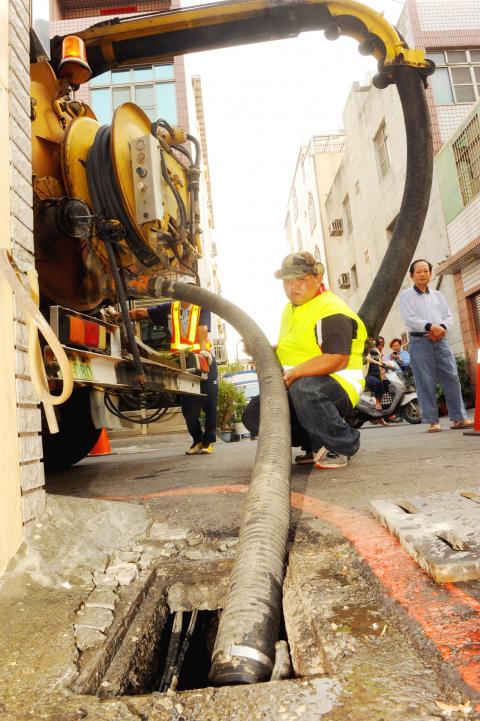
Photo: Chang Chung-yi, Taipei Times
“To prevent more mosquito larvae from breeding in drains during the dry season, the department recently began an experimental program to curb the mosquitoes’ rampant growth by pouring seawater down the drains,” Disease Prevention Division section head Ho Hui-pin (何惠彬) said.
In the first stage of the experiment, the department drew seawater samples from five ports, including the ferry station and the coast guard post in Cijin District (旗津), the Cianjhen and Gushan fishing ports and Sizihwan Bay (西子灣).
The samples had an average salinity of 30.5 practical salinity units (psu). Twenty mosquito larvae placed in a shallow container with the samples died within three hours, Ho said.
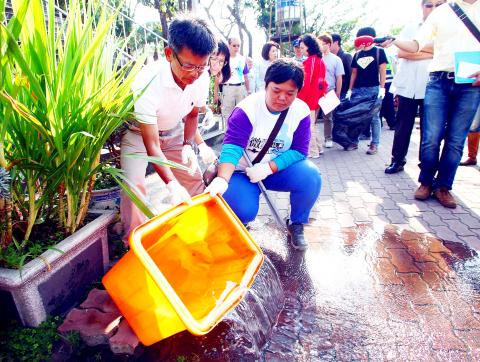
Photo: CNA
The samples were then diluted with water to about 15 psu, before being poured into five shallow containers that each held 20 larvae, Ho said, adding that all of the larvae died within 24 hours.
“The department then put 200 larvae in 10 nets made out of silk stockings and immersed them in two seawater-filled drains in Sanmin District’s (三民) Benguan Borough (本館), which has been the most severely affected area in the outbreak,” Ho said.
Only three larvae were still alive as of 9am yesterday, which met expectations, he said.
“For the next stage, we will pour seawater into 400m of drains in Sanmin District,” Ho said.
Centers for Disease Control Deputy Director-General Chou Jih-haw (周志浩) said he had only read about such a preventive approach in research papers and had never seen it being applied in real life.
“Soaking mosquito larvae in high-density seawater for an extended period has been proven to be an effective mosquito-killing method in lab experiments. The agency will stay in close touch with Kaohsiung’s health department,” Chou said.
Meanwhile, Chinese Nationalist Party (KMT) Greater Kaohsiung mayoral candidate Yang Chiu-hsing (楊秋興) lambasted the seawater plan as “ludicrous.”
The only effective way to contain the spread of the disease is by eliminating the environments where vector mosquitoes breed, the candidate said.
He said that with cases of people contracting dengue soaring, the municipality has suffered a major setback in its efforts to combat the disease, but Greater Kaohsiung Mayor Chen Chu (陳菊) continues to keep busy by attending opening ceremonies.
Additional reporting by Sean Lin

Taiwan Semiconductor Manufacturing Co (TSMC, 台積電), the world’s largest foundry service provider, yesterday said that global semiconductor revenue is projected to hit US$1.5 trillion in 2030, after the figure exceeds US$1 trillion this year, as artificial intelligence (AI) demand boosts consumption of token and compute power. “We are still at the beginning of the AI revolution, but we already see a significant impact across the whole semiconductor ecosystem,” TSMC deputy cochief operating officer Kevin Zhang (張曉強) said at the company’s annual technology symposium in Hsinchu City. “It is fair to say that in the past decade, smartphones and other mobile devices were
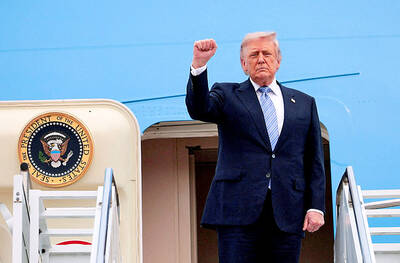
US-CHINA SUMMIT: MOFA welcomed US reassurance of no change in its Taiwan policy; Trump said he did not comment when Xi talked of opposing independence US President Donald Trump yesterday said he has not made a decision on whether to move forward with a major arms package for Taiwan after hearing concerns about it from Chinese President Xi Jinping (習近平). Trump’s comments on Taiwan came as he flew back to Washington after wrapping up critical talks in which both leaders said important progress was made in stabilizing US-China relations even as deep differences persist between the world’s two biggest powers on Iran and Taiwan. “I will make a determination,” Trump said, adding: “I’ll be making decisions. But, you know, I think the last thing we need right

TAIWAN ISSUE: US treasury secretary Scott Bessent said on the first day of meetings that ‘it wouldn’t be a US-China summit without the Taiwan issue coming up’ There were no surprises on the first day of the summit between US President Donald Trump and Chinese President Xi Jinping (習近平), the Mainland Affairs Council (MAC) said yesterday, as the government reiterated that cross-strait stability is crucial to the Asia-Pacific region, as well as the world. As the two presidents met for a highly anticipated summit yesterday, Chinese state media reported that Xi warned Trump that missteps regarding Taiwan could push their two countries into “conflict.” Trump arrived in China with accolades for his host, calling Xi a “great leader” and “friend,” and extending an invitation to visit the White House
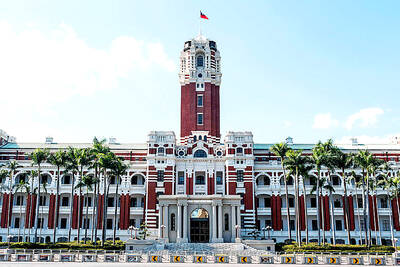
SECURITY: Taipei presses the US for arms supplies, saying the arms sales are not only a reflection of the US security commitment to Taiwan but also serve as a mutual deterrent against regional threats Taiwan is committed to preserving the cross-strait “status quo” and contributing to regional peace and stability, the Presidential Office said yesterday. “It is an undeniable fact that the Republic of China is a sovereign and independent democratic nation,” Presidential Office spokeswoman Karen Kuo (郭雅慧) reiterated, adding that Beijing has no right to claim sovereignty over Taiwan. The statements came after US President Donald Trump warned against Taiwanese independence. Trump wrapped up a state visit to Beijing on Friday, during which Chinese President Xi Jinping (習近平) had pressed him not to support Taiwan. Taiwan depends heavily on US security backing to deter China from carrying


 RSS
RSS