


Japan yesterday named five uninhabited small isles belonging to an island group in the center of a dispute with China as part of efforts to reinforce its claim, a move likely to spark anger from Beijing and another claimant, Taiwan.
The five islands, named after directions of the compass — including Higashi Kojima (East Small Island) and Seihokusei Kojima (West Northwest Small Island) — are part of the group in the East China Sea known as the Senkakus in Japanese and the Diaoyu Archipelago (釣魚群島) in Chinese. Five bigger islands in the group already have names. Chinese and Japanese coast guard ships have regularly confronted each other in surrounding waters.
The five were among 158 islands that were named yesterday and their list published on a Web site of the Japanese maritime policy department. The other islands elsewhere in the Japanese waters are not disputed. The government said that naming the islands is meant to raise public awareness that they belong to Japan.
However, assigning names to disputed islands does not change their status. Japan insists the islands lie within its territorial waters; China says they were stolen by Japan in 1895 and should have been returned at the end of World War II. Taiwan, which calls them the Diaoyutais (釣魚台), also claims the islands, but has worked out an arrangement with Japan guaranteeing its fishermen access to the area, and it rejects any notion of joining with Beijing on the matter.
China and Japan are also at odds over exploitation of East China Sea gas deposits in the area. The disputed waters are surrounded by rich fishing grounds. Chinese coast guard and fishing boats have recently more frequently approached the area, sometimes violating Japan’s waters, especially since Japan’s previous government nationalized the main Senkaku Islands in 2012.
Ties between Japan and China have worsened in recent years over the island dispute, a contested gas field in the East China Sea and lingering animosity over Japan’s World War II-era actions in China.
In related news, Tokyo said it would give Hanoi six vessels to boost its capacity to patrol its territorial waters, amid a bitter maritime dispute with Beijing in the South China Sea.
The deal for the six used vessels, worth ¥500 million (US$5 million), was announced in Hanoi during a two-day visit by Japanese Foreign Minister Fumio Kishida aimed at deepening bilateral ties.
“We hope this will help strengthen the maritime law enforcement capability of Vietnam,” Kishida said at a press briefing with his Vietnamese counterpart, Pham Binh Minh.
Relations between Vietnam and China plummeted to their worst point in decades in early May after Beijing moved a deep-water oil drilling rig into waters in the South China Sea claimed by Vietnam.
China withdrew the rig in the middle of last month, a month earlier than initially expected, claiming it had successfully completed the drilling mission.
While the rig was in place, there were repeated skirmishes between dozens of Chinese and Vietnamese vessels around the rig. Hanoi accused Beijing of ramming and sinking one of its wooden fishing vessels. Beijing denied the allegation, blaming intrusions by Hanoi’s fishing fleet for the incident.
The rig’s deployment also triggered a wave of violent anti-China riots in Vietnam, which saw some foreign-invested factories vandalized and set on fire.
“Both Vietnam and Japan agree on maintaining peace and stability in the East China Sea and East Sea,” Fumio said.
East Sea is the Vietnamese name for the South China Sea.
He said disputes must be settled “in accordance with international law [and] by peaceful means.”
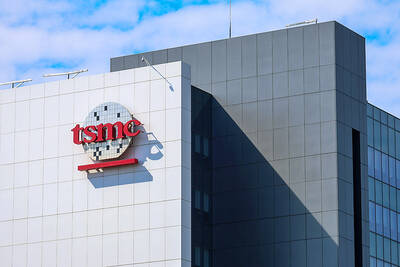
Taiwan Semiconductor Manufacturing Co (TSMC, 台積電), the world’s largest foundry service provider, yesterday said that global semiconductor revenue is projected to hit US$1.5 trillion in 2030, after the figure exceeds US$1 trillion this year, as artificial intelligence (AI) demand boosts consumption of token and compute power. “We are still at the beginning of the AI revolution, but we already see a significant impact across the whole semiconductor ecosystem,” TSMC deputy cochief operating officer Kevin Zhang (張曉強) said at the company’s annual technology symposium in Hsinchu City. “It is fair to say that in the past decade, smartphones and other mobile devices were
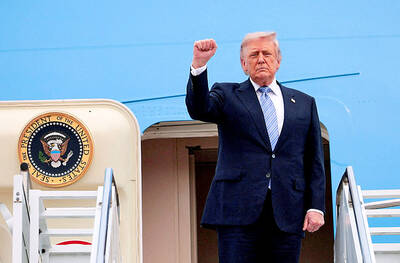
US-CHINA SUMMIT: MOFA welcomed US reassurance of no change in its Taiwan policy; Trump said he did not comment when Xi talked of opposing independence US President Donald Trump yesterday said he has not made a decision on whether to move forward with a major arms package for Taiwan after hearing concerns about it from Chinese President Xi Jinping (習近平). Trump’s comments on Taiwan came as he flew back to Washington after wrapping up critical talks in which both leaders said important progress was made in stabilizing US-China relations even as deep differences persist between the world’s two biggest powers on Iran and Taiwan. “I will make a determination,” Trump said, adding: “I’ll be making decisions. But, you know, I think the last thing we need right
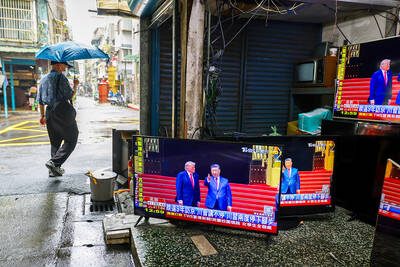
TAIWAN ISSUE: US treasury secretary Scott Bessent said on the first day of meetings that ‘it wouldn’t be a US-China summit without the Taiwan issue coming up’ There were no surprises on the first day of the summit between US President Donald Trump and Chinese President Xi Jinping (習近平), the Mainland Affairs Council (MAC) said yesterday, as the government reiterated that cross-strait stability is crucial to the Asia-Pacific region, as well as the world. As the two presidents met for a highly anticipated summit yesterday, Chinese state media reported that Xi warned Trump that missteps regarding Taiwan could push their two countries into “conflict.” Trump arrived in China with accolades for his host, calling Xi a “great leader” and “friend,” and extending an invitation to visit the White House
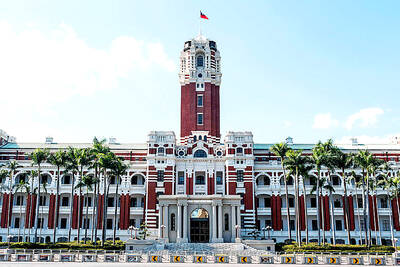
SECURITY: Taipei presses the US for arms supplies, saying the arms sales are not only a reflection of the US security commitment to Taiwan but also serve as a mutual deterrent against regional threats Taiwan is committed to preserving the cross-strait “status quo” and contributing to regional peace and stability, the Presidential Office said yesterday. “It is an undeniable fact that the Republic of China is a sovereign and independent democratic nation,” Presidential Office spokeswoman Karen Kuo (郭雅慧) reiterated, adding that Beijing has no right to claim sovereignty over Taiwan. The statements came after US President Donald Trump warned against Taiwanese independence. Trump wrapped up a state visit to Beijing on Friday, during which Chinese President Xi Jinping (習近平) had pressed him not to support Taiwan. Taiwan depends heavily on US security backing to deter China from carrying


 RSS
RSS